The standard-tool problem
73/ 100
An opaque score with no repair path
A proprietary readiness score can look precise while hiding the response, crawler rule, route, or data block that actually needs correction.
Growthract’s core verification layer does not ask an AI model to decide whether your infrastructure passed. We inspect observable network responses, raw HTML, crawler rules, structured data, and metadata against explicit technical checks.
Request Technical Review$ growthract inspect example.com
GET /robots.txt 200 PASS
GET /llms.txt 200 PASS
initial HTML found
JSON-LD parse valid
canonical metadata found
5 checks · 5 observed resultsDeterministic vs. heuristic
Narrative summaries can help explain a result. They should never replace the response, rule, route, or syntax failure that produced it.
The standard-tool problem
A proprietary readiness score can look precise while hiding the response, crawler rule, route, or data block that actually needs correction.
The Growthract approach
An endpoint responds or fails. A JSON block parses or does not. Required content is present in the initial HTML or absent. Every finding points back to observable evidence.
Three inspection pipelines
Protocol access, first-response content, and entity data are inspected independently so a passing result in one layer cannot conceal a failure in another.
Protocol & retrieval
Output
Status · headers · rule match · Markdown structure
What it executes
Why it matters
This establishes the response and crawler rules visible at scan time. It does not claim that a third-party platform has already crawled, indexed, or used the content.
DOM & hydration
Output
Initial HTML · content presence · metadata · hydration risk
What it executes
Why it matters
This verifies whether critical content is present on the first network response. It does not assume that every crawler executes—or ignores—the same JavaScript lifecycle.
Entity & schema
Output
JSON parse · entity types · properties · @id relationships
What it executes
Why it matters
This confirms JSON syntax, expected properties, and the agreed entity structure. It does not guarantee how an external model will interpret, rank, or cite the entity.
See how Growthract structures diagnostics, implementation and technical search engagements, then choose the level of support that fits your business.
Designed for engineering trust
External audit tasks run server-side and return results after the requested routes respond and parsing completes. Timing depends on network conditions, target availability, and route count.
The diagnostic performs safe retrieval requests and response analysis. It does not write to your website, modify production code, or require production credentials.
Sprint changes are delivered through isolated, documented pull requests or reviewable patches. Your engineering team controls review, merge, and deployment.
Technical field guide
A deeper technical guide to entity identity, structured relationships, retrieval infrastructure, and the signals that help machines build a more coherent representation of a company.
Organization
  ├── owns → WebSite
  ├── offers → Product
  ├── serves → Audience
  └── describedBy → WebPage

Product
  ├── category
  ├── featureList
  ├── offers → Offer
  └── provider → Organization
The guide explains how these relationships support clearer entity interpretation without claiming guaranteed ranking or citation outcomes.
Verification boundary
What the engine verifies
What controls the rest
OAI-SearchBot, PerplexityBot, and Claude-SearchBot are automated search crawlers with provider-controlled schedules. User-triggered agents such as ChatGPT-User, Perplexity-User, and Claude-User may retrieve pages under different access rules.
Corrected infrastructure is available after deployment, but Growthract does not guarantee when an external platform will crawl, index, retrieve, rank, or cite it.
Observed bot activity
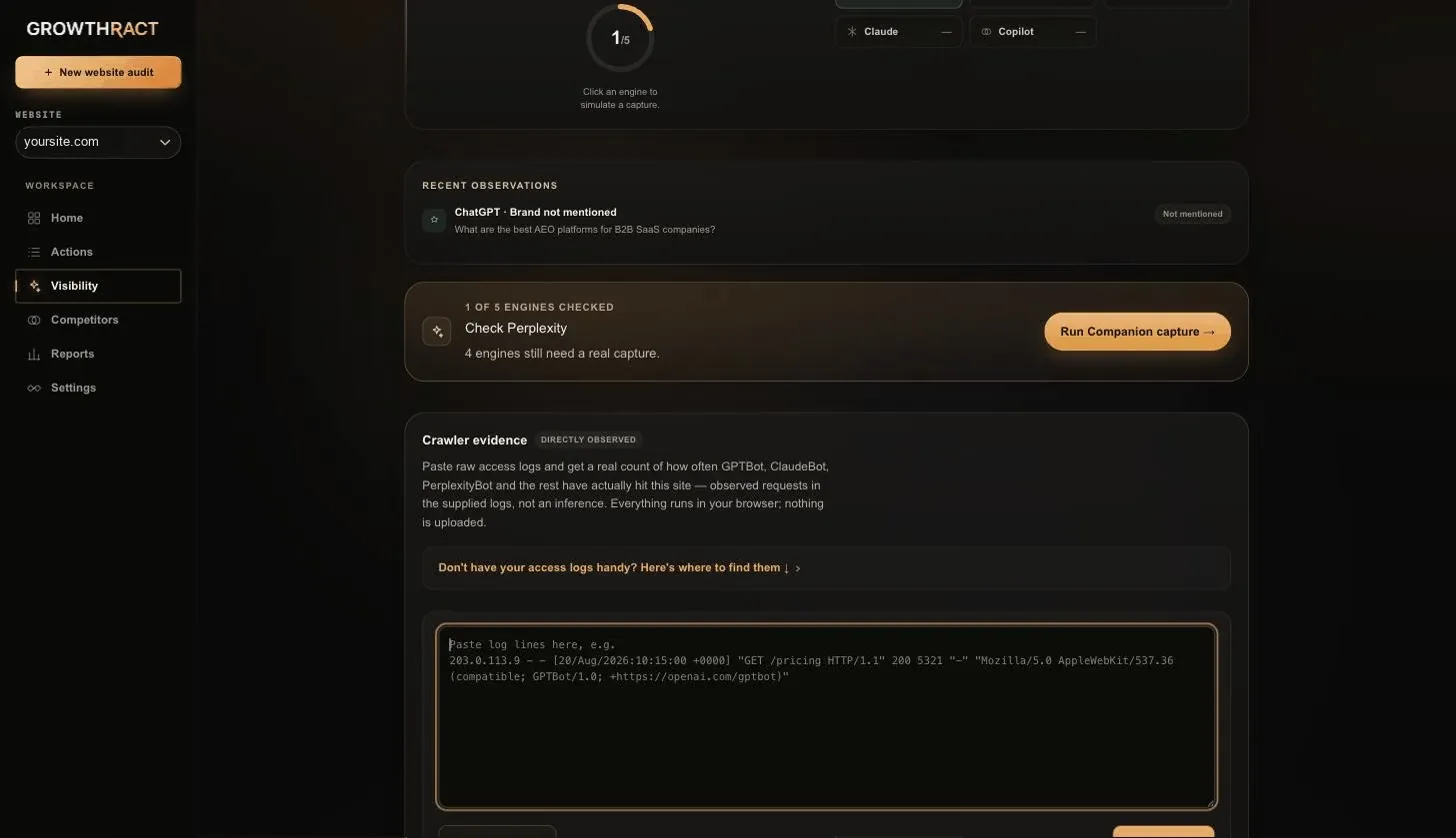
robots.txt can show whether a crawler is permitted to request a route. Server logs can show whether a recognized bot actually requested the site during the log window being examined.
Crawler Logs provides that second layer of evidence without uploading the supplied log data.
Provider references
Explore related resources