Company and product identity
Check whether important pages consistently explain who the company is, what the product does and which offer the website is actually presenting.
Check whether your company, product, audience, category and buyer answers are represented clearly and consistently enough to inspect — without treating a black-box score as proof.

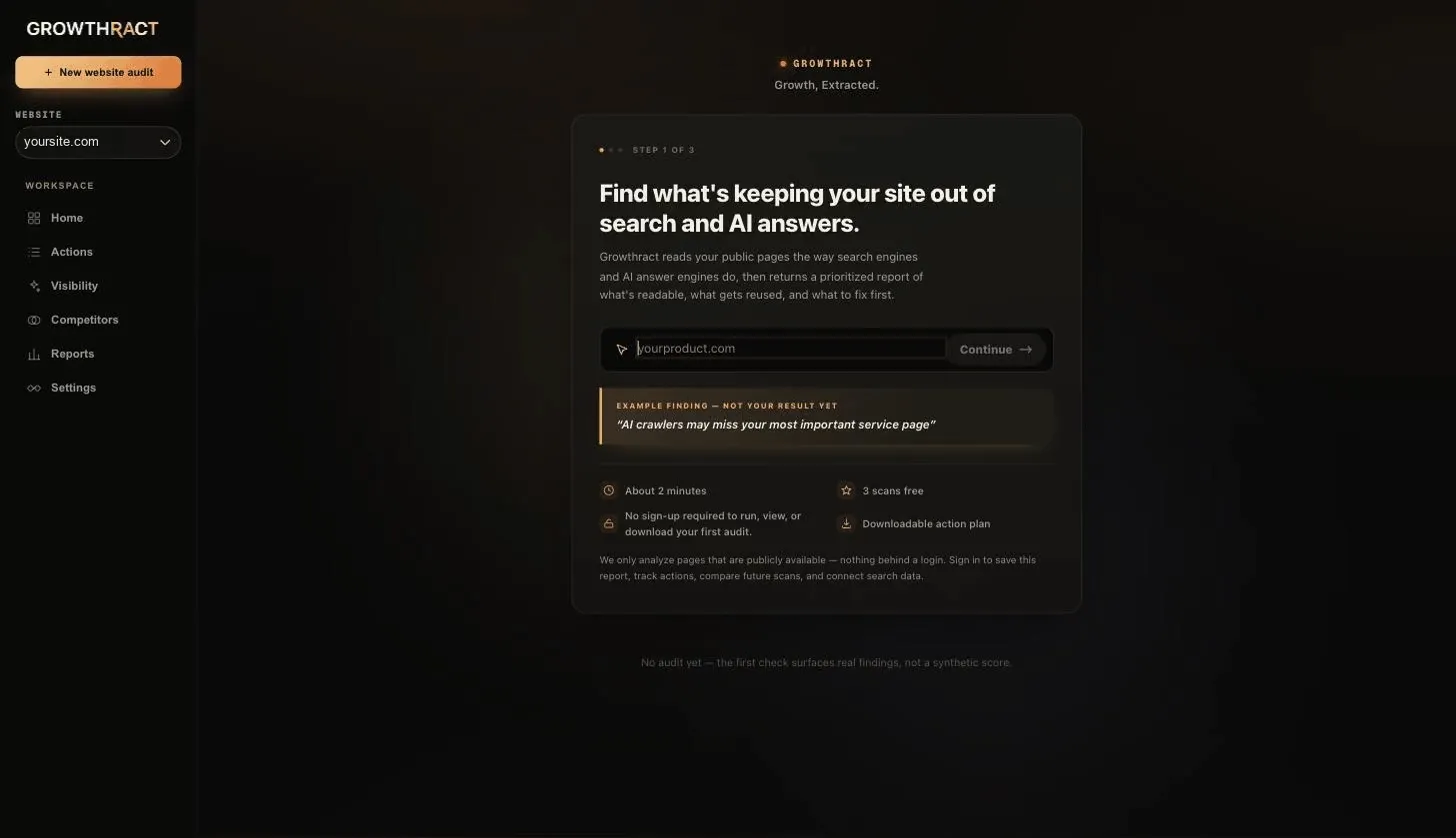
Existing Search Operator interface capture. A dedicated AI Search Readiness screenshot can replace this asset later.
What readiness means
AI search readiness begins after basic retrieval. The next question is whether the website clearly represents the company, product, audience, category, capabilities and commercial context that a search or retrieval system can inspect.
Search Operator evaluates observable website evidence. It helps surface unclear entity relationships, missing buyer answers and inconsistent content without claiming to reverse-engineer a proprietary model.
Six readiness layers
The analysis moves from basic business identity to the buyer questions and structured signals that make the site easier to interpret.
Check whether important pages consistently explain who the company is, what the product does and which offer the website is actually presenting.
Inspect whether a reader can determine what category the product belongs to, who it is built for and which problems it is designed to solve.
Review whether company, product, category, audience and related concepts reinforce one another instead of creating contradictory interpretations.
Inspect structured data and machine-readable information that can reinforce the relationships already expressed in visible website content.
Check whether the site directly answers the commercial questions a buyer may ask before visiting a landing page.
Surface missing, weak or inconsistent information that makes the business harder to interpret across important product and commercial pages.
Observable signals
Product identity
Important pages consistently describe the same product, category and primary use case.
Different pages describe the product in ways that imply different categories or audiences.
Audience clarity
The intended buyer and user are stated clearly enough to understand who the product serves.
The site relies on broad language such as 'for every team' without useful audience context.
Structured data
Machine-readable entity information reinforces what visitors can visibly read.
Structured data is absent, incomplete or contradicts the visible page content.
Buyer answers
Commercially important questions are answered directly on relevant pages.
Important questions require inference or are scattered across unrelated pages.
From finding to fix
Search Operator structures recommendations around evidence so you can trace an action back to something observable on the site.
The specific website condition that is unclear, missing or inconsistent.
The page, field, structured signal or visible content supporting the finding.
The concrete change Search Operator recommends making.
Implementation guidance for resolving the issue instead of a vague recommendation.
The exact page, content area, site template or technical layer where the work belongs.
Readiness vs Visibility
Readiness
Technical accessibility, entity clarity, product context, audience language, structured data and buyer-answer coverage are inspectable website conditions.
Visibility
Brand mentions, competitor presence and citations are observations produced by independent AI systems at a particular point in time.
Readiness does not prove Visibility. Improving observable website conditions can make the site clearer and easier to inspect, but it does not prove that an independent AI system will mention, rank, cite or recommend the company.
Evidence boundary
Readiness can support:
Readiness does not prove:
Related evidence
Measure presence after the website-readiness baseline.
ExploreAudit access, entity, content, evidence and visibility together.
ExploreExplore how machine-readable business relationships work.
ExploreSee deterministic findings from 100 B2B SaaS websites.
ExploreFrequently asked questions
AI search readiness describes observable website conditions that can make a company, product and its information easier to retrieve and interpret in AI-assisted discovery. It can include entity clarity, product and audience context, structured data, buyer-question coverage and technical accessibility.
Search Operator can review company and product identity, category language, target audience, visible content, structured data, important buyer questions and content gaps across the pages included in the scan.
No. Readiness describes observable conditions on your website. Visibility describes an external observation such as whether your brand appears in a defined AI-search test. A website can be technically and editorially well prepared without appearing in every AI answer.
No. Readiness does not prove that ChatGPT, Gemini, Claude, Perplexity, Google or another system will rank, mention, cite or recommend a brand. Those systems operate independently of Growthract.
Search Operator can summarize findings, but Growthract does not treat one black-box score as proof of AI-search performance. The useful evidence is the underlying technical, entity, content and visibility signals.
A Quick scan reviews the homepage plus four relevant pages. A Full scan reviews up to 25 pages using the sitemap when available. The result is a sampled diagnostic rather than an exhaustive crawl of every URL on a large website.