AI readability
Can AI search systems read my website?
Check the machine-readable foundations that determine whether AI and search crawlers can access, parse and interpret your website correctly.
Run AI Readability Check↗Signals inspected
Check whether AI systems can read and understand your website, then test whether AI assistants actually mention your brand.
Understand the site
Read the signals that matter
Test Gemini visibility
Check a live Gemini response
Get prioritized actions
Know what to change next
Discovery surfaces
Where software evaluation happens
Growthract researches technical visibility across ChatGPT, Perplexity, Claude, Gemini, Google AI Overviews, Microsoft Copilot, Reddit, YouTube, and Quora. Displayed platforms do not imply partnership or endorsement. Search Operator’s live response test currently runs on Gemini only.
AI search visibility tool
Search Operator is Growthract's free AI search visibility tool for B2B SaaS. It combines website-readiness checks, content and entity analysis, a point-in-time Gemini visibility test, and evidence-backed recommendations in one diagnostic workflow.
It can support an AI visibility audit, AI SEO audit or AEO review without pretending that one score predicts how an independent AI model will rank, cite, mention or recommend a brand.
What it checks
Crawler access, robots.txt, /llms.txt, structured data, indexability and machine-readable page signals.
Whether the site clearly explains the business, category, audience, offer and answers buyers are likely to need.
A live Gemini response showing whether the brand, website or competitors appear for a tested buyer-style prompt.
Three questions Growthract helps answer
Growthract focuses on AI-search visibility: technical readability, content and entity clarity, and real AI-assistant response tests.
AI readability
Check the machine-readable foundations that determine whether AI and search crawlers can access, parse and interpret your website correctly.
Run AI Readability Check↗Signals inspected
AI search readiness
Analyze whether your content gives AI systems enough clear, answer-ready information about what you do, who you serve and why your business is relevant.
Analyze AI Search Readiness↗Signals inspected
AI visibility
Test a real buyer-style prompt and inspect how your brand, website and competitors appear in an AI-generated response.
Test AI Visibility↗Signals inspected
Growthract is focused on AI-search visibility. It is not a paid ads, social media or general-purpose marketing platform.
Technical proof
Crawler Logs
Paste raw server access logs and Crawler Logs identifies requests from recognized AI bots such as GPTBot, ClaudeBot and PerplexityBot. Parsing runs entirely in your browser, so the log data is not uploaded to Growthract.
A missing bot in one log window does not prove it has never crawled the site. The result only describes the evidence you pasted.
Open Crawler Logs

Two views of visibility
Growthract compares the evidence on your website with the evidence found in a tested AI response.
Site evidence
Response evidence
From goal to action
Tell Growthract what you actually want to improve.
Growthract checks the evidence relevant to that goal.
See the finding, evidence, recommended change and where it belongs.
Evidence before recommendations
Growthract does not start with a generic score. It collects the evidence relevant to AI-search visibility, identifies the gap, and then turns that finding into a specific next action.
Machine-readable evidence
Deterministic checks reveal whether important technical signals are accessible and machine-readable.
Content & entity evidence
The analysis looks for clear information about the business, category, entities and answers the site actually provides.
AI response evidence
A tested assistant response provides a point-in-time view of how the brand appears against real competitors.
Evidence becomes action
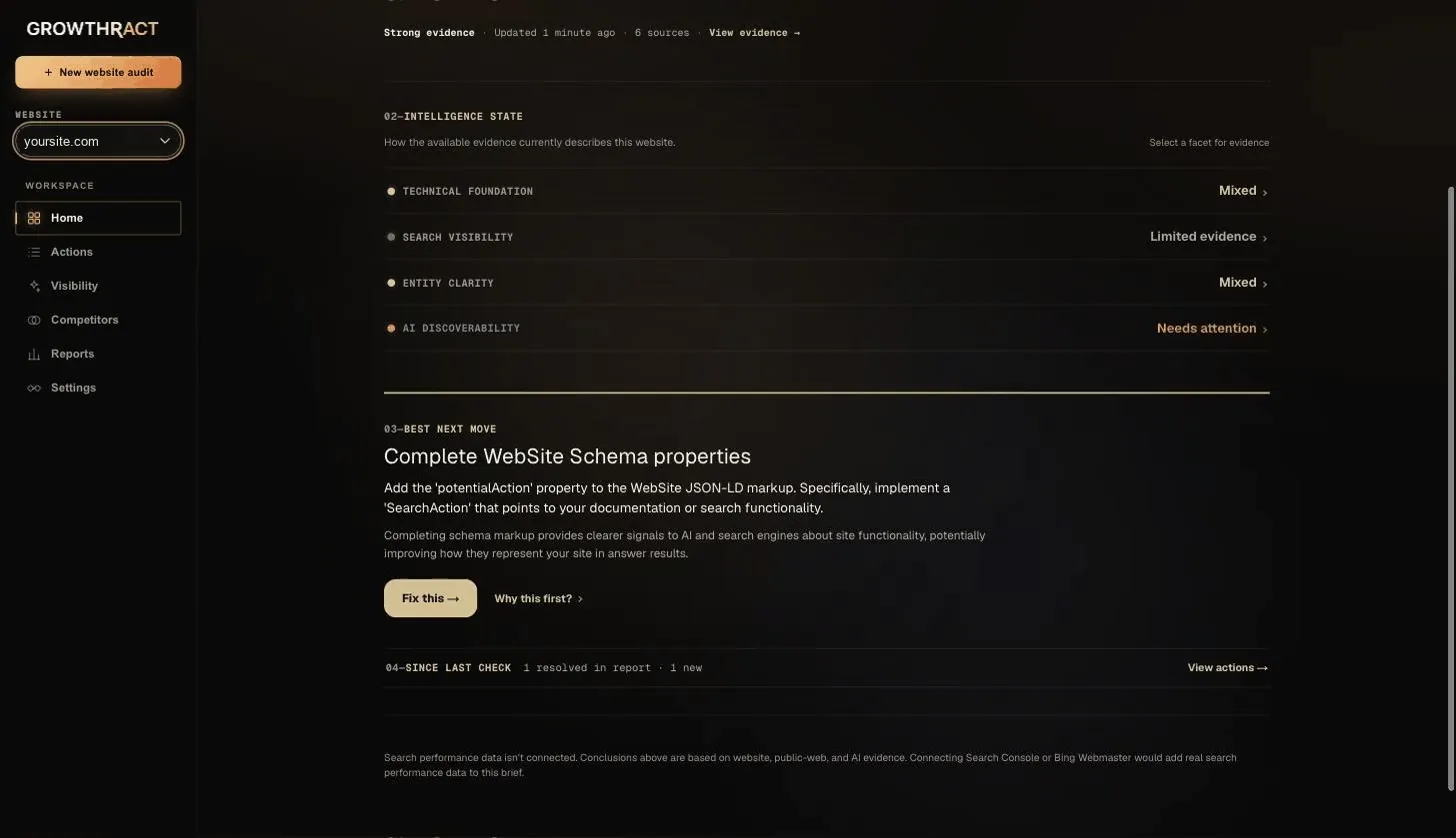
The recommendation should tell you what was found, why it matters, what to change and where the work belongs.
Need help interpreting the results?
If you want help understanding the findings, prioritizing the work, or deciding what to fix first, talk it through with Growthract.
AI visibility
Every scan runs live test prompts against Gemini and shows whether it mentions your brand when someone asks a real category-level question. ChatGPT, Claude and Perplexity are next on the roadmap.
Enter your site
Run test prompts
Gemini answers, live
See what's missing
Example result
One tested response
Brand mentioned
Yes
Website referenced
No
Competitors mentioned
3
Recommendation signal
Mentioned
Illustrative result layout. Actual results depend on the response being tested.
The payoff
Every recommendation tells you what was found, why it matters, what to change, how to change it and where.
Action feed
Illustrative recommendation format
Example recommendation
Problem
What Growthract found and why it deserves attention.
Evidence
The page, field or signal that supports the finding.
Action
The exact change the platform recommends making.
How to do it
Practical implementation guidance for the change.
Where
The page, file, platform or site area where the work belongs.
Recommendations stay traceable to the supplied goal, scanned page or measured technical evidence.
Any action can be turned into a deliverable — a rewritten title tag, a JSON-LD block, ad copy, a content outline — generated from that action’s own evidence, without re-scanning your site.
Product questions
Growthract can analyze website pages and visible content, robots.txt, XML sitemaps, titles, descriptions, headings, canonicals, meta robots, links, images, structured data and calls to action. The exact analysis depends on your selected goal and focus.
No. Growthract routes the analysis around the goal. A technical-readiness request can focus on crawler access, indexability and structured data, while an LLM-driven critique can focus on content quality, positioning, topic coverage and answer readiness.
Today, Growthract runs live test prompts against Gemini and shows whether it mentions your brand. Live testing against ChatGPT, Claude and Perplexity is on the roadmap. The Search Operator methodology in the app explains what's measured today versus what's planned.
No. The platform is designed to diagnose evidence, visibility signals and actionable opportunities. Search rankings and AI recommendations ultimately depend on systems outside Growthract's control.
Only if you connect them. In Settings, you can optionally link Google Search Console and/or GA4 — when connected, the last 28 days of real clicks, impressions, average position and sessions ground your keyword and prioritization recommendations. Without a connection, every recommendation is inferred from page content alone, and the platform is explicit about which case applies.
A Quick scan reviews your homepage plus four relevant pages. A Full scan reviews up to 25 pages, using the sitemap when available. You can also choose specific URLs. Even Full mode is a sampled audit, not an exhaustive crawl of every page on a large website.
No. If you sign in, each scan is saved so you can manually rerun the same site and compare findings over time. If Search Console or GA4 is connected, those reruns can also be compared alongside the available search and traffic data. Search Operator does not run autonomous background monitoring.
The on-screen report is free and complete. The full downloadable PDF engineering handover report requires signing in with Google.
No. Search Operator diagnoses and prioritizes issues and can generate a ready-to-use draft for a selected recommendation. It does not deploy changes to your website. Growthract implementation is a separate, human-delivered consulting engagement.
A separate, free tool at app.growthract.com/crawler-logs. You paste your own raw server access logs (Combined/Common Log Format or JSON Lines) and it counts how often GPTBot, ClaudeBot, PerplexityBot and other AI crawlers actually hit your site. Parsing happens entirely in your browser — log files are never uploaded to a server.
Yes. Clicking "Turn this into a deliverable" on any recommended action makes one additional, targeted request that writes the specific content implied by that action — a rewritten title tag, a JSON-LD block, ad copy, a content outline — grounded in that action's own evidence. It does not re-scan your site.
Your website is the starting point
Start with the evidence and leave with a clearer idea of what deserves attention next.
Run Free Audit