Crawler
Which recognized AI crawler or user agent appears in the supplied logs.
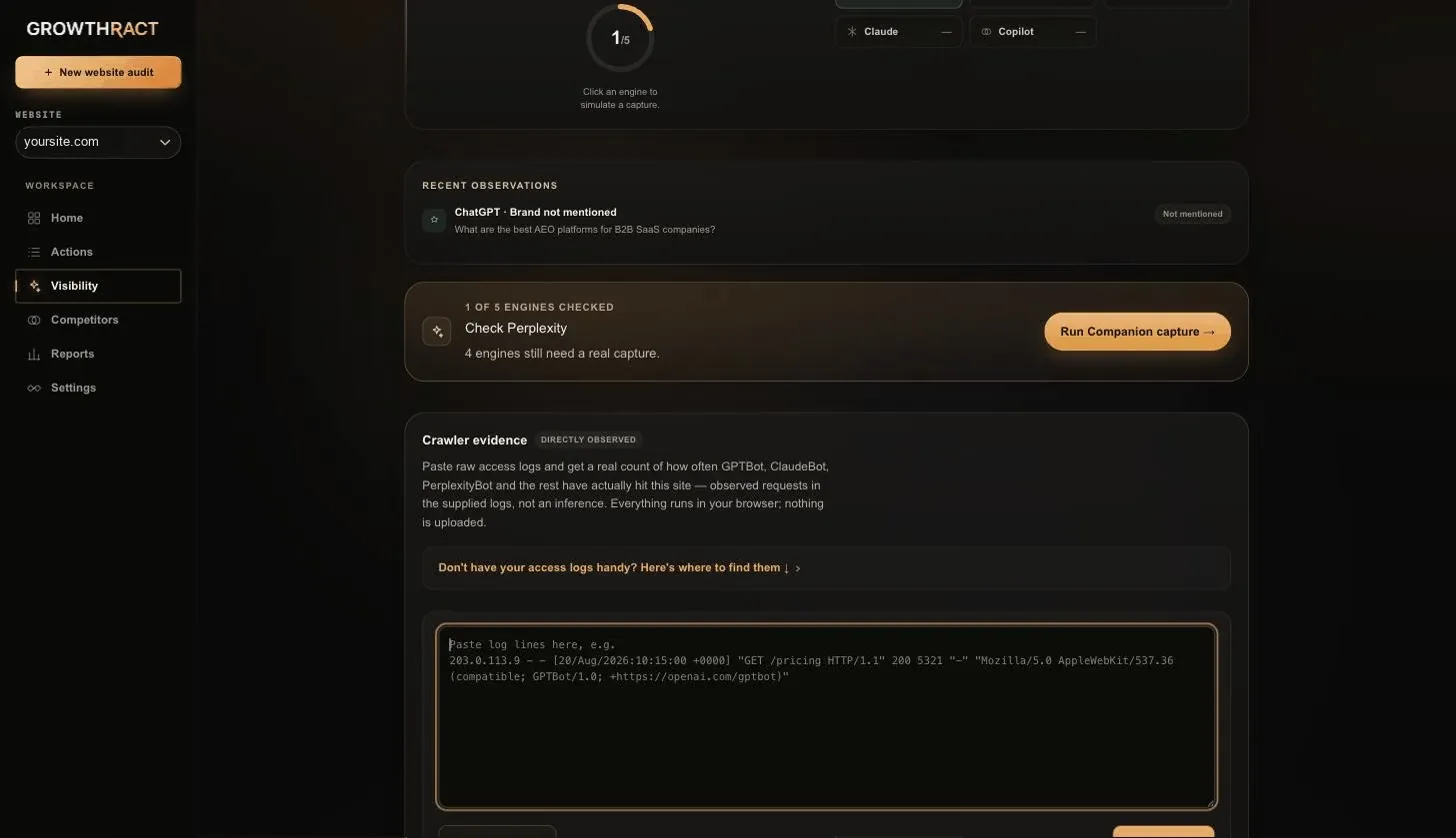
Paste raw server logs and identify observed requests from recognized AI crawlers such as GPTBot, ClaudeBot and PerplexityBot — without uploading the raw logs to Growthract.
The analyzer is the Crawler evidence panel on the app’s Visibility page. Run a free audit on your site first to unlock it. No sign-in required.
Permission vs observation
robots.txt
robots.txt contains crawler-facing directives. An allowed crawler is not proof that the crawler has ever requested a page from your server.
server logs
Access logs record requests represented by the server-log data you supply. They provide observable evidence of activity rather than permission alone.
Five-step workflow
No API connection is required. Supply the access-log data you want to inspect and let the browser-local parser identify recognized crawler activity.
Get the access-log data from your hosting provider, reverse proxy, CDN or web server.
Crawler Logs accepts Common Log Format, Combined Log Format and JSON Lines where supported by the parser.
The supplied raw logs are processed in the browser. Growthract does not upload your raw log file to its server for analysis.
The tool looks for recognized crawler requests such as GPTBot, ClaudeBot, PerplexityBot and other supported AI crawler user agents.
Use the observed requests to separate crawler permissions from crawler activity without assuming what happened after the request.
Supported inputs
Real product output
Crawler Logs surfaces the crawler evidence available in the data you pasted instead of converting it into a speculative visibility score.
What you can inspect
Which recognized AI crawler or user agent appears in the supplied logs.
How many matching requests appear in the portion of server-log data you supplied.
Which website routes or resources were represented in those logged requests where available.
Evidence that a request reached the server represented by the supplied access logs.
Recognized crawler examples
OpenAI
A matching request in your supplied logs is evidence that the GPTBot user agent requested a resource represented in that log data.
Anthropic
A matching request shows observed ClaudeBot activity in the supplied server logs.
Perplexity
A matching request shows observed PerplexityBot activity in the supplied server logs.
Browser-local analysis
Crawler Logs parses the raw log data locally in the browser. The supplied raw server logs are not uploaded to Growthract's server for processing.
As with any log-processing workflow, review your own internal data-handling requirements before copying sensitive operational data into any tool.
Evidence boundary
Server-log evidence can support:
A request does not prove:
Related Growthract Audit capabilities
Check the technical conditions available before crawler activity.
ExploreMeasure observable AI-search presence separately from crawler activity.
ExploreSee how Growthract separates deterministic evidence from inference.
ExploreExplore the technical relationship between crawlers, entities and site architecture.
ExploreFrequently asked questions
Explore related resources