ConfirmedDeterministic technical checks
Crawler access, robots.txt, /llms.txt, metadata, structured data.
These either pass or they do not.
Example
robots.txt blocks a known AI crawler
Not every "checker" tests the same things, and not every result means what it looks like it means. See the three kinds of evidence a legitimate checker should keep separate, and what none of them can promise you.
Run the checker described below for free. If it turns up real problems, the Expert Action Plan ranks them by impact with exact fix instructions.
Crawler access, robots.txt, /llms.txt, metadata, structured data.
These either pass or they do not.
Example
robots.txt blocks a known AI crawler
How clear your company, product, and category actually are.
Judgment, not a measured fact.
Example
Pricing page never states who it's for
Fixed prompts run against a real AI system, right now.
A moment, not a permanent ranking.
Example
Brand missing from today's Gemini test
Watch it first
The free audit
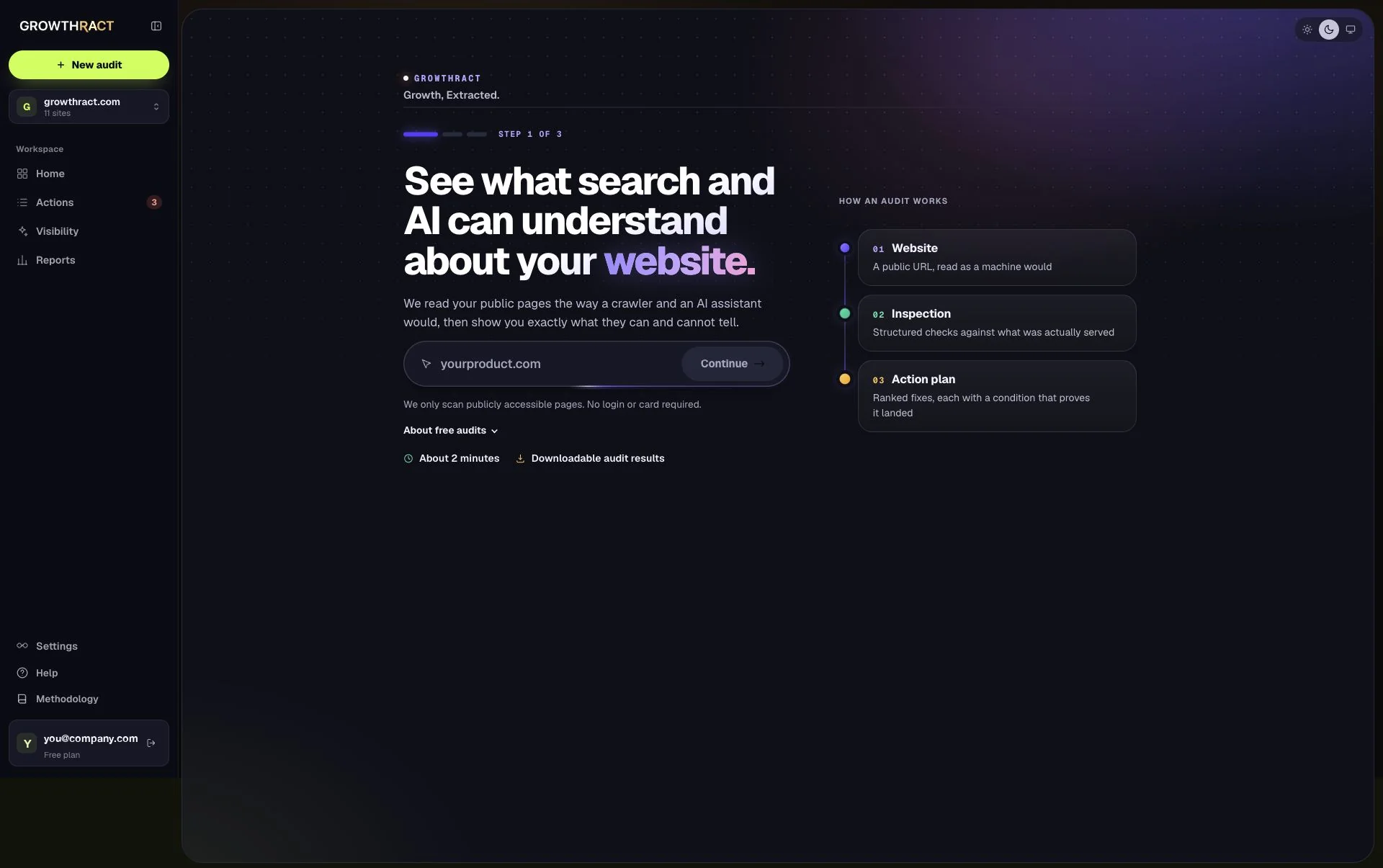
The audit reads your public pages the way a crawler and an AI assistant would, then shows what they can and cannot tell. It only scans publicly accessible pages, with no login or card required.
Discovery surfaces
Where software evaluation happens
Growthract researches technical visibility across ChatGPT, Perplexity, Claude, Gemini, Google AI Overviews, Microsoft Copilot, Reddit, YouTube, and Quora. Displayed platforms do not imply partnership or endorsement. Growthract Audit’s live response test currently runs on Gemini only.
What a checker should test
A factual technical failure, a content judgment, and a point-in-time AI observation are three different kinds of evidence. A checker that compresses them into a single number is hiding the part you actually need to see.
Direct, repeatable checks against your live website: crawler access and robots.txt rules, initial HTML and server-rendered content, canonical and metadata consistency, structured data, and optional /llms.txt availability. The file check is informational; Google says llms.txt is not a Search or AI Overview signal.
Example: robots.txt blocks a known AI crawler.
An assessment of how clearly your company, product, and category come across, and whether priority pages actually answer the questions buyers ask. This is judgment, not a measured fact — useful for prioritizing what to look at, not for treating as proof.
Example: your pricing page never states who the product is for.
A small set of fixed prompts run against a real AI system, recording whether your brand or a chosen competitor appears and what the response actually says. This is evidence from that specific moment, not a permanent ranking or a guarantee of future results.
Example: your brand did not appear in a tested Gemini response today.
What it cannot tell you
No legitimate checker can guarantee that ChatGPT, Gemini, Perplexity, Google AI features, or another third-party system will rank, mention, recommend, or cite a company in the future.
Re-crawling, indexing, citation selection, recommendation behavior, and response generation all remain controlled by external platforms. A result of "not mentioned today" is not a permanent verdict, and a result of "mentioned today" is not a guarantee of tomorrow.
That is why a checker's job is to separate what it actually observed from what it hopes will happen next — and why the deterministic technical findings, which you can fix directly, deserve more weight than any single prompt response.
A checker, in action
Growthract Audit's free diagnostic is a working example of the three-category model above, not a separate methodology.
Run Free AuditNo login, no repository access, no production credentials. Just the website you want checked.
Crawler access, initial HTML, metadata, and structured data are checked directly. Optional /llms.txt availability is reported separately and is not treated as a Google ranking signal.
The scan assesses how clearly your company, product, and category come across on priority pages.
A point-in-time Gemini response check records whether your brand or a competitor appears.
Confirmed, directional, and observed results are labeled as what they are, not merged into one score.
The audit is read-only. Findings describe what Growthract can observe at scan time and do not guarantee indexing, citations, mentions, rankings, or recommendations from third-party systems.
A checker is a starting point, not the finish line. For a more structured diagnostic that organizes findings into prioritized, explained conclusions across five layers, see the AI visibility audit. Once you know what is actually wrong, work through the six-step improvement framework to fix it, and use Growthract's AI search visibility tracking to see whether it worked.
Where this fits
See it for yourself
Get a free, read-only scan of your public website. If the evidence points to real problems, the Expert Action Plan ranks your top 5–8 issues by impact with exact fix instructions, delivered within 48 hours.
Frequently asked questions