What Growthract fixes

Make your SaaS easier for AI search to understand.

When someone asks ChatGPT, Perplexity, or another AI search system for a software recommendation, your product has to be accessible, understandable, and technically legible. We fix the infrastructure behind that process.

Business-first diagnosisCode-level implementationExternal verification

AI visibility path

Access

Can retrieval systems reach the right routes?

Context

Can machines identify the product and offer?

Response

Is critical content present before hydration?

Evidence

Can every recommendation be tied to observable output?

The principle

We do not start by producing more content. We start by making sure the systems retrieving your content can actually access and interpret it.

Specialist

Built specifically around SaaS, technical SEO, and AI search infrastructure.

Transparent

Recommendations are tied to observable technical evidence, not vague visibility scores.

Low risk

Audit first. Your engineering team controls every production change and deployment.

The technical barriers

Three infrastructure problems appear again and again.

They are different problems, but they share the same business consequence: your product becomes harder for automated systems to retrieve and understand accurately.

ACCESS

The Welcome Mat Problem

AI search systems may not be able to reach the information that matters.

Your site can be technically live while search-specific crawlers encounter restrictive rules, unclear routes, or no concise path to authoritative product information.

What we fix

Crawler access & retrieval infrastructure

  • Audit robots.txt user-agent groups, wildcard rules, and route restrictions.
  • Review access rules for OAI-SearchBot, PerplexityBot, and Claude-SearchBot.
  • Separate user-triggered agents such as Claude-User from automated search crawlers.
  • Create and maintain a structured /llms.txt resource where appropriate.
  • Verify that priority product and conversion routes are actually retrievable.

Intended outcome

A clearer, verifiable path from AI retrieval systems to your authoritative product information.

CONTEXT

The Context Problem

Your product may be visible without being understood correctly.

If your company, product, features, audience, pricing, and relationships are inconsistently represented, machines have less reliable context about what you actually sell.

What we fix

Structured entity & product data

  • Implement a clean Organization foundation.
  • Connect Organization, WebSite, SoftwareApplication, Product, Service, and Offer entities where appropriate.
  • Build reusable, type-safe schema components for important routes.
  • Align structured data with visible content and canonical URLs.
  • Keep product, pricing, audience, and feature relationships internally consistent.

Intended outcome

More consistent machine-readable context about your company, products, and offers.

RESPONSE

The Blank Page Problem

Important content may not exist in the first response.

A browser can make a JavaScript-heavy site look complete while the initial HTML response contains little of the product information an automated system needs.

What we fix

Server rendering & metadata alignment

  • Inspect raw, unhydrated HTML on priority routes.
  • Identify content that depends entirely on browser-side JavaScript.
  • Refactor appropriate routes to SSR, ISR, or static server rendering.
  • Align titles, descriptions, canonical URLs, Open Graph data, and structured entities.
  • Verify what an external retrieval system can actually see before hydration.

Intended outcome

Core product positioning is present in the initial response instead of hidden behind client-side execution.

Why this approach

A specialist problem deserves specialist infrastructure.

We do not start with keywords. We start with access and clarity.

Growthract is deliberately narrow. We are not trying to become another broad marketing agency that happens to mention AI.

The focus is the technical layer between your SaaS website and the systems increasingly responsible for discovering, summarizing, comparing, and recommending software.

That means we care about things that are easy to overlook: crawler behavior, raw HTTP responses, rendering paths, entity relationships, structured data, canonicalization, and the difference between what a browser displays and what a retrieval system can actually access.

See the diagnostic

See the problembefore discussing the fix.

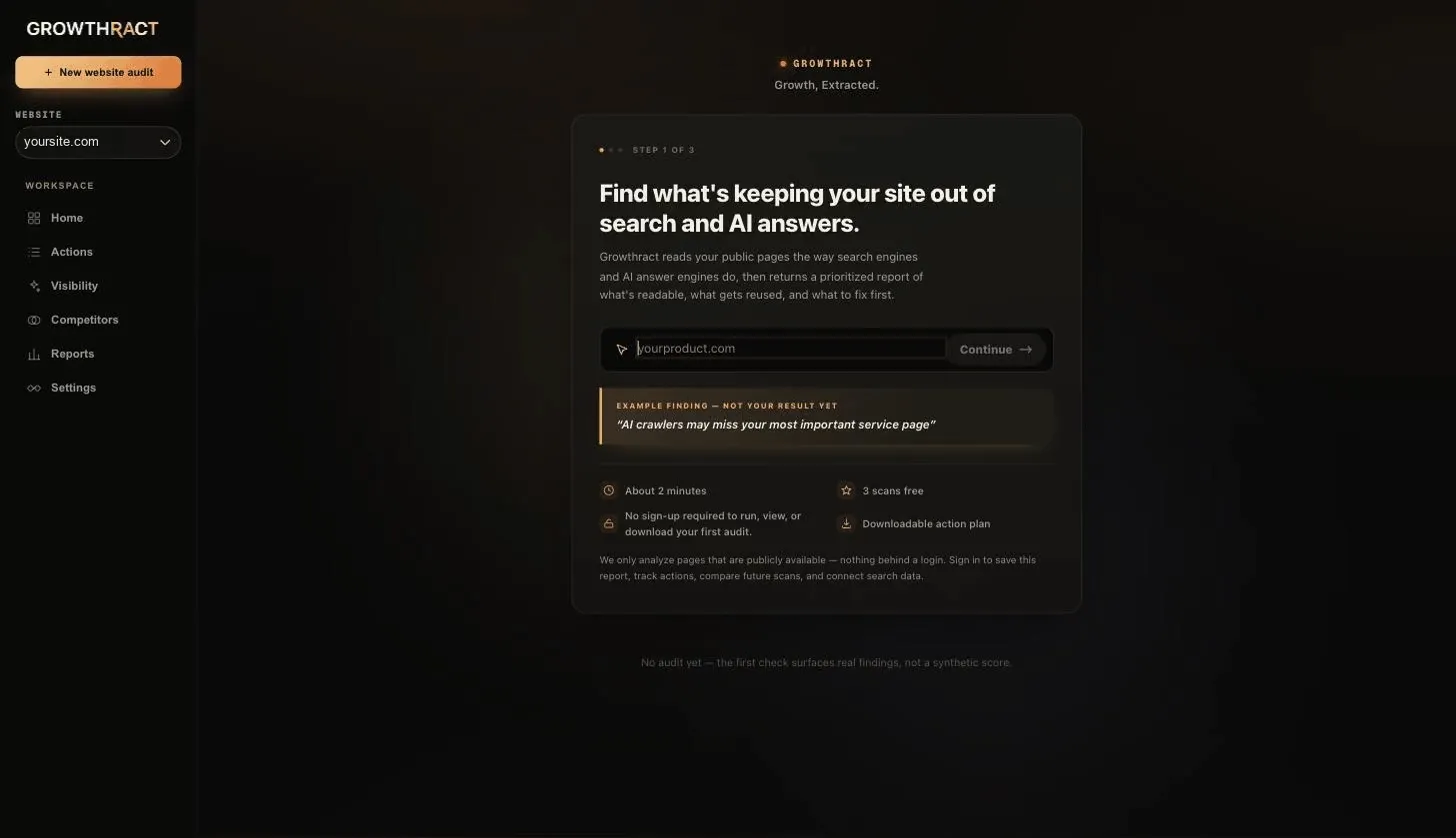
Search Operator checks the website first and turns the evidence into prioritized findings. That gives you something concrete to review before deciding whether implementation help is necessary.

See how Search Operator works
Search Operator screen for starting an automated website diagnostic.
Search Operator · automated website diagnostic

Show, don't tell

Don't take our word for it. Scan your own site.

The fastest way to understand the problem is to inspect the infrastructure itself. Run a free code audit and see what your site exposes to automated retrieval systems.

Inspect

See what your public infrastructure actually exposes.

Understand

Separate observable technical barriers from assumptions.

Prioritize

Know which issues deserve engineering attention first.

Pricing + scopeEngagement blueprint

Know the scope before you commit.

See how Growthract structures diagnostics, implementation and technical search engagements, then choose the level of support that fits your business.

Clear scopeDefined deliverablesPractical engagement paths

How we work

Methodology is the proof.

When the problem is technical, the strongest proof is inspectable evidence. Our methodology is designed so your team can see exactly what was observed, why it matters, and what should change — without handing over more access than the diagnosis requires.

Evidence before opinion

We start with observable technical evidence: HTTP responses, crawler behavior, HTML output, structured data, metadata, and route accessibility. Recommendations come after the evidence.

Infrastructure before content volume

Adding more pages does not solve an infrastructure problem. We first make sure the systems responsible for retrieving and interpreting your existing information can actually access it.

No-risk guardrails

  • No production deployment keys required.
  • No master write permissions required.
  • No forced CMS migration.
  • No black-box score presented as proof.
  • No long-term retainer required to understand the problem.
  • Every recommended change can be reviewed by your engineering team.
See it in action

See these fixes applied to a real product.

Access, structured context, and server-rendered content, walked through on an actual SaaS site — before you commit to an audit.

Before / after walkthrough
0:43 · Unedited walkthrough

Built for SaaS teams

Have a visibility problem worth solving?

Tell us what you are seeing. We can help identify where the technical layer is getting in the way and what is actually worth fixing.