Run a structured AI visibility audit across technical access, entity clarity, content coverage, evidence, and point-in-time AI search presence. See the findings behind the diagnosis instead of relying on one black-box score.
AI visibility auditAI SEO auditAEO auditAI visibility report
Growthract
AI visibility audit stack
Access
Can important information be retrieved?
Entity
Is the company and product clear?
Content
Are buyer questions answered?
Evidence
Are important claims supported?
Visibility
Does the brand appear in tested prompts?
Point-in-time diagnosis first. Ongoing visibility tracking comes after the baseline is established.
Want a benchmark before auditing your own site? Our original research measures many of the same observable technical signals across 100 B2B SaaS websites.
An AI visibility audit is a structured review of the conditions that may affect whether a business can be retrieved, understood, mentioned, or cited in AI-assisted search.
It combines established SEO foundations such as crawlability, rendering, site structure, metadata, and useful content with AEO and AI SEO questions around entity clarity, answer coverage, supporting evidence, prompt-level visibility, and competitor presence.
The purpose is diagnosis. The audit should tell you what can be observed, where the gap exists, why it deserves attention, and what action is worth considering next.
Want something lighter first? See what a free AI search visibility checker tests before committing to the full audit below.
What you get
A diagnosis you can act on, in the order worth doing it.
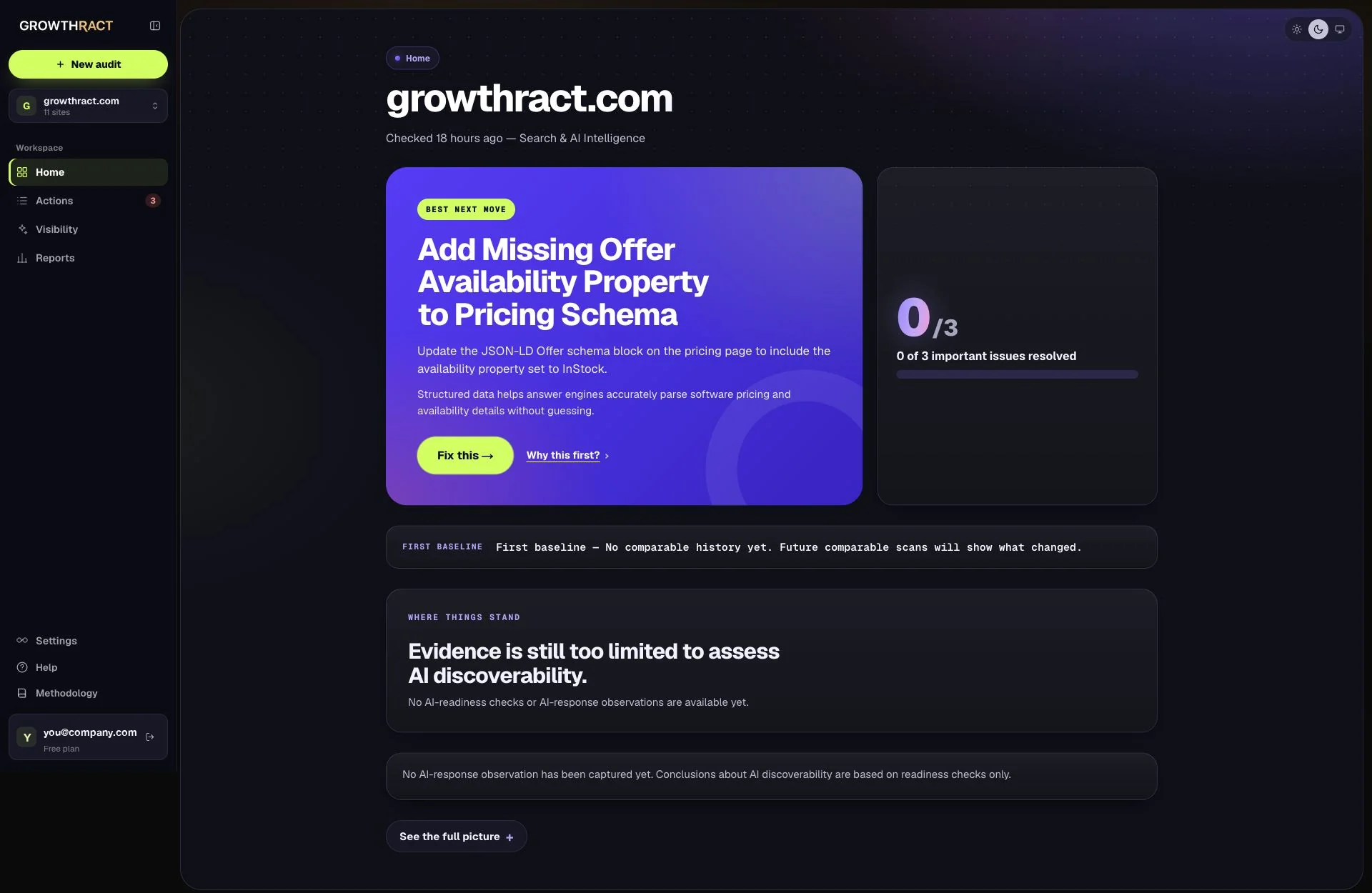
The results open on the one fix worth doing first and why, show how many important issues are resolved, and say plainly when the evidence is still too limited to conclude something.
Growthract · Home
Real screen · results for growthract.com
What the audit checks
Five layers behind AI search visibility.
A missing mention does not automatically tell you what is wrong. The audit works backward through the layers that can actually be investigated.
ACCESS
Technical retrieval
Check whether important pages and information are accessible through the routes, crawler rules, responses, metadata, canonicals, and initial HTML that retrieval systems can inspect.
Example checks
robots.txt and crawler access
priority route availability
HTTP response behavior
initial HTML and rendering dependencies
canonical and metadata consistency
ENTITY
Company and product clarity
Inspect whether your company, product, audience, category, pricing, features, and relationships are represented consistently enough to understand what the business actually is.
Example checks
company and product identity
category positioning
audience and use-case clarity
structured entity relationships
cross-page consistency
CONTENT
Answer coverage
Review whether commercially important questions have clear, useful answers across product, category, comparison, use-case, pricing, implementation, and educational pages.
Example checks
direct answers to buyer questions
comparison and alternative coverage
use-case and audience coverage
commercial information clarity
supporting internal links
EVIDENCE
Evidence and corroboration
Identify where important claims, expertise, product information, and category associations are supported by useful first-party or independent evidence.
Example checks
source attribution
original research and evidence
third-party references
community and industry mentions
consistency beyond your own domain
VISIBILITY
AI search presence
Use repeatable point-in-time prompt testing to observe whether your brand appears, which competitors appear instead, how the brand is described, and whether sources are surfaced.
Example checks
brand mentions
competitor mentions
prompt coverage
citation or source presence
answer context
Audit vs tracking
Diagnose first. Track second.
An AI visibility audit and an AI visibility tracker solve different problems. The audit establishes the baseline. Tracking measures what changes after the baseline exists.
AI visibility audit
AI visibility tracking
Purpose
AuditDiagnose the current technical, entity, content, evidence, and AI-search conditions affecting visibility.
TrackingObserve how defined AI visibility signals change across a repeatable prompt set over time.
Timing
AuditBest used as a baseline, after major website changes, or before deciding what to fix.
TrackingBest used continuously or at regular intervals after the baseline exists.
Primary output
AuditPrioritized findings, affected pages, evidence, explanations, and recommended actions.
TrackingMention rate, prompt coverage, competitor presence, citations, and change over time.
Core question
AuditWhat is limiting our AI search visibility right now?
TrackingIs our visibility improving, declining, or changing?
The output should help you decide what deserves attention. It should not hide the diagnosis behind an unexplained score.
Observable findings
What was actually found in the website, structured data, response output, or tested AI-search result.
Affected pages
Which commercially important URLs or information layers are connected to each finding.
Why it matters
The retrieval, entity, content, evidence, or visibility consequence associated with the issue.
Priority
Which findings deserve attention first based on evidence and likely business relevance.
Recommended action
The concrete next step rather than a vague instruction to simply create more content.
Limitations
What the audit can observe and what cannot legitimately be inferred from a third-party AI system.
AI SEO audit + AEO audit
Search foundations still matter.
AI SEO and AEO do not replace technical SEO. If important pages are difficult to retrieve, poorly rendered, inconsistently canonicalized, weakly connected, or unclear about what the business actually offers, AI-specific tactics cannot erase those fundamentals.
The audit therefore starts with observable search and website conditions before expanding into entity understanding, answer-ready content, supporting evidence, and AI-search visibility.
Manual review is valuable because it forces you to think about positioning, product clarity, content usefulness, evidence, and buyer questions directly.
Automation becomes useful when the work expands across more URLs, repeated checks, structured findings, technical patterns, and before-and-after comparisons.
An AI visibility audit is a structured review of the conditions that may affect how easily a business can be retrieved, understood, mentioned, or cited in AI-assisted search. It can include technical accessibility, entity clarity, content coverage, supporting evidence, and point-in-time AI-search observations.
What is the difference between an AI visibility audit and an AEO audit?
The terms overlap. An AEO audit typically evaluates whether a website is prepared for answer-driven search through technical accessibility, entities, answer-ready content, evidence, and visibility. An AI visibility audit emphasizes the observable visibility outcome as well as the underlying AEO and AI SEO conditions that may contribute to it.
What is an AI SEO audit?
An AI SEO audit extends traditional SEO analysis into AI-assisted discovery. Alongside crawlability, rendering, metadata, content, and site structure, it can examine entities, machine-readable context, buyer-question coverage, AI-search mentions, competitor visibility, citations, and external evidence.
What does Growthract's AI visibility audit check?
Growthract examines observable technical and website signals such as crawler access, initial HTML, metadata, canonicals, structured data, entity clarity, content coverage, and point-in-time AI visibility observations. Findings are separated from assumptions about proprietary third-party ranking systems.
Is an AI visibility audit the same as an AI visibility tracker?
No. An audit is primarily a diagnostic used to establish what is happening and why. An AI visibility tracker repeatedly measures defined signals such as brand mentions, competitor presence, prompt coverage, citations, and changes over time.
What should an AI visibility report include?
A useful AI visibility report should document the methodology, pages and prompts examined, observable findings, brand and competitor presence, citation or source visibility where available, technical and content gaps, recommended actions, priorities, and important limitations.
Can an AI visibility audit guarantee citations or rankings?
No. An audit cannot guarantee that ChatGPT, Google, Perplexity, Gemini, Claude, or another third-party system will rank, recommend, mention, or cite a company. It can identify observable conditions and gaps that deserve investigation or improvement.
Can I run an AEO audit myself?
Yes. A manual audit is useful for understanding a smaller set of important pages. Automation becomes more useful when you need consistent checks across more URLs, structured evidence collection, repeatable comparisons, and prioritization.