Original Growthract research
Traditional technical foundations are nearly universal. AI-oriented technical signals are not.
Growthract analyzed a frozen sample of 100 B2B SaaS marketing websites across four categories. Basic search infrastructure was overwhelmingly present: titles, canonical tags and XML sitemaps were detected on almost every site where the signal could be determined.
The larger differences appeared in newer AI-oriented publishing conventions and machine-readable entity structure. 74 of 97 sites with a determinable status published an llms.txt file, while only 21 of 97 inspectable homepages exposed SoftwareApplication schema in their initial HTML.
76.3%
Published llms.txt
74 of 97 websites where llms.txt status could be determined.
99.0%
Allowed tested AI search crawlers
97 of 98 sites with known robots evidence allowed each tested search crawler at the root.
78.4%
Homepage JSON-LD
76 of 97 inspectable homepages exposed JSON-LD in the initial HTTP response.
21.6%
SoftwareApplication schema
21 of 97 inspectable homepages exposed SoftwareApplication schema.
What we studied
The benchmark covers 100 B2B SaaS companies, divided evenly into four 25-company groups:
Sales, Marketing & Customer
25 companies
Productivity & Collaboration
25 companies
Data, Analytics & Automation
25 companies
Developer, Cloud & Security
25 companies
The sample was frozen before the final scan. Companies were not removed because their sites blocked or rate-limited our research client. That matters: excluding difficult-to-fetch sites would bias the benchmark toward websites that are easier for automated clients to access.
Coverage
100
companies in frozen sample
97
homepages inspected successfully
3
unavailable to the research client
The five findings that stood out
llms.txt adoption was already 76.3%
We detected an llms.txt file on 74 of 97 websites with a known status.
Of those 74 files, 68 met the benchmark's basic structural checks for Markdown headings. That is 91.9% of detected llms.txt files, or 70.1% of all 97 websites where presence could be determined.
We treat llms.txt strictly as an adoption signal. This benchmark does not claim that publishing the file causes rankings, citations or inclusion in an AI answer.
llms.txt present
76.3%
74 / 97 known
Structured among detected files
91.9%
68 / 74 present
For a deeper explanation of the file itself, see our guide to llms.txt and AI search.
Robots.txt was rarely the limiting factor for AI search crawlers
For each of the three search-oriented crawler tokens we measured — OAI-SearchBot, Claude-SearchBot and PerplexityBot — 97 of 98 sites with determinable robots evidence allowed root access.
One site in the known denominator blocked the tested search crawler tokens at the root. Two sites were unknown because robots.txt requests were rate-limited during the final collection.
OAI-SearchBot allowed
99%
97 / 98 known
Claude-SearchBot allowed
99%
97 / 98 known
PerplexityBot allowed
99%
97 / 98 known
This is a narrow robots.txt finding. It does not prove that every page is fetchable by every AI system. CDN rules, WAFs, bot mitigation, authentication and application behavior can create additional access layers.
Homepage JSON-LD was common, but software-specific schema was not
JSON-LD appeared in the initial HTML of 76 of 97 inspectable homepages.
Organization schema appeared on 70 of 97 homepages. WebSite schema appeared on 39. But SoftwareApplication schema appeared on only 21.
Any homepage JSON-LD
78.4%
76 / 97
Organization
72.2%
70 / 97
WebSite
40.2%
39 / 97
SoftwareApplication
21.6%
21 / 97
Schema is not a guarantee of AI citation. The useful observation here is narrower: many SaaS homepages expose organization-level machine-readable data, while substantially fewer describe the software product itself with SoftwareApplication markup in the initial response.
See our schema markup guide for AEO for implementation context.
llms.txt adoption differed substantially by SaaS category
Developer, Cloud & Security companies had the highest observed adoption at 87.5% among sites with a known status.
Productivity & Collaboration was much lower at 56.5%.
Developer, Cloud & Security
87.5%
21 / 24 known
Sales, Marketing & Customer
80%
20 / 25 known
Data, Analytics & Automation
80%
20 / 25 known
Productivity & Collaboration
56.5%
13 / 23 known
The sample is intentionally balanced rather than randomly drawn from the entire SaaS market, so category differences should be read as benchmark observations rather than population estimates.
Traditional technical foundations were already close to universal
Titles were present on all 97 inspectable homepages. Canonical tags were detected on 96 of 97. XML sitemaps were detected on 98 of 99 sites where sitemap status could be determined.
Title present
100%
97 / 97
Meta description present
97.9%
95 / 97
H1 present
94.8%
92 / 97
Canonical present
99%
96 / 97
XML sitemap detected
99%
98 / 99 known
That changes the diagnostic question. For sophisticated SaaS websites, the first problem often is not whether a title tag or sitemap exists. The more interesting technical questions are how clearly entities, products and supporting pages are exposed to retrieval systems.
Category comparison
Each category started with 25 companies. Denominators below vary when a specific signal could not be determined.
| Category | llms.txt | Homepage JSON-LD | Organization schema |
|---|---|---|---|
| Sales, Marketing & Customer | 80.0%20/25 | 87.5%21/24 | 75.0%18/24 |
| Productivity & Collaboration | 56.5%13/23 | 75.0%18/24 | 66.7%16/24 |
| Data, Analytics & Automation | 80.0%20/25 | 80.0%20/25 | 76.0%19/25 |
| Developer, Cloud & Security | 87.5%21/24 | 70.8%17/24 | 70.8%17/24 |
Machine-readable markup dropped on supporting pages
The collector attempted to inspect a small deterministic sample of supporting page types where discoverable: a product or pricing page, a solution or use-case page, an article or resource, and a help, FAQ or documentation page.
Homepage JSON-LD adoption was 78.4%. On the supporting page types we sampled, observed adoption was closer to 60–66%.
Homepage
78.4%
76/97
Product / pricing
66.3%
63/95
Article / resource
63.9%
62/97
Help / FAQ
62.6%
57/91
Solution / use case
60.2%
56/93
This does not mean every supporting page needs the same schema type. It shows that machine-readable markup observed on homepages did not consistently extend across the broader site sample.
What this benchmark suggests for B2B SaaS teams
Do not stop at robots.txt
Search-crawler access was already nearly universal in the known sample. Technical AI readiness requires looking beyond a simple allow/block check.
Treat llms.txt as an adoption signal
The file is now common in this benchmark sample, but its presence should not be presented as a ranking factor or citation guarantee.
Inspect what the initial HTML actually exposes
A browser-rendered page can look complete while machine-readable entity or product information is missing from the initial response.
Audit supporting pages, not only the homepage
Structured-data coverage was lower across product, solution, article and help pages in our deterministic page sample.
Growthract's broader AI search visibility framework separates technical accessibility from actual brand presence in AI answers. They are related problems, but they are not the same metric.
Methodology
Sample
100 intentionally selected B2B SaaS websites, split evenly across four categories. The sample was frozen before the final collection.
Collection date
August 24, 2026.
Data source
Public HTTP responses only. No private analytics, Search Console data or customer data was used.
Model calls
None. The benchmark used deterministic technical checks and made no Gemini, ChatGPT, Claude or other model requests.
Homepage HTML
Signals such as JSON-LD, H1 and canonical markup were measured from the initial HTTP HTML response. JavaScript-injected markup may therefore not be represented.
Crawler access
robots.txt rules were evaluated for root access using the named crawler tokens. This is not a claim that every URL or every infrastructure layer is accessible.
llms.txt
Measured as file presence plus basic Markdown heading structure. It is reported as an adoption signal, not a ranking or citation factor.
Structured data
Schema types were reported when observed in JSON-LD. Absence means the type was not observed by this collector in the inspected initial HTML.
Supporting pages
Up to one discoverable page was sampled for product/pricing, solution/use-case, article/resource and help/FAQ/documentation page types. Random pages were not used to fill missing categories.
Unknown values
Sites were retained when evidence could not be collected. Unknown signals were excluded from that metric's denominator rather than counted as failures.
Limitations
- This is a deliberately balanced benchmark sample, not a random census of the global B2B SaaS market.
- The benchmark measures technical signals, not whether a company is actually cited or recommended by an AI assistant.
- A robots.txt allow rule does not guarantee successful crawling through CDNs, WAFs, bot protection or application-level controls.
- Initial HTML inspection may not capture structured data injected only after JavaScript execution.
- llms.txt is reported as an emerging publishing convention. The benchmark does not treat it as a ranking factor.
- Websites change frequently. These findings are a snapshot of the collection date.
Open research data
Inspect the evidence yourself
We are publishing the domain-level benchmark data, sampled page-level evidence and machine-readable summary alongside this report.
Apply the benchmark
Find the same technical signals on your own SaaS website
Growthract's AI visibility audit separates deterministic technical evidence from actual AI visibility measurement so you can see what is accessible, what is machine-readable and what still needs investigation.
Continue exploring
Related insights
Case study
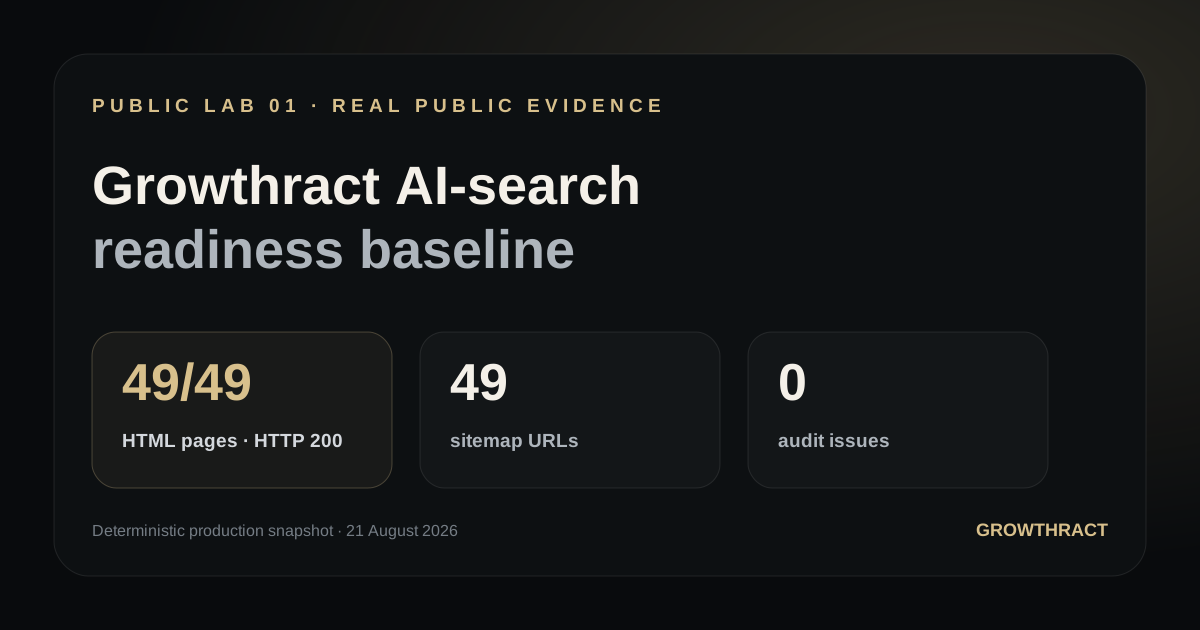
A public technical audit of growthract.com covering 49 production HTML pages, crawler access, robots.txt, sitemap integrity and legacy routes — with the limits of the evidence stated explicitly.
See the case study →
Insight
Direct downloads, a field dictionary and a citation format for the raw dataset behind Growthract's 2026 AI Search Readiness Benchmark — 100 B2B SaaS companies, deterministically checked.
Read the insight →
Insight
Original benchmark data comparing four B2B SaaS categories on llms.txt, schema and crawler-access signals — no single category wins on everything.
Read the insight →