Direct answer
Why do entities matter for AI search?
Entities help search systems connect a company, product, person, category and supporting facts into a consistent concept. Clear naming, relationships, structured information and corroborating references reduce ambiguity about what a business is and how it relates to the topics being searched.
01
Entity clarity reduces ambiguity around brands and products.
02
Relationships matter as much as isolated keywords.
03
Consistency across pages and supporting sources strengthens interpretation.
Search systems do not only need to find your pages. They also need to understand what your company is, what it offers, who is connected to it and how those pieces relate to the topics people search for.
That is the practical role of entity SEO.
Instead of optimizing only around keywords and individual URLs, entity SEO improves the clarity and consistency of the real-world things those pages describe: organizations, people, products, services, topics and the relationships between them.
The important distinction
A knowledge graph is a way of representing entities and their relationships. That does not mean every AI system uses one shared public graph or that ChatGPT, Google and Perplexity all understand brands through the same internal architecture.
What is an entity in SEO?
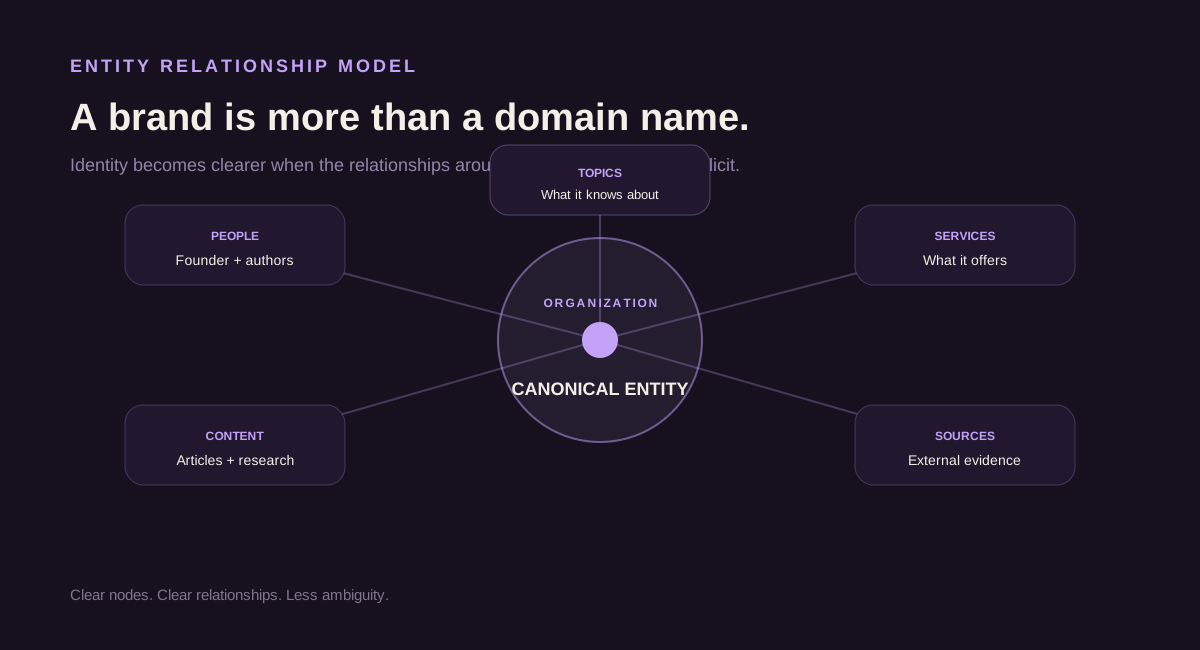
An entity is a distinct thing that can be identified independently from the words used to describe it.
Organization
The company or institution behind the website.
Person
A founder, author, executive, expert or contributor.
Product
A distinct software product, physical product or platform.
Service
A clearly defined commercial capability or offering.
Topic
A subject area the organization or expert is meaningfully connected to.
Content
Articles, research, documentation and resources about those entities.
A keyword is a string someone searches. An entity is the thing the words refer to.
That difference becomes increasingly useful when a search system must interpret conversational questions rather than match one phrase to one document.
What is a knowledge graph?
A knowledge graph represents identifiable things as nodes and the relationships between them as connections.
Instead of storing only isolated strings, a graph can represent relationships such as:
Growthract → is an → organization
Growthract → offers → SEO + AEO services
Umang Gupta → founded → Growthract
Growthract → publishes about → Answer Engine Optimization
Article → authored by → person
Service → addresses → search visibility problem
Google publicly discusses knowledge panels, organization disambiguation and structured data that provides explicit information about entities. But marketers should be careful not to assume that every AI-search system exposes or uses the same graph.
How search systems build an understanding of a brand
From the outside, we cannot inspect every proprietary representation used by modern search and AI platforms.
What we can audit are the information conditions those systems are able to observe.
Identity
What exactly is the organization?
Your site should make the basic identity of the business unmistakable: official name, website, logo, description and relevant identifiers.
Avoid switching unpredictably between multiple company names, abbreviations and descriptions unless the relationship between them is clear.
Type
What kind of thing is this?
An organization should look like an organization. A person should be identifiable as a person. A service should be described as a service rather than a vague collection of marketing language.
Clear typing reduces ambiguity around what each page is describing.
Attributes
What facts describe the entity?
Important facts may include the organization's official URL, logo, alternate name, founding details, areas of expertise and other information relevant to the business.
Only publish attributes that are accurate and genuinely useful.
Relationships
How does this entity connect to other things?
Connect people to the company, authors to their content, services to relevant problems and expertise to the topics where it is demonstrated.
Relationships are often more informative than repeating the same business description everywhere.
Corroboration
Does the wider web support the same understanding?
External publications, partner pages, directories, communities and other credible sources can reinforce important facts about the organization.
This is one reason AI search visibility depends on more than your website.
Organization schema helps make identity explicit
Google says Organization structured data on a homepage can help it understand an organization's administrative details and disambiguate that organization in Search.
That makes Organization markup useful when it accurately reflects the visible business information on the site.
Simplified example
{
  "@context": "https://schema.org",
  "@type": "Organization",
  "name": "Example Company",
  "url": "https://example.com",
  "logo": "https://example.com/logo.png"
}
The point is not to add every property you can find. Use properties that accurately describe the organization and match the information people can see.
Official Google guidance
Google Search Central — Organization structured data ↗What does sameAs actually do?
Schema.org defines sameAs as a URL that unambiguously identifies the same item.
In practice, that means it should connect an entity to genuinely equivalent authoritative references — not every profile or URL you can collect.
Appropriate
A verified official profile or another URL that clearly represents the exact same organization or person.
Not appropriate
Random articles, loosely related partner pages or unrelated directories simply because they mention the brand.
Schema.org definition
Schema.org — sameAs ↗Schema does not create an entity from nothing
Structured data can make information explicit, but markup cannot fix an incoherent business identity.
If your homepage says one thing, your About page says another and external profiles describe a third version of the company, adding JSON-LD does not magically remove that inconsistency.
Better sequence
Clarify the entity → align visible information → add accurate structured data → reinforce with credible external evidence
Google explicitly says structured data provides clues about page meaning, but correctly implemented markup does not guarantee a particular search appearance.
Your site architecture should reinforce entity relationships
Entity optimization is not limited to JSON-LD.
The visible site should create understandable relationships between the organization and the things it wants to be known for.
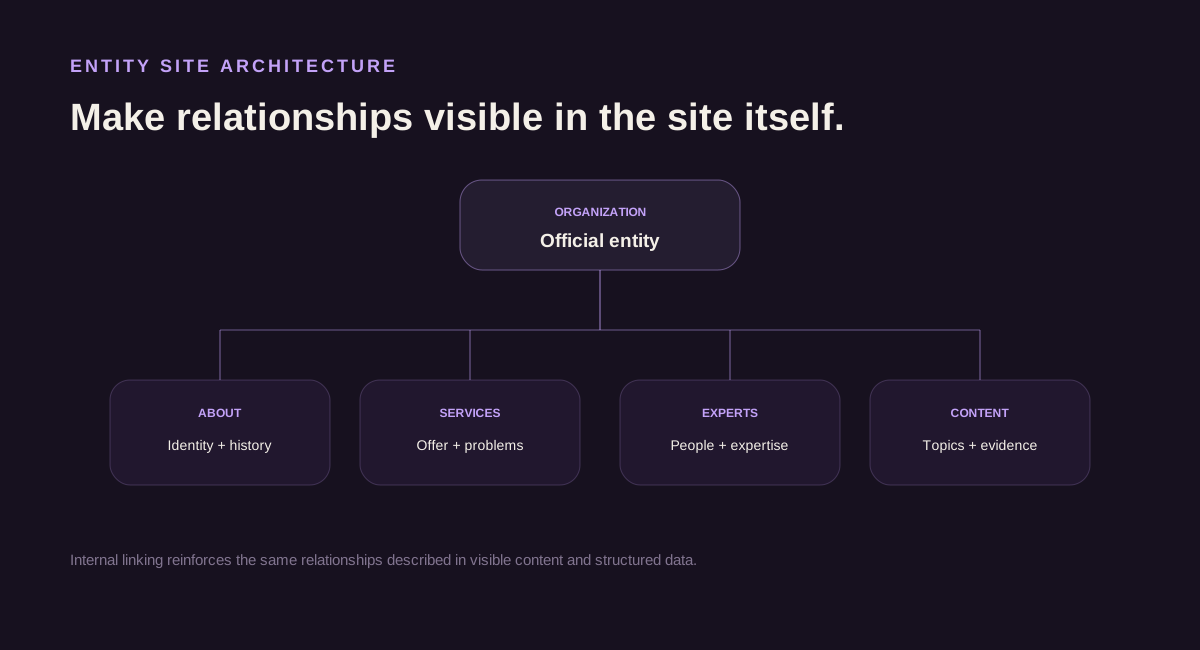
Homepage
Clearly state what the organization is, what it does and the market or problems it serves.
About page
Explain the organization, founder or team, expertise and relevant history without contradicting the homepage.
Service pages
Give important offerings dedicated context instead of hiding every capability inside generic marketing copy.
Author pages
Connect named experts to the content and topics where their expertise is genuinely demonstrated.
Content
Connect articles back to relevant services, entities and related topic clusters through meaningful internal links.
Structured data
Use markup that accurately reflects the entities and visible relationships represented on the page.
Entity clarity extends beyond your domain
Your website is your strongest controlled source, but search systems can also encounter information about the organization elsewhere.
Useful corroboration can include:
Relevant profiles
Official profiles that consistently describe the same business.
Industry publications
Independent coverage or expert contributions where the relationship is legitimate.
Partner ecosystems
Integration, partnership or association pages that accurately connect two organizations.
Communities
Meaningful participation where real expertise and entity context are visible.
Directories
Relevant, maintained listings that accurately represent the company.
Primary references
Research, documentation, repositories or resources directly connected to the entity.
Do not manufacture fake profiles or low-quality mentions just to create more references. Corroboration is useful when the source itself makes sense.
What does entity SEO have to do with ChatGPT and AI search?
The safest answer is not to pretend we can see the internal entity representation of every AI system.
What matters operationally is that generated search answers still have to interpret what the user's question refers to and retrieve information relevant to that subject.
OpenAI separately documents that public websites can appear in ChatGPT search and that allowing OAI-SearchBot supports discovery of public content.
That crawler guidance establishes accessibility. It does not disclose the complete internal entity model ChatGPT uses and should not be presented as if it does.
Official OpenAI guidance
OpenAI — Publishers and Developers FAQ ↗For the broader citation layer, see How to Get Your Brand Cited by ChatGPT, Perplexity & AI Overviews.
A practical entity SEO audit
You can audit entity clarity without pretending to reverse-engineer a proprietary knowledge graph.
Identity
Can someone clearly identify the official organization name, website and description?
Consistency
Do your homepage, About page, service pages and important profiles describe the same organization?
Relationships
Are founders, authors, services, products and topics clearly connected to the organization?
Dedicated context
Do important entities have enough dedicated content to be understood independently?
Schema
Does structured data accurately describe the visible entities instead of inventing information?
sameAs
Do sameAs URLs genuinely identify the exact same entity?
Corroboration
Are important business facts reinforced by credible external sources where appropriate?
AI representation
When you test relevant prompts, is the brand described accurately and consistently?
This entity layer is also part of the broader 15-Point AEO Checklist.
6 entity SEO mistakes to avoid
Treating schema as the whole strategy
Structured data is useful, but visible content, architecture and external consistency still matter.
Adding every profile to sameAs
sameAs should represent genuine identity equivalence, not act as a general link list.
Creating contradictory business descriptions
If the company category, offer or positioning changes across major pages, ambiguity increases.
Leaving experts disconnected from expertise
Named authors or founders should be connected to the topics and content that actually demonstrate their expertise.
Inventing external authority
Fake profiles, fabricated citations and low-quality directory spam do not create credible corroboration.
Claiming knowledge-graph certainty
Do not present a marketer-built diagram as proof of how a proprietary AI platform internally represents your brand.
How do you measure entity clarity?
There is no universal entity score that proves a search system understands your brand perfectly.
Use observable tests instead:
Branded queries
Does search consistently surface the correct official site and organization information?
Branded AI prompts
Do AI-search responses accurately describe what the company does?
Category prompts
Does the brand appear where its actual category and expertise are relevant?
Structured-data validation
Does the markup accurately validate and match visible page information?
Source consistency
Do important external references describe the same organization?
Error tracking
Do repeated tests reveal the same factual misunderstandings about the brand?
The broader prompt-level methodology is explained in The Cost of Being Invisible to AI Search.
Entity SEO is one layer of AEO
Entity optimization does not replace technical SEO or useful content.
It strengthens the understanding layer between discovery and answer visibility.
Discoverable → identifiable → understandable → useful → corroborated → measurable
That is why Growthract treats entity clarity as part of the same connected search-visibility system described in our SEO vs. AEO vs. GEO guide.
Clarify the entity
Find where your site leaves search systems guessing.
Run Growthract against your website to identify SEO and AEO opportunities across technical foundations, entity clarity, content and AI-search readiness.
Entity SEO FAQs
What is entity SEO?
Entity SEO improves how clearly a website describes identifiable organizations, people, products, services and topics and how those entities relate to one another.
Is an entity the same as a keyword?
No. A keyword is text used in a search or document. An entity is the identifiable thing those words refer to.
Does Organization schema help Google understand a company?
Google says Organization structured data can help it understand administrative details about an organization and disambiguate that organization in Search.
Does schema guarantee a Google knowledge panel?
No. Structured data can provide explicit information, but Google does not guarantee that correctly implemented markup will produce a particular search appearance.
Does ChatGPT use Google's Knowledge Graph?
You should not assume that. OpenAI does not publicly describe ChatGPT search as simply using Google's Knowledge Graph. Treat each platform's documented crawling and search behavior separately.
What is sameAs schema used for?
Schema.org defines sameAs as a URL identifying the same item. Use it for genuine identity-equivalent references rather than a general collection of links.
Continue exploring
Related insights
Case study
Illustrative strategy: how an e-commerce brand could improve product data, entity clarity, third-party evidence and AI-shopping visibility to compete for recommendation-level visibility across Gemini and Claude.
See the case study →
Insight
Which structured data actually matters for AEO, how to implement Organization, WebSite, Article and Breadcrumb schema, and what schema cannot guarantee in AI search.
Read the insight →
Insight
Does llms.txt help with Google rankings, ChatGPT visibility or AI search citations? Here is what the major platforms actually say, where llms.txt can be useful and what businesses should prioritize instead.
Read the insight →