Direct answer
What determines whether a brand appears in AI search?
AI search visibility depends on more than a single webpage or ranking. Search and AI systems can draw on crawlable website content, entity clarity, supporting evidence, third-party sources and the context of each query. No individual signal guarantees that a brand will be mentioned or cited.
01
Your website is one part of the evidence available to AI systems.
02
Entity consistency and accessible supporting evidence matter.
03
Visibility should be measured across prompts, mentions, citations and competitors.
When people ask an AI search engine about a company, product or category, the answer is rarely built from one website alone.
AI search systems can combine information from websites, structured data, third-party publications, directories, communities, reviews, videos and other sources to form an answer.
That means having a technically strong website is important, but it is only one part of becoming visible in AI-generated answers.
If you are looking for the measurement and diagnostic side rather than the broader concept, Growthract's AI search visibility tracking and analysis framework covers prompt presence, competitor mentions, technical retrieval, entity clarity, and citation signals.
AI Search Has Changed the Visibility Model
Traditional search often gives businesses a clear target: appear prominently in the organic results for an important query.
AI search introduces a different question. Instead of simply asking where a page ranks, businesses need to understand whether they are being discovered, understood, mentioned and cited when an answer is generated.
The shift
AI search visibility is about becoming part of the answer, not simply appearing beneath it.
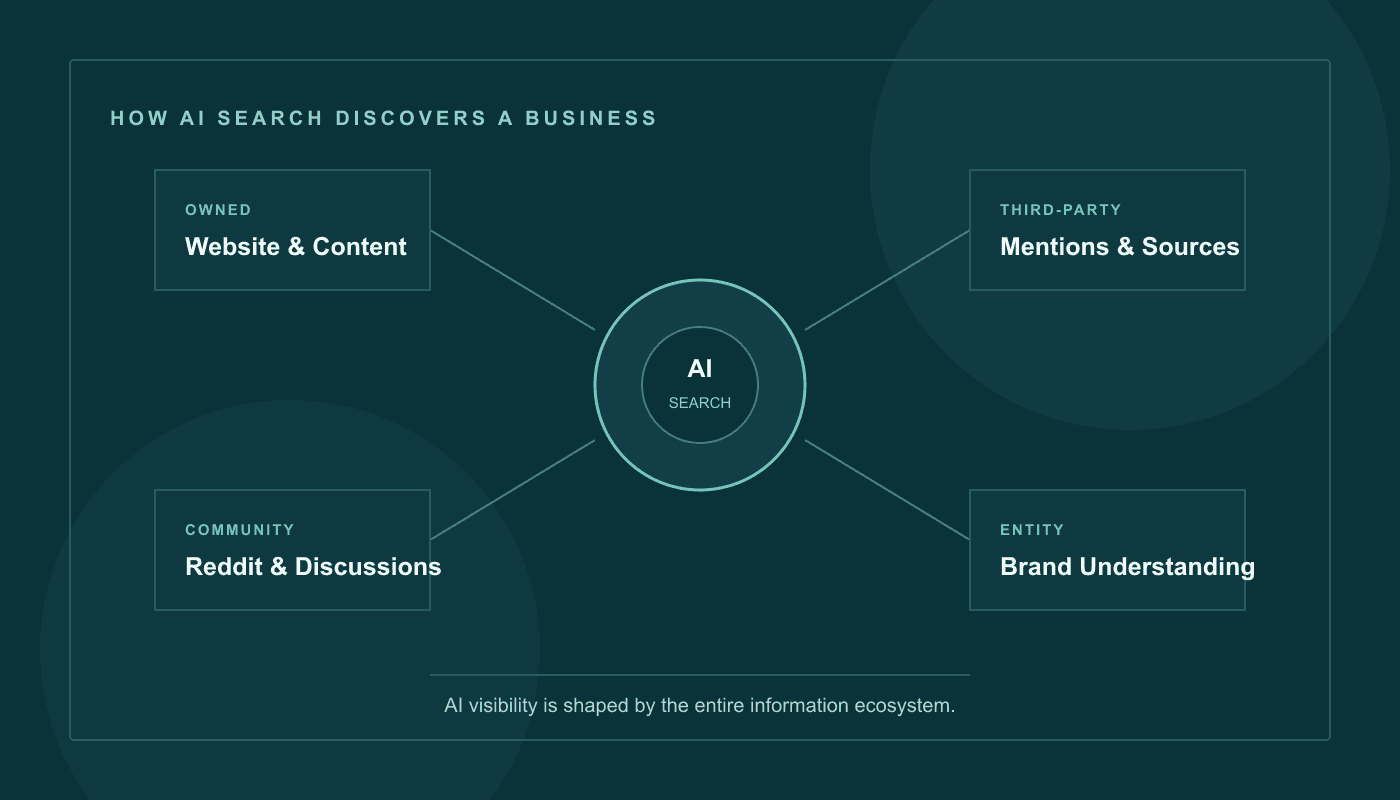
Your Website Is Only One Source
Your website remains the foundation of your digital presence. It provides the information that search systems can crawl, interpret and associate with your business.
But AI systems can also encounter your company through independent sources. If those sources consistently describe your business, expertise, products and positioning, they can contribute to a much stronger understanding of your brand.
The goal is therefore not to replace your website with third-party visibility. It is to make the information ecosystem around your business clearer, more consistent and more authoritative.
Entities Matter More Than Keywords Alone
Search systems increasingly need to understand what a business is, what it offers, who it serves and how it relates to other entities.
A company that clearly communicates its identity, category, products, expertise and relationships gives search systems more context to work with than a website built around isolated keywords.
Company identity
Products and services
Industry and category
People and expertise
Customers and use cases
Related entities
Third-Party Sources Can Shape the Answer
Independent sources can provide context that a company's own website cannot establish on its own.
Reviews, publications, industry websites, directories, comparison pages and other credible references can reinforce how a business is understood across the wider search ecosystem.
This makes third-party visibility an important part of modern search strategy rather than an afterthought.
Communities and Brand Mentions Matter
People frequently discuss products and companies outside official websites. Reddit, YouTube, forums, professional communities and social platforms can all become part of the discovery journey.
When those conversations provide useful, independent context, they can contribute to how a company is discovered and evaluated.
Citation Visibility Is a Separate Opportunity
Being mentioned by an AI system and being used as a source are not necessarily the same thing.
Citation visibility focuses on whether your content or trusted references about your business are selected as supporting sources for generated answers.
The objective is not to manufacture mentions. It is to build information that is useful enough, clear enough and credible enough to be referenced.
What Businesses Should Optimize
Make your website easy to crawl and understand.
Build clear entity and brand information.
Create genuinely useful answer-focused content.
Strengthen authoritative third-party references.
Participate meaningfully in relevant communities.
Build consistent descriptions of your company and offerings.
Measure mentions, citations and visibility across search surfaces.
Frequently Asked Questions
Is AI search replacing Google?
No. AI search is expanding the search landscape. Traditional search engines remain important, while AI-generated answers add new discovery and evaluation surfaces.
Does AI search only use information from websites?
No. AI search systems can draw on multiple types of information and sources. The exact sources and retrieval behavior vary by system and query.
What is the relationship between SEO and AI search visibility?
SEO remains foundational. AI search visibility builds on that foundation by expanding the focus to entities, answers, citations, mentions and broader information ecosystems.
AI search visibility
Your website is only the beginning of being found.
Find out how your business appears across AI search, traditional search and the wider sources that influence discovery.
Continue exploring
Related insights
Case study
Competitive Displacement: Benchmarking and Overtaking Competitor Citation Share in Perplexity Search
How a B2B company could benchmark competitor citation visibility in Perplexity, identify the sources and topics shaping AI answers, and build a focused strategy for earning greater citation share.
See the case study →Insight
Why Ranking #1 on Google No Longer Guarantees AI Visibility
A #1 Google ranking is valuable, but it does not guarantee that your brand will appear in AI Overviews, AI Mode, ChatGPT or Perplexity. Learn why the visibility paths differ and what to measure next.
Read the insight →Insight
How AI Summaries Intercept High-Intent Branded Traffic
AI-generated answers can sit between a branded search and the website visit. Learn where high-intent branded journeys can change, how to measure the effect and how to protect visibility without inventing lost-revenue estimates.
Read the insight →