A branded search used to create a fairly direct path: someone searched your company or product, saw your result and decided whether to visit your website.
AI-generated search experiences can insert another layer between the query and the click.
A buyer can now ask about your pricing, reputation, alternatives, integrations, strengths, weaknesses or suitability and receive a synthesized response before opening your site.
The important distinction
"Intercept" does not mean every AI summary steals a click. It means the generated answer can become an additional decision surface before the website visit, changing what the buyer knows, which sources they trust and whether they need to click at all.
What is high-intent branded traffic?
A branded query contains the name of a company, product or service. But branded searches can represent very different levels of intent.
Someone searching only your company name may simply want the homepage. Someone searching your name alongside a comparison, integration, review or buying question is much closer to a decision.
Evaluation
Example: Brand + reviews
Why it matters: The buyer wants evidence about credibility and may rely heavily on information outside your website.
Comparison
Example: Brand vs competitor
Why it matters: The answer can define the comparison criteria before the buyer reaches either company.
Commercial
Example: Brand + pricing
Why it matters: The buyer is investigating commercial fit and may receive a summarized answer before visiting your pricing or contact page.
Suitability
Example: Is Brand good for enterprise teams?
Why it matters: The system may synthesize your own claims with external documentation, reviews and third-party commentary.
Capability
Example: Does Brand integrate with X?
Why it matters: Documentation, integrations and third-party sources can influence the answer.
Alternatives
Example: Best alternatives to Brand
Why it matters: The buyer already knows you, but the generated response may expand the consideration set to competitors.
Where the AI summary enters the branded journey
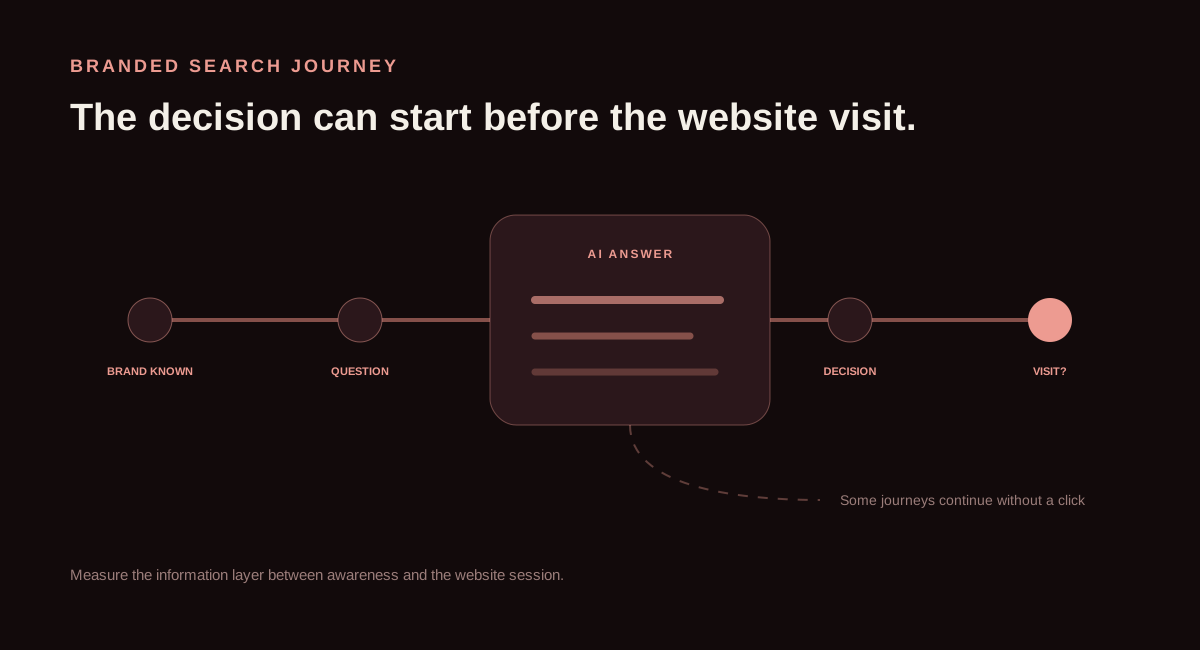
The risk is easiest to understand by separating the journey into stages.
The buyer already knows the brand
Awareness has already happened.
This is why branded traffic is important. You are no longer competing only to become known. The buyer has already identified your company or product.
The buyer asks an evaluation question
The search moves from navigation to decision support.
Questions about alternatives, pricing, reviews, integrations, limitations and suitability indicate that the buyer wants more than a homepage.
The AI system constructs an answer
The answer can combine multiple sources.
Google's AI Overviews and AI Mode can use related searches and supporting web pages to construct a response.
Other answer-driven systems can also present synthesized information with citations or links.
The buyer forms an impression
Your site may not have been visited yet.
The response can influence whether the brand appears credible, expensive, suitable, limited, differentiated or comparable to a competitor.
The buyer decides whether to continue
A website visit becomes one possible next step.
Some people will click through because they want deeper information. Others may continue their research inside the generated experience or move directly to another source.
One branded question can trigger a much broader information search
Google documents a technique called query fan-out for AI Overviews and AI Mode.
The system can issue multiple related searches across subtopics and data sources to develop an answer.
Example
"Is Brand X a good choice for a 50-person SaaS company?"
That means owning the #1 position for your company name does not automatically mean you control every source that contributes to a high-intent branded answer.
This extends the argument in Why Ranking #1 on Google No Longer Guarantees AI Visibility.
Official Google guidance
Google Search Central — AI features and your website ↗The bigger risk is not only losing the click
A zero-click mindset focuses on traffic.
For branded queries, the more important question may be who shapes the buyer's understanding before the click.
Your own website
Product pages, service pages, documentation, pricing information, FAQs and comparison content.
Review platforms
Customer sentiment, recurring strengths, complaints and perceived limitations.
Publications
Independent analysis, news, comparisons and category context.
Communities
Real-world recommendations, implementation experiences and objections.
Partner sources
Integrations, marketplace listings and ecosystem relationships.
Competitors
Alternative and comparison pages that frame the category from another company's perspective.
This is why AI search visibility depends on more than your website.
Can you prove an AI summary caused a lost click?
Usually not from one metric alone.
A decline in branded click-through rate can happen for many reasons: search-result changes, seasonality, demand shifts, ads, new SERP features, competitor activity or changes in the query mix.
Safer interpretation
If branded traffic changes while generative-search visibility also changes, investigate the relationship. Do not automatically label the entire difference "AI traffic loss."
The same evidence rule applies to revenue. Missing visibility cannot automatically be converted into lost pipeline.
Our AI-search visibility measurement framework explains how to separate observable exposure from business-specific revenue modeling.
How to measure the branded-traffic shift
Use several layers of evidence together.
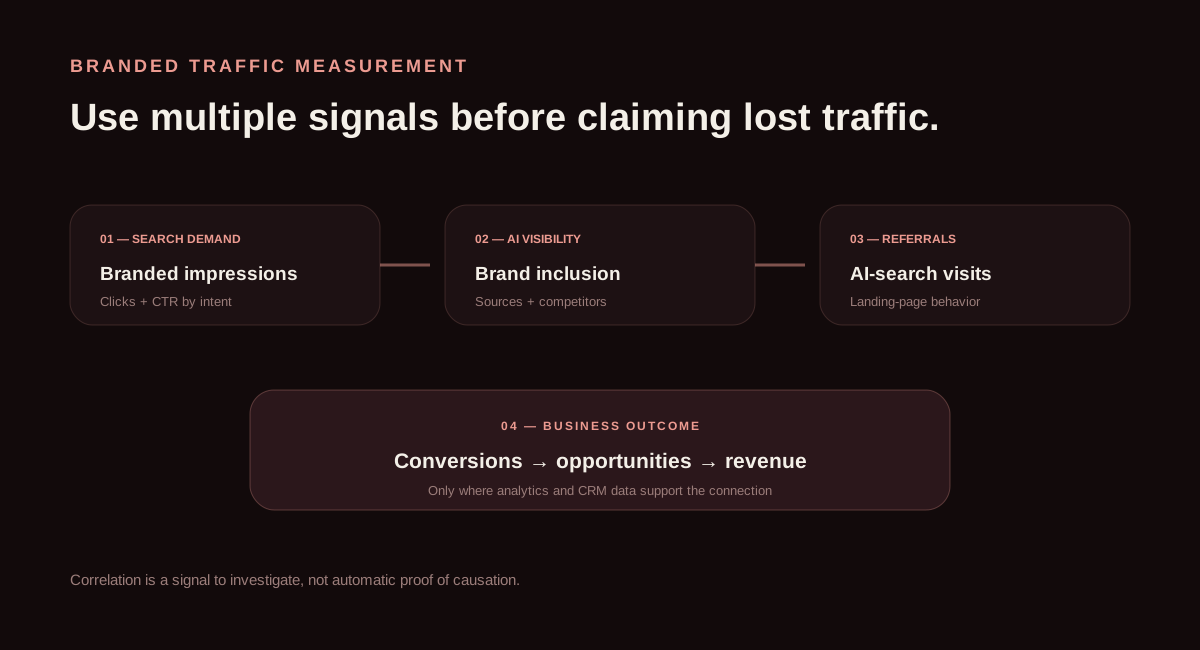
Branded query demand
Track impressions for core brand, product and high-intent branded query groups so you can distinguish demand changes from click changes.
Branded clicks and CTR
Monitor clicks and click-through rate by branded query type instead of combining every branded search into one number.
Generative visibility
Where available, use Search Console's generative-AI reporting alongside normal Web performance data to understand visibility inside Google's AI features.
Prompt-level presence
Test repeatable branded evaluation prompts and record how your company, competitors and source links appear.
AI referral traffic
Track identifiable referrals from answer-driven platforms when they send traffic to your site.
Landing-page behavior
Compare which pages AI-referred and conventional branded-search visitors enter through and what they do next.
Qualified conversion
Where analytics and CRM data support it, compare forms, booked calls, opportunities and other meaningful outcomes.
Google now gives site owners more AI-search visibility data
Google reports AI Overview and AI Mode activity as part of Search Console performance data.
Google also introduced dedicated generative-AI performance reporting to provide more specific visibility into impressions from its generative search features.
Where that dedicated reporting is available to your site, use it alongside branded query trends rather than replacing conventional Search Console analysis.
ChatGPT referral traffic gives you another observable signal
OpenAI says ChatGPT referral URLs automatically include utm_source=chatgpt.com.
That gives you a practical way to identify inbound traffic from ChatGPT search when a user actually follows a referral link.
It still does not reveal every time your brand was mentioned without a click, so referral analytics should be combined with prompt-level visibility testing.
Official OpenAI guidance
OpenAI — Publishers and Developers FAQ ↗How to protect high-intent branded demand
The goal is not to force every branded query to produce a website click.
The goal is to make sure that when a search system answers questions about your business, the available information is accurate, useful and commercially aligned.
Own the obvious branded questions
Make pricing approach, capabilities, use cases, integrations, limitations and other important decision information easy to find where appropriate.
Create strong evaluation pages
Give buyers useful comparison, alternatives and suitability information instead of forcing them to rely entirely on third parties.
Keep entity information consistent
Make the organization, products, services and expertise easy to identify across important pages and public profiles.
Strengthen third-party evidence
Build legitimate external coverage, reviews, partnerships and expert references where they naturally belong.
Monitor branded prompts
Test the high-intent questions buyers ask after they already know your brand, not only broad category prompts.
Fix factual gaps quickly
If repeated tests expose inaccurate descriptions or outdated information, identify which controlled and external sources need correction.
Entity consistency is especially important here. The Entity SEO and Knowledge Graph guide explains how to reduce ambiguity around the organization and its relationships.
Citation visibility matters more when the buyer already knows you
On a broad discovery query, simply being mentioned can be valuable.
On a branded evaluation query, the sources supporting the answer can influence trust.
If the system describes your product using a competitor's comparison page, an outdated review or incomplete documentation, the problem is not merely whether your homepage ranked.
Our guide to earning stronger citation visibility across ChatGPT, Perplexity and Google AI search covers that source layer in detail.
Build a branded prompt baseline
A useful baseline should reflect the questions someone asks after awareness but before purchase.
Brand description
What is Brand X and what does it do?
Suitability
Is Brand X a good option for [specific use case]?
Comparison
Brand X vs Brand Y for [specific buyer requirement].
Alternatives
What are the strongest alternatives to Brand X?
Limitations
What are the main limitations or tradeoffs of Brand X?
Commercial fit
How does Brand X pricing or commercial model work?
Implementation
Does Brand X work with [platform, workflow or requirement]?
Record the platform, date, answer, brand description, competitors and visible sources. Repeat the same set periodically rather than collecting only favorable screenshots.
What not to claim from the data
Do not call every CTR decline an AI Overview loss
Search behavior changes for many reasons. Use multiple signals before attributing a decline to generative search.
Do not treat referral traffic as total AI visibility
A brand can appear in an answer without generating a click, so referral data represents only observable downstream traffic.
Do not turn impressions directly into revenue
Revenue modeling requires real conversion, opportunity and deal-value data.
Do not assume one prompt represents the market
AI responses can vary. Use a defined prompt set and repeatable methodology.
Do not treat branded ranking as complete ownership
A strong organic position does not control every source or narrative used in a generated response.
Protect the decision journey
Find what AI search can see before your customer reaches your site.
Run Growthract against your website to identify SEO and AEO gaps across technical foundations, branded content, entity clarity and AI-search readiness.
AI summaries and branded traffic FAQs
What is high-intent branded search traffic?
It is branded search activity where the user is evaluating the company or product rather than simply trying to reach the homepage. Examples include branded reviews, comparisons, alternatives, pricing, integrations and suitability questions.
Do AI Overviews always reduce branded clicks?
No. AI features can provide information before a click, but a traffic change cannot automatically be attributed to an AI Overview. Measure query demand, clicks, AI visibility and other search-result changes together.
Can AI Mode use sources beyond the exact branded query?
Google documents query fan-out for AI Mode and AI Overviews, where multiple related searches can be issued across subtopics and data sources to develop a response.
Can Google AI-search visibility be measured in Search Console?
Google includes AI-feature activity in Search Console performance reporting and has also introduced dedicated generative-AI performance reporting for more specific visibility where available.
Can ChatGPT referral traffic be tracked?
Yes. OpenAI says ChatGPT referral URLs automatically include utm_source=chatgpt.com, allowing inbound referral traffic from ChatGPT search to be identified in analytics.
What should brands optimize for first?
Start with accurate branded information, strong evaluation content, clear entity relationships and credible supporting evidence. Then monitor the branded prompts that matter most to commercial decisions.
Continue exploring
Related insights
Case study
An illustrative strategy showing how a Series B fintech could aim to improve citation coverage from a modeled 10% baseline to a 34% target across a controlled set of high-intent ChatGPT and Perplexity prompts.
See the case study →
Insight
15 sourced statistics on AI Overviews, ChatGPT-driven B2B buyer research, and the shift from clicks to citations — each with a link to the original data and a note on how to read it.
Read the insight →
Insight
A #1 Google ranking does not guarantee your brand appears in AI Overviews, AI Mode, ChatGPT or Perplexity. Why the visibility paths differ, and what to measure next.
Read the insight →