Direct answer
Does ranking #1 on Google guarantee visibility in AI answers?
No. A strong traditional ranking can be valuable, but it does not guarantee that a brand will be mentioned, cited or recommended in an AI-generated answer. AI-search visibility should therefore be measured separately using relevant prompts, brand presence, cited sources, competitor visibility and referral data.
01
Traditional rankings and AI-answer visibility are different observations.
02
A page can rank well without the brand appearing in a generated answer.
03
Track prompts, mentions, citations and referrals alongside rankings.
Ranking first on Google is still valuable. It can create visibility, traffic and commercial opportunity.
But a #1 organic position does not automatically mean your brand will appear inside an AI Overview, Google AI Mode response, ChatGPT answer or Perplexity result.
That is because modern search visibility is no longer one ranking system producing one ordered list. Different systems can retrieve different sources, expand the question differently and assemble different responses.
The important distinction
A Google ranking tells you how a page performs in a particular search context. AI visibility asks a different question: when an answer is generated, does your brand or content become part of that answer or its supporting sources?
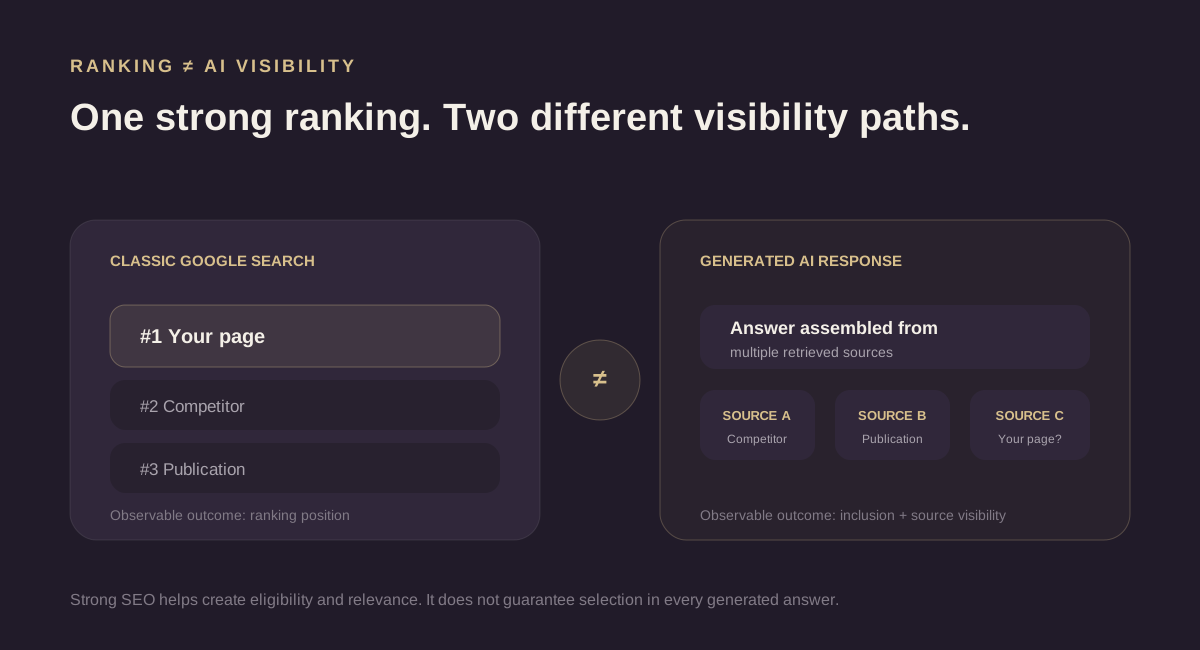
Ranking #1 and being visible in AI search are different outcomes
Conventional organic search gives marketers a familiar measurement model: enter a query, observe where a page appears and track how that position changes.
AI-search experiences can behave differently. A response may combine information from multiple sources, run related searches behind the scenes, surface a different set of links or answer the question without preserving the same ordering as a conventional results page.
Google AI search may expand one question into many searches
Google documents a technique called query fan-out for AI Mode and AI Overviews.
Instead of relying only on the exact question entered by the user, Google's systems may issue multiple related searches across subtopics and data sources to develop the response.
Why this matters
Your page could rank extremely well for the original keyword while another source is more relevant to one of the related questions used to construct the AI response.
Google also says AI Overviews and AI Mode can use different models and techniques, so the responses and supporting links they show can vary.
Official Google guidance
Google Search Central — AI features and your website ↗This does not mean SEO stopped mattering
The wrong conclusion is that rankings no longer matter because AI answers exist.
Google explicitly says its generative AI features are rooted in its core Search ranking and quality systems and that established SEO best practices remain relevant.
For a page to be eligible as a supporting link in Google's AI features, Google says it must be indexed and eligible to appear in Search with a snippet.
Technical access still matters
Googlebot must be able to access important public content and the page needs to satisfy normal Search eligibility requirements.
Useful content still matters
Pages still need to provide relevant, reliable and genuinely useful information.
Internal discovery still matters
Important pages should remain easy for users and search systems to find through meaningful internal links.
Search quality still matters
Generative interfaces do not remove the need for strong search-engine foundations.
This is why the useful framework is not SEO versus AI search. Our SEO vs. AEO vs. GEO guide explains how the three visibility lenses fit together.
6 reasons a #1 ranking may not translate into AI visibility
The AI system may be answering a broader question
Does your page satisfy the full information need?
A keyword ranking often represents one explicit query. A conversational AI prompt can combine multiple needs at once: comparison, suitability, tradeoffs, recommendations and supporting evidence.
A page optimized for one narrow query may not contain enough information to support the broader answer.
Related searches may retrieve different sources
Are you relevant to the subtopics behind the answer?
Google's documented query fan-out behavior means the system can search related subtopics instead of treating the original prompt as one conventional keyword.
Ranking first for the head query does not automatically make the same page the best source for every supporting sub-question.
Your answer may be buried inside the page
Can the useful passage be understood quickly?
A page can rank well because it is broadly authoritative and relevant while still making a specific answer difficult to retrieve.
Clear headings, direct explanations and passages that retain meaning outside their surrounding copy improve answer readiness.
This is one of the core principles in our Answer Engine Optimization guide.
The brand entity may be unclear
Can the system confidently identify who or what the page represents?
Ranking a page does not automatically solve ambiguity around the company, product, people, category or expertise behind it.
If important business facts are inconsistent or relationships are unclear, the page can perform in organic search while the broader entity remains difficult to represent accurately.
Other sources may provide stronger supporting evidence
What evidence exists beyond your own claim?
AI-search responses can surface multiple supporting sources. Independent publications, documentation, primary research, communities and other credible references may provide useful evidence around the same question.
That is why AI search visibility depends on more than your website.
Another platform may use an entirely different discovery system
Are you measuring only Google rankings?
A Google ranking does not describe how ChatGPT or Perplexity will discover and retrieve public web content.
OpenAI documents OAI-SearchBot for ChatGPT search, while Perplexity documents PerplexityBot for surfacing and linking websites in its search experience.
Strong Google visibility can be useful evidence that your site has solid search foundations, but it should not be used as a proxy measurement for visibility across unrelated AI-search systems.
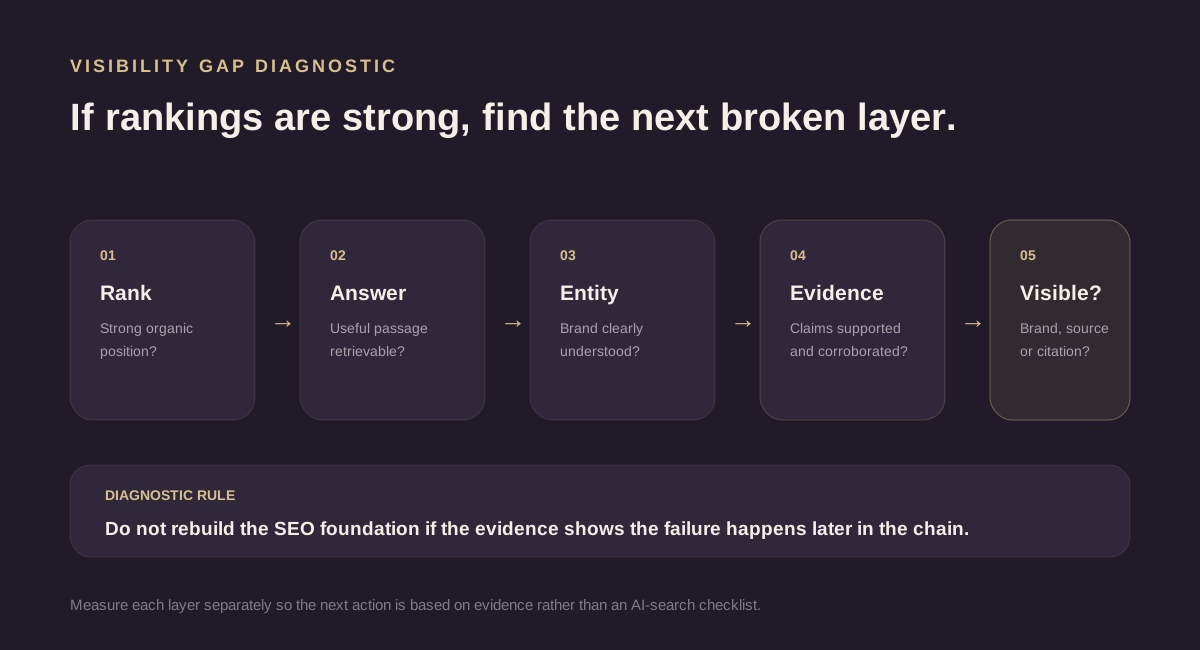
Diagnose the gap between ranking and AI visibility
If you already rank strongly, do not start by rewriting everything. First identify where the visibility chain breaks.
Ranks well, never mentioned
Test entity clarity, prompt relevance and whether competitors provide stronger supporting information for the same buyer questions.
Mentioned, not cited
Inspect which supporting sources the system selects and whether your page contains uniquely useful evidence worth linking.
Cited for some prompts
Map the prompts where the page succeeds and compare their information needs with prompts where the site disappears.
Wrong brand description
Audit company, product, category and expertise consistency across the site and important external sources.
Competitors dominate
Identify which competitors appear, which sources reinforce them and what information or evidence your ecosystem lacks.
AI referral traffic exists
Connect identifiable AI-search traffic to landing pages, conversions and business outcomes rather than stopping at sessions.
Ranking strength and citation strength are not identical
A page can deserve a strong organic ranking because it performs well across relevance, quality and other search signals while another page contains the specific passage or evidence selected to support a generated answer.
This does not make the lower-ranking source "better" in every sense. It means the generated response has a different retrieval and presentation task.
If citations are strategically important, our guide on getting your brand cited across ChatGPT, Perplexity and Google AI search covers the access, answer, entity and evidence layers in detail.
Measure rankings and AI visibility separately
If two outcomes are different, they should not share one proxy metric.
Traditional search
Keyword rankings
Search impressions
Organic clicks
Landing-page traffic
Organic conversions
AI search
Priority prompts tested
Observed brand inclusion
Competitor inclusion
Visible citations or sources
Identifiable AI referral traffic
Our AI-search visibility measurement framework shows how to build a repeatable baseline without inventing a mystery score.
What to optimize when you already rank well
If the SEO foundation is already strong, the next improvements should address evidence uncovered by your AI-visibility tests.
Broaden question coverage
Identify commercially important questions that the ranking page does not yet answer clearly.
Improve passage clarity
Make definitions, comparisons, claims and recommendations understandable without requiring unnecessary surrounding copy.
Strengthen entity context
Make company, product, service, expert and category relationships explicit and consistent.
Add real evidence
Use original data, methodology, examples, primary references or expert analysis when you genuinely have them.
Build corroboration
Earn legitimate third-party references and participate meaningfully in the sources relevant to the market.
Retest
Repeat the same prompt set after meaningful changes and compare observations rather than relying on anecdotes.
The 15-Point AEO Checklist gives you a structured way to inspect those layers.
Why a normal ranking report can miss the problem
A conventional SEO report can show that the site is performing extremely well while saying nothing about whether the brand appears in generated answers.
That is not a failure of SEO measurement. It is simply a different measurement question.
The same distinction applies to audits. Traditional SEO audits can miss AI-search signals when they stop at indexation, relevance, rankings, links and traffic without evaluating answer readiness, entity clarity, source visibility or prompt-level presence.
What the platforms actually say
Google says SEO best practices remain relevant for AI Overviews and AI Mode. It also documents query fan-out and says the set of responses and links can vary between its AI experiences.
Google Search Central — AI features and your website ↗Google Search Central — Optimizing for generative AI features ↗OpenAI
OpenAI says any public website can appear in ChatGPT search and recommends allowing OAI-SearchBot when publishers want content discoverable, surfaced, cited and linked.
OpenAI — Publishers and Developers FAQ ↗Perplexity
Perplexity describes PerplexityBot as a crawler designed to surface and link websites in its search results and recommends allowing it when a site wants to appear.
Perplexity — Crawler documentation ↗The new goal is not to stop ranking. It is to expand visibility.
Businesses should still compete for valuable Google rankings. Organic visibility can continue to produce qualified demand.
The change is that rankings now sit inside a broader visibility system.
Rank where traditional search matters
Continue improving technical SEO, relevance, useful content, authority and organic conversion.
Understand the questions behind the keyword
Map comparisons, evaluation criteria, risks, use cases and related questions that an AI response may need to resolve.
Make answers retrievable
Create clear sections that answer important questions without burying the useful information.
Strengthen the entity and evidence
Make the business easier to identify and support important claims with legitimate evidence and corroboration.
Measure AI visibility directly
Track brand inclusion, competitors, visible sources, citations and identifiable referral traffic alongside rankings.
Look beyond the ranking
Find the visibility gaps your rankings cannot show you.
Run Growthract against your website to identify SEO and AEO opportunities and see where technical, content, entity and answer-readiness issues deserve attention.
Google rankings and AI visibility FAQs
Does ranking #1 on Google guarantee an AI Overview citation?
No. Strong Google rankings are valuable, but Google says its AI features can use query fan-out, multiple supporting pages and different models and techniques. Search eligibility does not guarantee that a particular page will be shown as a supporting link.
Does SEO still matter for Google AI Overviews and AI Mode?
Yes. Google explicitly says established SEO best practices remain relevant and that its generative AI features use core Search ranking and quality systems.
Why can a lower-ranking page appear in an AI response?
Generated answers can have a different information need from the original keyword. Related searches, specific passages and supporting evidence can make another source relevant to part of the response.
Does a strong Google ranking guarantee ChatGPT visibility?
No. ChatGPT search has its own documented discovery mechanisms, including OAI-SearchBot. Google rankings should not be used as a proxy measurement for visibility on a different platform.
How should AI visibility be measured?
Use a stable set of commercially relevant prompts and record brand inclusion, competitors, visible sources, citations and identifiable referral traffic. Keep those measurements alongside conventional ranking and organic-performance data.
Should businesses stop focusing on rankings?
No. The goal is to expand the measurement model, not abandon rankings. Strong SEO remains a foundation for search visibility while AI-search measurement covers additional discovery and answer surfaces.
Continue exploring
Related insights
Case study
How a B2B company could benchmark competitor citation visibility in Perplexity, identify the sources and topics shaping AI answers, and build a focused strategy for earning greater citation share.
See the case study →
Insight
SEO, AEO, GEO and AI SEO overlap, but they describe different parts of modern search visibility. What each term means, where they differ, where AI SEO fits, and how to build one practical strategy across Google and AI search.
Read the insight →
Insight
A practical framework for improving your chances of being discovered, understood, sourced and cited across ChatGPT, Perplexity and Google AI search without relying on fake citation hacks.
Read the insight →