Direct answer
If an AI visibility check fails to return a result, does that mean the AI system didn't mention my company?
No. A failed or incomplete AI visibility check is a different outcome from a check that ran successfully and found no mention. Treating the two as the same thing turns a technical failure into a false conclusion about your brand.
01
An AI visibility observation can end in one of three states: it ran with retrieval support, it ran without it, or it didn't complete at all.
02
Only the first two states tell you anything about what an AI system actually said.
03
A tool that quietly treats every failure as 'not mentioned' will eventually convince you of things that aren't true.
Say you run a test to see whether ChatGPT mentions your company when someone asks about your category. The test comes back empty. What do you actually know?
Less than you'd think. An empty result can mean the AI system genuinely didn't mention you. It can also mean the request never properly completed — a timeout, a provider outage, a search-grounding layer that didn't kick in. Those are very different findings, and most tools don't bother telling you which one happened.
Two very different failures that look identical
Imagine you ask a friend to check whether your restaurant is mentioned on a food blog. They come back and say "no." You'd probably ask a follow-up: did you actually read the blog, or did your phone die before you opened it? The answer changes what you do next. If they read it and your name wasn't there, you have real information. If their phone died, you have nothing — you just haven't checked yet.
AI visibility testing has the same problem, except the failure mode is quieter. A request to an AI system can fail for reasons that have nothing to do with your brand: the provider is rate-limited, a search-grounding layer didn't activate, the response timed out. If a tool doesn't distinguish that from a clean, completed answer that simply doesn't mention you, it's reporting a coin flip as a fact.
Why this needs three states, not two
A binary mentioned-or-not model breaks down the moment a request fails partway through. Growthract's AI visibility observations are recorded in one of three states instead: grounded, ungrounded, or unavailable.
A grounded observation means the request ran with a live, search-backed retrieval layer and returned an answer based on information the system actually looked up. An ungrounded observation means a usable answer came back, but without confirmation that a retrieval or search layer was involved — still a real response, just a weaker evidentiary basis for claims about what the system "knows" versus what it retrieved. Unavailable means the observation didn't complete at all. No answer, no evidence, nothing to interpret.
Only the first two states tell you anything about whether your brand showed up. The third tells you the test didn't run — full stop.
Why this distinction changes what you do next
If you're a marketer looking at a dashboard that says "not mentioned in ChatGPT," the natural response is to start rewriting content, adding schema, chasing citations — treating it as a content or entity problem. But if that result was actually an unavailable observation mislabeled as a clean miss, you'd be solving a problem that hasn't been diagnosed yet. You might fix nothing that was actually broken, or worse, convince a team that a real gap doesn't exist because the one test they saw happened to come back "fine."
This is also why a single test run, on its own, should never be treated as a verdict. Assistants can behave differently across sessions, and grounding availability can vary by provider and by moment. A pattern that holds across repeated, correctly-labeled observations is worth acting on. One ambiguous result is not.
What to ask any AI visibility tool you're evaluating
Before you trust a "not mentioned" result from any product — Growthract included — it's worth asking a direct question: when a request to an AI provider fails, what does your report show? If the honest answer is "it looks the same as a real miss," treat every negative finding from that tool with real skepticism.
This same principle — that a failure to observe something is not the same as observing its absence — shows up elsewhere in how we think about evidence. It applies just as much to a crawler that fails to load a page as it does to an AI assistant that fails to answer a prompt.
It's also part of why we separate real observed answers — whether retrieval-backed or captured from an actual assistant session — from simulated ones, which is a distinction worth understanding on its own. That's covered in Simulated AI Answers vs. Real Ones.
See the evidence, not a guess
Growthract labels every AI visibility observation by its actual evidence state.
A grounded answer, an ungrounded one, and an unavailable observation are reported as what they are — not flattened into a single yes-or-no result.
A couple of follow-up questions
Is an ungrounded answer still useful?
It can be, as one data point, but it carries less weight than a grounded, retrieval-backed answer. It tells you what the system produced, without confirming that a live lookup informed it.
How often do these tests come back unavailable?
It varies by provider and by moment, which is exactly why the state needs to be recorded rather than assumed. A single unavailable result isn't unusual; what matters is that it's never quietly counted as a miss.
Continue exploring
Related insights
Case study
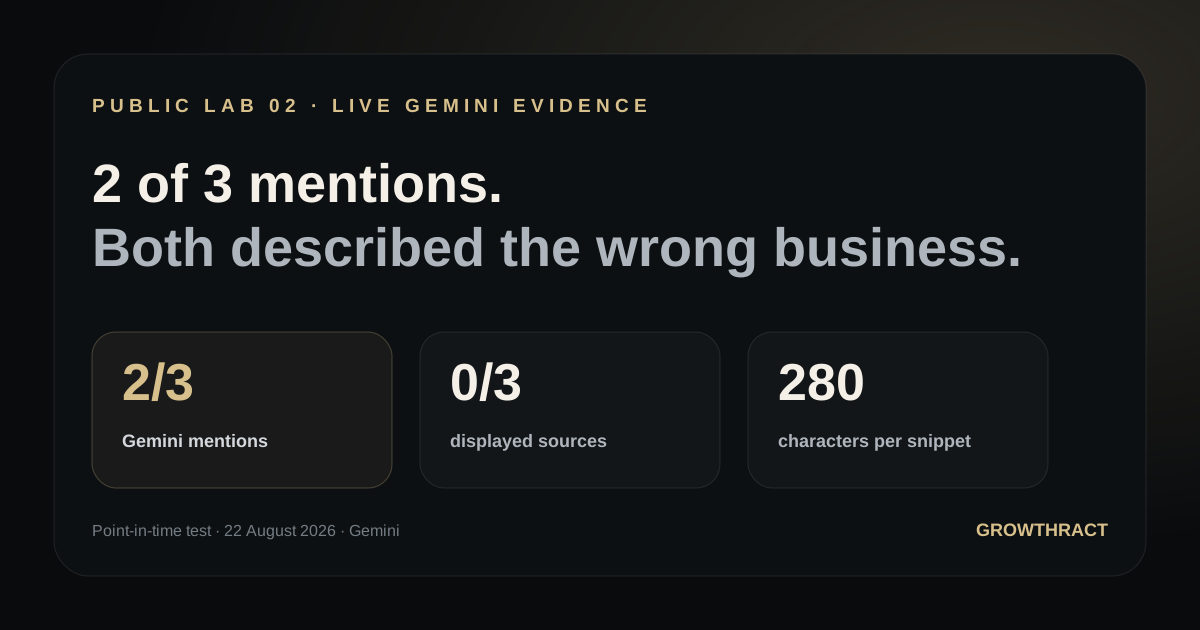
A point-in-time Gemini visibility test produced two Growthract mentions across three prompts — but both mention-containing responses materially mischaracterized the business. This Public Lab shows why mention rate and answer accuracy need to be measured separately.
See the case study →
Insight
Not every 'AI visibility test' is asking a real AI system anything. Here's how to tell simulation apart from an actual observed answer, and why the difference should change how much you trust the result.
Read the insight →
Insight
A copy-paste set of ChatGPT and Perplexity prompts you can run today to see whether — and how — your SaaS shows up when AI assistants answer category, comparison and vendor questions.
Read the insight →