Direct answer
Is there a faster way to understand a long SEO or AEO audit report than reading the whole thing?
Yes — asking direct, natural-language questions about your own report's evidence, rather than reading every section to find the one answer you need. Growthract's Ask Growthract layer answers from the evidence already collected for your website, distinguishing question types like status, why, fix, changed and verified, rather than generating freeform, unsupported analysis.
01
A long audit report and a usable one aren't the same thing — length doesn't make a report more actionable.
02
Answering from your own report's evidence is a different, more trustworthy design than a generic AI chat bolted onto a dashboard.
03
Some questions are genuinely unsupported by the available evidence, and a well-built system should say so rather than guessing.
Nobody actually reads a 60-page audit report front to back. They skim for their name, their page, their one urgent question, and close the tab.
That's not a discipline problem. A long technical report is genuinely hard to navigate when what you actually want is one specific answer: what should I fix first? Why is this flagged as a problem? Has this been fixed since last time? A table of contents doesn't really solve that — it just organizes the same wall of information slightly better.
Asking instead of searching
Ask Growthract is the layer that lets you ask a direct question about your own report and get an answer, instead of hunting through it yourself. "What should I fix first?" "Why is this a problem?" "Which pages have this issue?" "When was this checked?" "What evidence do you have?" "What changed?" "Has this been fixed?" — these are the kinds of things a person actually wants to know, and they're the kinds of things the system is designed to answer directly.
The distinction that matters here isn't the conversational interface itself — plenty of tools have bolted a chat window onto a dashboard. It's what the answers are built from.
Why answering from evidence, not invention, is the whole point
A generic AI chatbot asked "why is this a problem" will confidently generate a plausible-sounding explanation whether or not it actually has the evidence to back it up. That's fine for brainstorming. It's a real liability when the question is about a specific finding on a specific website, because a fluent, wrong answer is worse than no answer at all — it looks exactly as trustworthy as a correct one.
Ask Growthract is built to answer from the evidence already collected for your own website and report, rather than freely inventing analysis. It recognizes different kinds of questions — status, why, fix, what changed, whether something was verified, what evidence exists — and answers each from what's actually there. Where the underlying evidence supports it, it can reason at the level of a specific page rather than the whole domain, which matters for the same reasons covered in Why One SEO Score for Your Whole Website Doesn't Tell You Much.
What happens when a question can't be answered from the evidence
Some questions are simply outside what a report's evidence supports — a question about a page that was never scanned, or about a claim the underlying data doesn't cover. A system that answers deterministically has to be willing to say so, rather than generating a confident-sounding guess to fill the gap. That's a less satisfying answer in the moment, and it's the honest one.
This is the same underlying discipline that shows up in how a verification check works — a "has this been fixed" question is only answerable if the evidence has actually been re-checked, not just because someone marked a ticket as done. More on that in You Fixed the SEO Issue. Did Anyone Check It Actually Got Fixed?.
Stop scrolling, start asking
Ask your own Growthract report a direct question.
Run a free audit, then ask what should be fixed first, why it matters, and which pages are affected — answered from your actual evidence.
A couple of follow-up questions
Can I ask it anything, or just about specific findings?
It's designed around your own website's evidence and report — status, causes, fixes, changes, verification. Questions outside that scope are treated as unsupported rather than answered with a guess.
Does it replace reading the report entirely?
It's meant to make the report usable without reading it end to end — the underlying evidence is still there if you want to go deeper on any specific finding.
Continue exploring
Related insights
Case study
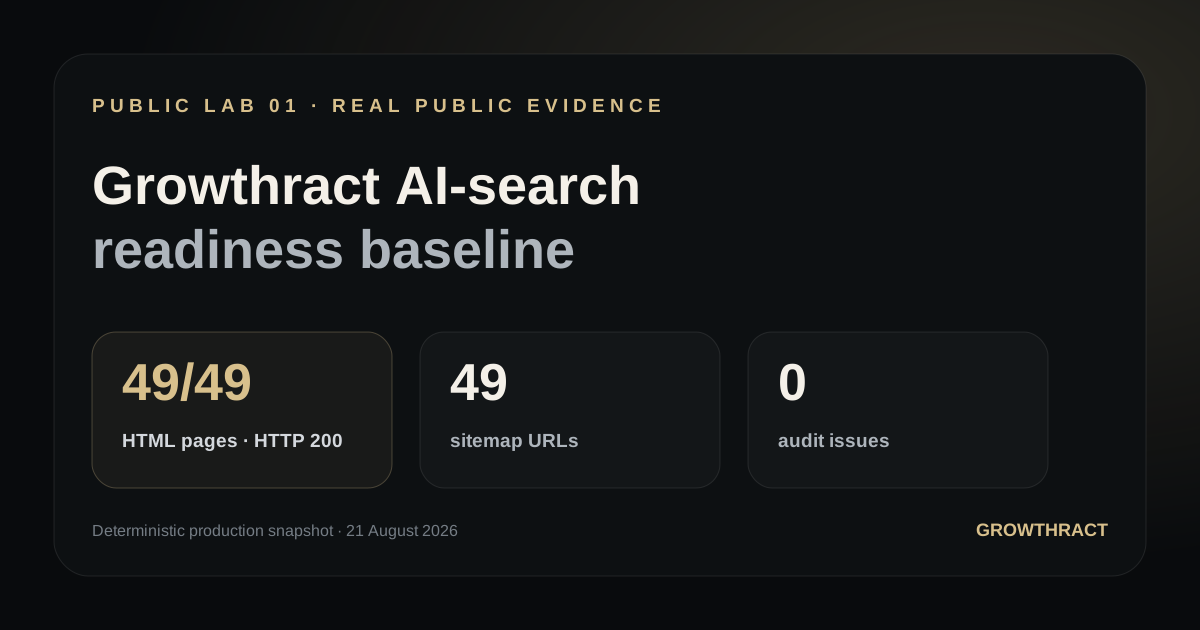
A public technical audit of growthract.com covering 49 production HTML pages, crawler access, robots.txt, sitemap integrity and legacy routes — with the limits of the evidence stated explicitly.
See the case study →
Insight
A scan, a finding, a recommendation, a fix, a verification check — most audit tools stop partway through that chain. Here's what it looks like when all the steps are actually connected.
Read the insight →
Insight
A copy-paste set of ChatGPT and Perplexity prompts you can run today to see whether — and how — your SaaS shows up when AI assistants answer category, comparison and vendor questions.
Read the insight →