If a buyer asks an AI system for companies, products, approaches or resources in your category and your business never appears, there is a visibility gap.
The difficult part is putting a value on that gap. There is no universal report showing exactly how much revenue you lost because an AI-generated answer mentioned several competitors and not you.
That does not make the problem immeasurable. It means you need to measure observable parts of the journey instead of inventing a single "AI visibility score."
The principle
Measure what you can observe: which prompts matter, whether your brand appears, who appears instead, which sources are surfaced, what identifiable referral traffic reaches your site and what those visitors do next.
What does being invisible to AI search actually mean?
AI-search invisibility is not one binary condition. A company can be visible for one type of question and absent for another.
An AI system may know your company exists when someone asks about the brand directly while still failing to surface it when a buyer asks about relevant providers, tools, alternatives or approaches.
Branded visibility
Can the system accurately describe your company when someone asks about it directly?
Category visibility
Does the brand appear when someone asks about the category you compete in?
Problem visibility
Does the business appear when a buyer describes the problem you solve without naming your category?
Comparison visibility
Is the brand considered when buyers compare providers, approaches or alternatives?
This is why AI search visibility depends on more than your website. Your site is part of the system, but the broader question is whether your business becomes part of the information environment surrounding the decisions your customers are making.
The real cost is missing from consideration
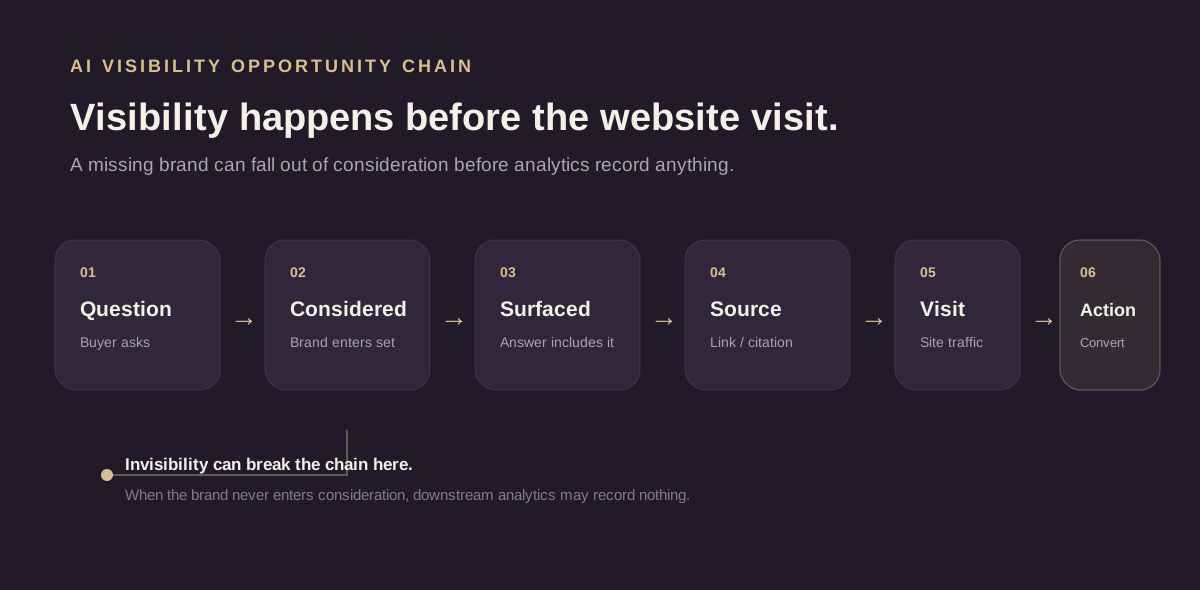
The easiest mistake is reducing AI visibility to referral traffic. Traffic matters, but the visibility event happens earlier.
An answer can influence which companies a buyer knows about, which sources they investigate and which alternatives they consider before anyone reaches your website.
The consideration gap
If relevant competitors repeatedly appear and your business does not, those competitors receive opportunities to enter the buyer's consideration set earlier.
You cannot assume every appearance creates revenue. You can measure whether competitors are receiving exposure in situations where your company is absent.
The narrative gap
Visibility is not just whether your name appears. It is also how the business is represented.
If competitors are associated with the qualities your market values while your own position is misunderstood or omitted, the problem is deeper than one missed citation.
The source gap
When an interface exposes supporting sources, repeated citations can show which websites and information environments shape the answer.
If your useful content and credible references are absent from those environments, that gives you something concrete to investigate.
The traffic gap
When an AI-search experience provides an outbound path, visibility can become measurable referral traffic.
Referral sessions are useful downstream evidence, but they should not be treated as the complete measure of AI-search visibility.
The measurement gap
Without a baseline, you cannot tell whether your visibility is improving or whether competitors are becoming more prominent around commercially important questions.
The first cost of having no measurement system is simply not knowing where the gap exists.
Do not invent a "lost AI revenue" number
It is tempting to turn a visibility gap directly into a dramatic revenue estimate. In most cases, that requires assumptions that the available data cannot support.
A defensible revenue model would need evidence for questions like:
How many relevant buyers actually use the AI experience being tested?
How often do they ask questions represented by your prompt set?
How much does brand inclusion influence their next action?
How often does that exposure produce an identifiable visit or interaction?
What percentage of those interactions become qualified opportunities?
What is the actual economic value of those opportunities?
If you have reliable inputs for those stages, build a business-specific model. If you do not, report the observed visibility gap instead of disguising assumptions as revenue.
A practical framework for measuring AI-search visibility
Start with a stable measurement system rather than a score. The goal is to collect evidence you can compare over time.
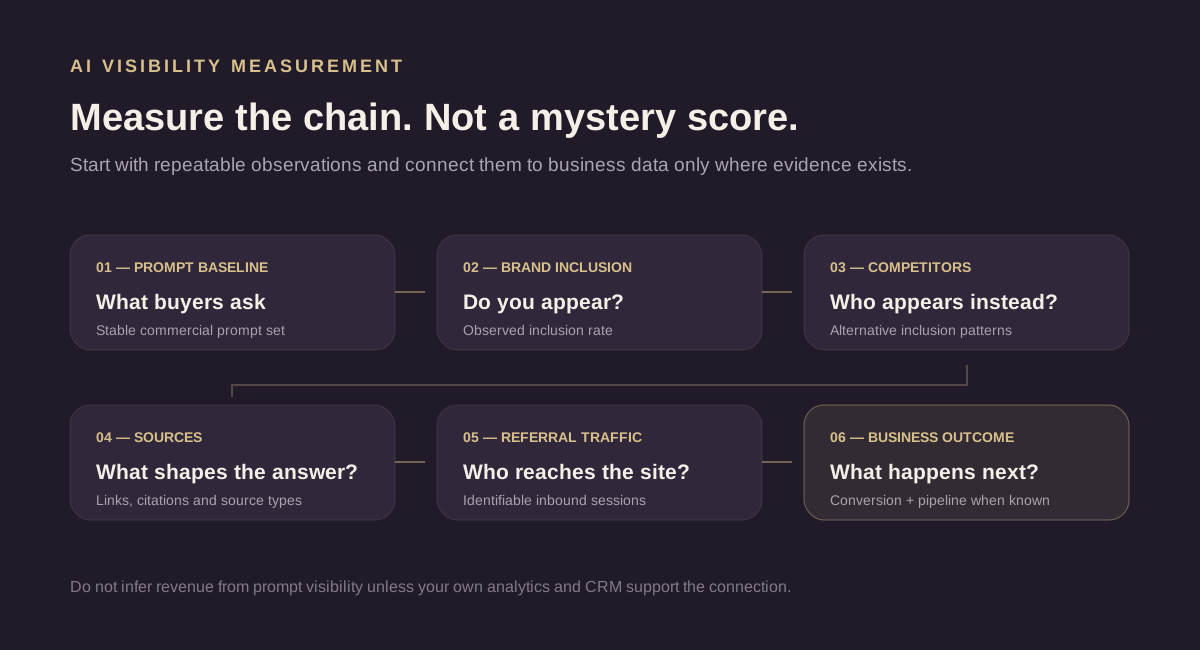
Priority prompt coverage
Ask: Which buyer questions are important enough to monitor?
Track: A stable set of category, problem, comparison, recommendation, evaluation and branded prompts.
Brand inclusion
Ask: How often does your business appear in the defined prompt set?
Track: Prompts where the brand appears divided by the total prompts tested in that baseline.
Competitor inclusion
Ask: Which alternatives appear when your business does not?
Track: Observed competitor appearances across the same stable prompt set.
Source visibility
Ask: Which domains or pages are visibly used as supporting sources?
Track: Repeated sources, source types and whether your own pages or relevant third-party references appear.
Referral traffic
Ask: Does identifiable AI-search traffic reach your website?
Track: Sessions and landing pages attributable to identifiable AI-search referral sources.
Business outcome
Ask: What do identifiable visitors do after reaching the site?
Track: Qualified conversions, booked conversations and pipeline where your analytics and CRM can support the attribution.
Step 1: build a buyer-oriented prompt baseline
A measurement system is only useful when the prompts represent real commercial questions.
Do not create hundreds of tiny prompt variations simply to manufacture a large dataset. Start with a smaller set representing distinct buyer decisions.
Category
Questions asking which companies, products or services belong in your category.
Problem
Questions describing the problem without explicitly naming your solution category.
Comparison
Questions comparing approaches, providers, products or alternatives.
Recommendation
Questions asking what someone should choose for a defined use case.
Evaluation
Questions about requirements, tradeoffs, implementation or suitability.
Branded
Questions directly asking about your company, product or expertise.
If you need a structured process for reviewing the site first, use the DIY AEO audit guide.
Step 2: measure observed brand inclusion
One useful baseline metric is the share of your defined prompts where the brand appears.
Observed brand inclusion rate
Prompts where your brand appeared ÷ prompts tested
This is not universal market share. It describes only the prompt set, platform and test period you defined.
AI responses can vary, so treat individual outputs as observations. The value comes from repeating a consistent methodology over time.
Step 3: measure who appears instead
Your own inclusion rate becomes more useful when competitor appearances are recorded alongside it.
Whether your brand appeared
Which competitors or alternatives appeared
How each company was described
Which sources were visibly surfaced
Whether important factual errors appeared
This helps distinguish a broad visibility problem from a narrower issue where certain competitors dominate specific buyer questions.
Step 4: inspect the sources shaping the answer
When an answer experience shows supporting links or citations, record them.
Look for repeated patterns. Are answers consistently supported by company websites, publications, documentation, communities, directories, review sites or comparison resources?
The source environment can expose visibility problems a conventional page-level audit does not reveal.
That is one of the gaps covered in Why Traditional SEO Audits Miss AI Search Signals.
Step 5: connect visibility to identifiable referral traffic
Once someone clicks through to your site, conventional analytics become more useful.
OpenAI says ChatGPT automatically includes utm_source=chatgpt.com in referral URLs, helping publishers identify inbound traffic from ChatGPT search results.
Google says appearances in AI features such as AI Overviews and AI Mode are included in overall Search Console search traffic. Google also introduced dedicated generative-AI performance reports in 2026 and initially rolled them out to a subset of websites.
Official measurement references
Track sessions, landing pages, engagement and conversions when the source is identifiable. Do not assume every AI-influenced journey will produce a clean referral signal.
Step 6: connect identifiable traffic to business outcomes
Once identifiable AI referral traffic reaches the site, evaluate it with the same commercial discipline you would apply to another acquisition source.
Landing-page engagement
Which pages do AI-referred visitors enter through, and do they continue into commercially relevant content?
Qualified conversions
Do identifiable visitors submit forms, request audits, book conversations or complete another meaningful action?
Lead quality
Where CRM data allows it, determine whether those conversions resemble the customers you actually want.
Pipeline influence
Where attribution is reliable, connect identifiable visits and conversions to opportunities instead of stopping at session counts.
This is where the cost of invisibility can start becoming commercially meaningful — but only when your analytics and CRM provide evidence for the connection.
What your AI-visibility baseline should record
You do not need a proprietary score to begin. A structured spreadsheet can establish a useful baseline when the inputs remain consistent.
Prompt
The exact buyer-oriented question tested.
Prompt type
Category, problem, comparison, recommendation, evaluation or branded.
Platform
The answer-driven search experience being tested.
Date
When the observation was collected.
Brand included?
Whether the brand appeared and enough context to understand the appearance.
Description
How the answer characterized the company, product or expertise.
Competitors
Which alternatives appeared in the same response.
Sources
Any links or citations visibly provided by the interface.
Accuracy issue
Any important factual error or misleading representation.
Next action
The specific entity, page, content or evidence issue worth investigating.
The 15-Point AEO Checklist gives you a practical diagnostic framework once the baseline exposes a weak area.
What should you fix after finding a visibility gap?
Measurement should lead to diagnosis, not random AI-search tactics.
Fix access problems
If important public content cannot be reliably discovered, solve the technical problem first.
Clarify the entity
If the company, products or services are described inconsistently, make the underlying business information clearer.
Improve the answers
If commercially important questions are poorly answered on your own site, improve those pages before chasing external mentions.
Strengthen evidence
If credible independent sources shape your category while your brand is absent, investigate legitimate ways to contribute expertise and earn relevant references.
Repeat the baseline
Run the same prompt set after meaningful changes so you can compare evidence rather than impressions.
Visibility and clicks are not the same measurement problem
A brand can become visible inside a generated answer without receiving a website visit. It can also receive occasional AI referral traffic while remaining absent from many commercially important questions.
Referral traffic tells you what happened after a clickable path existed. Prompt and source tracking help you understand the visibility environment before the click.
For the traffic-side risk specifically, see The Zero-Click Revenue Trap.
Establish your baseline
Find the visibility gaps worth investigating first.
Run Growthract against your website to surface SEO and AEO opportunities, organize the evidence and identify where technical, entity and content issues deserve attention.
AI-search visibility measurement FAQs
Can AI-search visibility be measured?
Yes, but no single metric captures the whole journey. Track a defined prompt set, brand inclusion, competitors, visible sources, identifiable referral traffic and downstream outcomes.
Is there one universal AI visibility score?
No universal score represents visibility across every AI-search experience. Tool-specific scores should be interpreted according to their documented methodology and inputs.
Can ChatGPT referral traffic be tracked?
OpenAI says referral URLs from ChatGPT search automatically include utm_source=chatgpt.com, allowing inbound traffic to be identified in analytics platforms.
Does Search Console report Google AI visibility?
Google says AI Overview and AI Mode appearances contribute to Search Console reporting. Dedicated generative-AI performance reports were also introduced in 2026 with an initial limited rollout.
Can I calculate how much revenue AI invisibility costs?
Only when you have reliable business data connecting visibility, traffic, conversion and opportunity value. Otherwise, report the observed visibility gap instead of fabricating a revenue figure.
Continue exploring
Related insights
Case study
An illustrative strategy showing how a Series B fintech could aim to improve citation coverage from a modeled 10% baseline to a 34% target across a controlled set of high-intent ChatGPT and Perplexity prompts.
See the case study →
Insight
A practical framework for improving your chances of being discovered, understood, sourced and cited across ChatGPT, Perplexity and Google AI search without relying on fake citation hacks.
Read the insight →
Insight
AI-generated answers can sit between a branded search and the website visit. Learn where high-intent branded journeys can change, how to measure the effect and how to protect visibility without inventing lost-revenue estimates.
Read the insight →