Direct answer
Why can a traditional SEO audit miss AI search problems?
Traditional SEO audits are usually designed around crawling, indexing, rankings and organic performance. Those checks remain important, but they may not evaluate prompt-level brand presence, answer accuracy, entity consistency, citation sources or whether important evidence is easy for AI-assisted search systems to retrieve and interpret.
01
Traditional technical SEO remains necessary.
02
AI visibility introduces additional measurement and entity questions.
03
Audit readiness and observed answer presence separately.
A traditional SEO audit can tell you whether your pages are crawlable, indexable, internally connected and reasonably optimized for search. Those checks still matter.
But they do not automatically tell you whether an answer engine can clearly identify your business, extract a useful answer from your content, find corroborating evidence elsewhere or surface your brand when a buyer asks a conversational question.
That is the gap between auditing for rankings and auditing for broader search visibility.
Important distinction
In this guide, "AI search signals" means observable conditions worth auditing. It does not mean these are confirmed ranking factors disclosed by every AI platform.
What traditional SEO audits still do extremely well
The problem is not that SEO audits are obsolete. The problem is expecting an audit built around conventional search results to answer every question created by answer-driven discovery.
Crawlability & indexation
Whether important pages can be discovered, rendered, canonicalized and indexed correctly.
Site architecture
Whether important pages are logically organized and supported by useful internal links.
Search intent
Whether each page serves a clear informational, commercial or navigational purpose.
Technical quality
Whether status codes, redirects, duplication and performance create unnecessary friction.
Content gaps
Whether useful pages exist for important topics and stages of the buying journey.
Authority
Whether external links and domain signals support the site's ability to compete organically.
Those foundations are also part of Answer Engine Optimization. AEO expands what you inspect rather than replacing the technical foundation.
Why the audit gap exists
Most established SEO audit frameworks were built around a familiar path:
Crawl → Index → Rank → Click
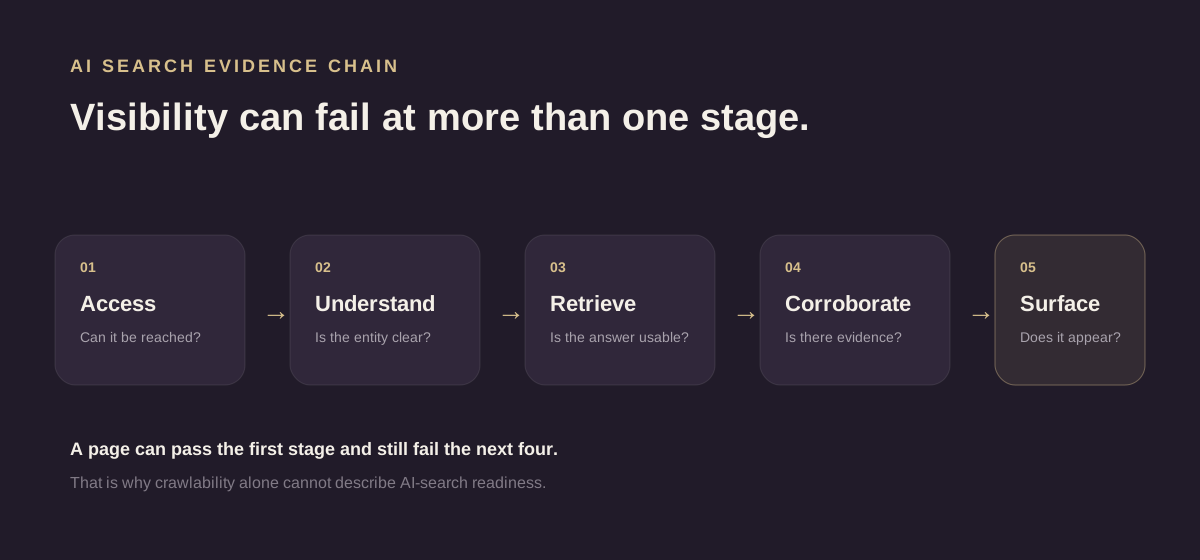
Answer-driven discovery introduces additional questions. Can the system understand the entity? Can it retrieve a useful passage? Does other evidence support the claim? Does the brand appear in the resulting answer?
Discover → Understand → Retrieve → Corroborate → Surface
Not every answer engine follows one identical sequence. The useful point for auditing is that visibility can involve more than obtaining a position on a conventional results page.
That broader environment is why AI search visibility depends on more than your website.
7 AI-search signals a traditional audit can miss
Strong SEO specialists may already inspect some of these areas. The problem is that they are not consistently represented in older or ranking-focused audit templates.
Entity clarity
Traditional audit asks
Is this page relevant to the intended keyword and topic?
Expanded audit asks
Can a system clearly determine what the business, product, service or person actually represents?
Keyword relevance does not automatically create entity clarity. A website can contain the correct terminology and still be vague about what the company does, who it serves or how its products relate to one another.
An expanded audit compares core descriptions across important pages and machine-readable business information to look for contradictions and ambiguity.
Answer readiness
Traditional audit asks
Does the page contain useful content about the target topic?
Expanded audit asks
Can an important answer be located quickly and still make sense when considered as a passage?
A page can be comprehensive while still burying the actual answer beneath long introductions or vague marketing copy.
Definitions, comparisons, recommendations and factual explanations should be clear enough to remain useful when the relevant section is encountered on its own.
Third-party corroboration
Traditional audit asks
Does the domain have backlinks and sufficient authority?
Expanded audit asks
Which independent sources reinforce the facts, expertise and associations the business claims?
Link analysis and corroboration overlap, but they are not the same exercise.
An AI-search audit asks what the wider web says about the entity and whether important external sources consistently reinforce or contradict the business information on the website.
Source visibility
Traditional audit asks
Which pages and domains rank for the target queries?
Expanded audit asks
Which sources repeatedly appear around the questions buyers ask in answer-driven search?
Ranking competitors are only part of the environment. Generated answers may surface publications, product documentation, communities, directories, comparison resources or other source types.
Studying those sources helps reveal the evidence environment around a topic.
Crawler-policy intent
Traditional audit asks
Is robots.txt blocking Google or other important search crawlers?
Expanded audit asks
Do crawler directives match which public discovery systems the business actually wants accessing its content?
The point is not to allow every crawler automatically. The point is to make access an intentional decision rather than relying on an inherited robots configuration nobody has reviewed.
Prompt-level visibility
Traditional audit asks
Where does the site rank for the tracked keyword set?
Expanded audit asks
Does the business appear when buyers ask realistic category, comparison and recommendation questions?
Conversational discovery does not always map cleanly to one keyword and one ranking position.
Build a repeatable prompt set and record whether the brand appears, how it is described, which alternatives appear and which sources are surfaced when available.
The DIY AEO audit guide gives you a manual workflow for doing this.
Cross-source consistency
Traditional audit asks
Is the individual page technically sound and appropriately optimized?
Expanded audit asks
Do the website and important external sources agree about the business facts that matter?
A technically strong page can still exist inside a confused entity footprint.
Company descriptions, product names, categories and other important facts should not create avoidable contradictions across major public sources.
Think in terms of an evidence chain
One useful way to expand an SEO audit is to stop treating visibility as a single page-level event.
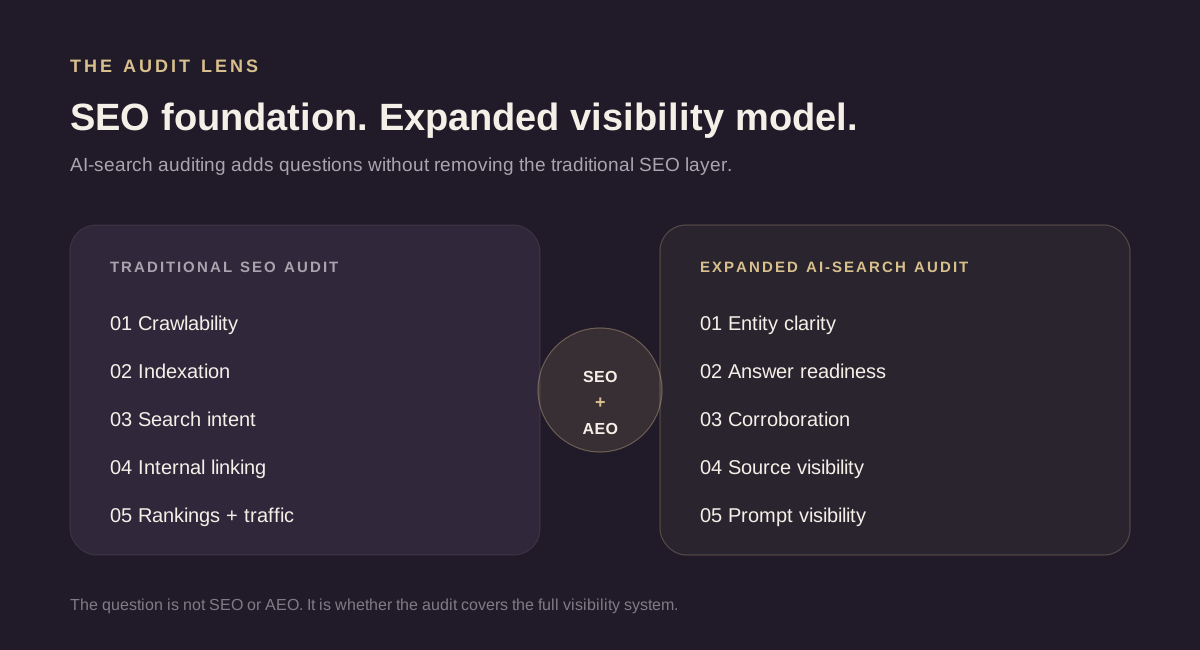
Traditional SEO audit vs. expanded AI-search audit
The expanded model does not remove traditional SEO checks. It adds another layer of questions.
How to upgrade an existing SEO audit
You do not need to throw away your existing SEO process. Add a second layer after the technical and conventional search foundations are understood.
Keep the technical foundation
Do not skip crawlability, indexation, canonicalization, internal linking, architecture or page quality.
Add entity-consistency checks
Compare important pages and structured business information for unclear or contradictory facts.
Audit answers, not just topics
Identify the questions each important page should answer and check whether those answers are direct and understandable.
Map external evidence
Identify the publications, communities, documentation and other sources shaping understanding around your category.
Build a repeatable visibility baseline
Use a stable set of buyer-oriented prompts and compare the same observations after meaningful changes.
Use the 15-Point AEO Checklist as a practical reference for that expanded audit layer.
Do not replace an old checklist with a fake AI score
Adding AI-search checks only helps when the findings are transparent. Separate evidence from assumptions.
Useful finding
The company is described differently across the homepage, service page and structured business information.
Weak finding
Entity optimization score: 62/100 — without a transparent reason for how that number was produced.
Useful finding
The brand appeared in 2 of the 10 defined buyer prompts tested on this date.
Weak finding
AI visibility is poor — without recording the prompts, platform, result or evidence.
This distinction matters because SEO and AEO solve related but different visibility problems. Expanding the audit should create better evidence, not more invented metrics.
Look beyond the traditional audit
Find the SEO and AEO gaps your current audit may be missing.
Run Growthract against your website to surface technical, structural, content and AI-search opportunities and turn them into a clearer set of priorities.
SEO audit and AI-search FAQs
Are traditional SEO audits obsolete?
No. Technical SEO, crawlability, indexation, search intent, content quality and internal linking remain important foundations. The opportunity is to expand the audit rather than replace it.
What does an AEO audit add?
It can add checks around entity clarity, answer structure, external corroboration, source visibility, crawler-policy intent and repeatable prompt-level visibility.
Are AI-search signals confirmed ranking factors?
Not necessarily. In this framework, a signal is an observable condition worth inspecting, not a claim that every answer engine uses it as a formally disclosed ranking factor.
Can strong Google rankings guarantee AI visibility?
No. Traditional search performance can provide useful foundations, but AI-search visibility should be measured directly rather than inferred from rankings alone.
Continue exploring
Related insights
Case study
Technical SEO, content architecture, search intent and entity clarity, connected into one search visibility system across Google and AI-powered search — an illustrative walkthrough for a B2B SaaS company.
See the case study →
Insight
The 15 technical checks worth adding to a standard SEO audit now that ChatGPT, Perplexity and Google's AI Overviews are reading — and sometimes citing — your website.
Read the insight →
Insight
Traditional SEO tooling was never built to test whether ChatGPT mentions your brand, or to tell a real observation apart from a simulated one. Here's the actual case for a dedicated layer, and what it needs to do.
Read the insight →