Direct answer
How can a brand improve its chances of being cited in AI search?
There is no reliable way to guarantee an AI citation. A practical strategy is to publish accessible, specific and well-supported information, make the brand and its entities easy to understand, provide useful original evidence and ensure important claims can be discovered and evaluated by search systems.
01
No technical tactic can guarantee a citation.
02
Specific evidence is more useful than generic commodity content.
03
Accessibility, entity clarity and source quality should work together.
There is no tag you can add to a page that forces ChatGPT, Perplexity or Google AI Overviews to cite your brand.
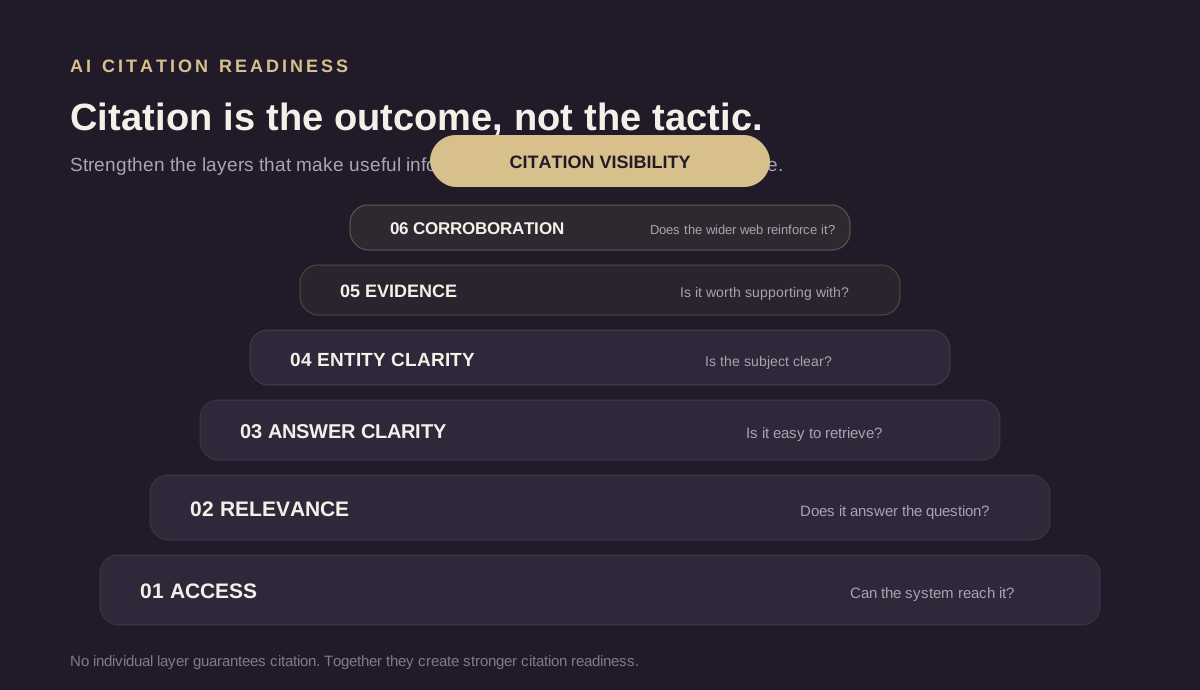
Citation visibility is the result of a chain: your information has to be accessible, relevant to the question, understandable, useful enough to retrieve and supported strongly enough to become a credible source.
That makes citation optimization less about finding an AI-search trick and more about strengthening the information systems around your business.
The useful goal
Do not optimize for a guaranteed citation. Improve the conditions that make your brand and content easier to discover, understand, retrieve, verify and reference — then measure whether citation visibility actually improves.
First: what does being "cited" actually mean?
Citation behavior differs between search experiences.
A system might link directly to one of your pages, mention your brand inside an answer, use your information as a supporting source or show your site alongside a generated response.
Brand mention
Your company or product appears in the generated answer, but your website may not be linked.
Direct source citation
A page from your site is visibly linked or presented as a supporting source.
Third-party citation
The answer discusses your brand while citing an independent publication, directory, community or other source.
Supporting-link visibility
Your page appears among supporting links associated with an AI-generated search experience.
This distinction matters because AI search visibility depends on more than your website. Your brand can be represented through information distributed across the wider web.
ChatGPT, Perplexity and Google do not work identically
One of the biggest mistakes in AI-search optimization is pretending every system has the same crawler, index, retrieval process and citation behavior.
ChatGPT Search
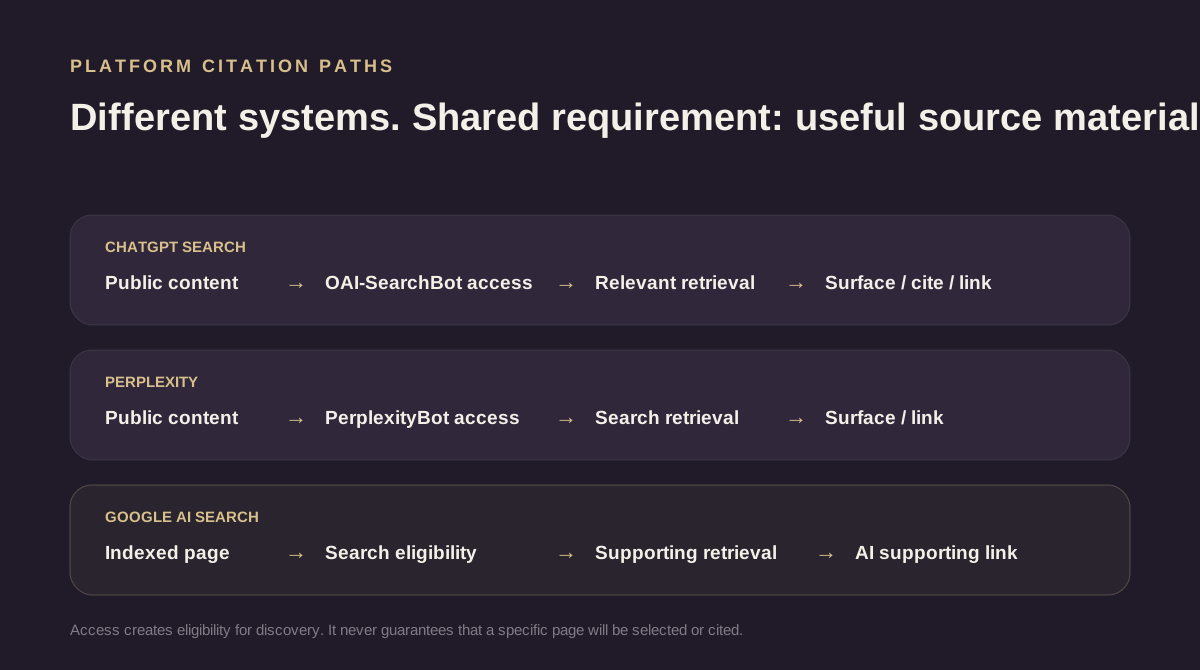
Access: OpenAI says public sites can appear in ChatGPT search and recommends allowing OAI-SearchBot when you want content discoverable, surfaced, cited and linked.
Optimization focus: Accessible public pages, clear information, useful answers and pages relevant enough to the user's question to become source material.
Important: Allowing the crawler creates eligibility for discovery; it does not guarantee that a page will be cited.
Perplexity Search
Access: Perplexity says PerplexityBot is designed to surface and link websites in search results and recommends allowing it when you want the site to appear.
Optimization focus: Accessible pages that directly satisfy the information need and provide useful source material.
Important: Crawler access does not guarantee that a particular answer will use or cite your site.
AI Overviews & AI Mode
Access: Google says supporting pages must be indexed and eligible to appear in Search with a snippet.
Optimization focus: The same strong SEO foundations Google recommends for Search: useful content, crawlability, internal discovery and accurate structured information.
Important: Google explicitly says there are no additional technical requirements or special AI schema required for these features.
The 6-layer AI citation-readiness framework
Work from the bottom of the system upward. A citation strategy cannot compensate for a page that is inaccessible, irrelevant or unclear.
Access
Can the relevant search system reach the content?
Start with crawler access, indexability and technical discoverability.
For ChatGPT search, review whether OAI-SearchBot is being blocked. For Perplexity, review access for PerplexityBot. For Google AI features, the page needs to satisfy the normal Search eligibility requirements for supporting links.
Do not confuse search crawlers with model-training crawlers. Different user agents can have different purposes and controls.
Our llms.txt and AI-search guide explains why crawler controls and experimental AI files should not be treated as the same thing.
Question relevance
Does the page actually answer the question being asked?
A page does not become citation-worthy simply because it mentions the right keyword or brand category.
Map important pages to real buyer questions: definitions, comparisons, implementation questions, alternatives, evaluation criteria, problems, costs, risks and decision points.
The content should satisfy a specific information need rather than attempting to be vaguely relevant to every query in the category.
Answer clarity
Can useful information be retrieved without losing its meaning?
Write sections that answer important questions clearly. Use descriptive headings, direct explanations and enough context that the relevant passage remains understandable when isolated from the rest of the article.
This does not mean turning every page into short robotic paragraphs. It means removing unnecessary ambiguity around the information people actually need.
This is a core part of Answer Engine Optimization.
Entity clarity
Is it obvious who or what the information is about?
Search systems need enough context to distinguish your company, products, services, people and expertise from similarly named or loosely related entities.
Keep core business facts consistent. Make important relationships explicit. Connect experts to their topics and offerings to the problems they solve.
For a deeper technical treatment, read Entity Node Engineering for AI Crawlers.
Evidence
Why should this source be useful for supporting the answer?
Strong source material is specific. Claims should have context, reasoning, examples, methodology or primary evidence where those things are available.
Original research, first-party data, documented processes, technical documentation, expert analysis and genuinely useful comparisons can create information that is harder to replace with generic summaries.
Do not manufacture statistics, quotes, studies or customer results simply to make a page appear authoritative.
Corroboration
Does the wider information ecosystem reinforce the brand and its expertise?
Your own website cannot independently verify every claim you make about yourself.
Relevant publications, communities, directories, partner pages, interviews, documentation and other credible sources can provide independent context around the entity.
The objective is not link spam. It is to build legitimate evidence that the business exists, does what it says it does and participates meaningfully in the topic it wants to be associated with.
How to improve your chances of being cited by ChatGPT
OpenAI says any public website can appear in ChatGPT search. For site content to be included in summaries and snippets, OpenAI advises publishers not to block OAI-SearchBot.
Check OAI-SearchBot
Confirm that robots.txt, your CDN and your firewall are not unintentionally preventing the ChatGPT search crawler from reaching public content you want discoverable.
Build source-worthy pages
Publish pages that directly resolve important questions rather than relying on thin commercial copy.
Strengthen entities
Make company, product, service and expert relationships clear enough that the information is difficult to misinterpret.
Add real evidence
Use first-party expertise, primary data, documented methodology and specific examples when you genuinely have them.
Measure actual prompts
Test a stable set of commercial questions and record whether the brand appears, how it is described and which sources are linked.
Official OpenAI guidance
OpenAI — Publishers and Developers FAQ ↗How to improve your chances of being cited by Perplexity
Perplexity says PerplexityBot is designed to surface and link websites in its search results and recommends allowing the bot when you want your site to appear.
Allow search crawling
Check robots.txt and any WAF or CDN rules that may block PerplexityBot from public pages you want searchable.
Answer specific questions
Create pages with enough depth and specificity to resolve real research, comparison and buying questions.
Make evidence obvious
Clearly identify original data, methodology, definitions, authorship and other source context where it genuinely exists.
Study cited sources
Run your priority prompts and inspect which source types repeatedly appear. Use those observations to understand the information environment around the topic.
Repeat the baseline
Re-test the same prompts after meaningful improvements rather than judging success from one isolated answer.
Official Perplexity guidance
Perplexity — Crawler documentation ↗How to improve visibility in Google AI Overviews and AI Mode
Google takes a notably direct position: existing SEO fundamentals continue to apply to AI Overviews and AI Mode.
Google says a page must be indexed and eligible to appear in Search with a snippet to be eligible as a supporting link. It also says there are no additional technical requirements specifically for AI Overviews or AI Mode.
Protect SEO foundations
Keep important pages crawlable, indexable, internally discoverable and technically eligible for Google Search.
Publish unique value
Create genuinely useful information that adds something meaningful rather than reproducing generic summaries already available elsewhere.
Keep key content textual
Make important information available in page text and support it with useful images or video where appropriate.
Keep schema accurate
Use structured data when appropriate, but make sure it accurately represents visible page content.
Do not invent AI markup
Google says no special schema.org markup or new AI text file is required to appear in AI Overviews or AI Mode.
Official Google guidance
The specifics vary by platform, but the underlying work does not. For a single, ordered framework that covers all of it, see how to improve AI search visibility step by step.
Does schema markup make AI systems cite you?
Structured data can help search engines understand explicit information about a page, but it should not be treated as a citation switch.
Google says structured data provides explicit clues about page meaning, but even correctly implemented structured data does not guarantee a particular search appearance.
Good use
Accurately describing visible entities, articles, products, organizations and other supported content using appropriate structured data.
Bad assumption
Adding schema and assuming ChatGPT, Perplexity or Google must now cite the page.
Create information worth citing
The strongest long-term citation strategy is creating information that helps answer a question better than another generic page.
Original data
Publish real research, benchmarks, surveys or first-party datasets when you genuinely have the methodology and evidence.
Primary expertise
Document processes, technical knowledge, implementation lessons and specialist experience that comes directly from the work.
Useful definitions
Explain difficult concepts precisely enough that the definition remains understandable outside the surrounding page.
Decision frameworks
Help readers evaluate tradeoffs instead of producing generic lists of benefits.
Specific comparisons
Compare approaches using transparent criteria and acknowledge meaningful limitations.
Documented evidence
Support important claims with primary sources, methodology, examples or clearly attributed references.
Your own website is not the entire citation strategy
If every claim about your expertise exists only on pages you control, the wider information environment may provide limited independent context.
Build legitimate visibility where your audience already evaluates information:
Industry publications where you can contribute genuine expertise
Relevant communities where useful answers are valued
Partner and integration ecosystems
Directories and profiles that accurately describe the business
Podcasts, interviews and expert commentary when genuinely relevant
Original research that other credible sources have a reason to reference
Avoid manufacturing mentions, fake reviews or low-quality link placements. The objective is evidence and useful presence, not a volume target.
How to measure AI citation visibility
Citation visibility should be measured with a repeatable prompt set, not screenshots chosen because they make the brand look good.
Define prompts
Create a stable set of category, problem, comparison, recommendation and evaluation questions tied to real buyer decisions.
Record platform
Keep ChatGPT, Perplexity and Google observations separate rather than combining different systems into one unexplained score.
Record brand inclusion
Note whether your company appears and how it is described.
Record sources
Capture visible citations or supporting links and identify whether they point to your site, competitors or third parties.
Record competitors
Track which alternatives repeatedly receive visibility for the same commercial questions.
Repeat
Run the same baseline after meaningful changes so you can compare observations over time.
The full measurement framework is in The Cost of Being Invisible to AI Search.
A practical citation-improvement sequence
Do the work in dependency order rather than collecting random AI SEO tactics.
Audit access
Verify search crawler access, indexing and internal discoverability for the pages that matter.
Choose questions
Define the buyer questions where citation visibility would genuinely matter.
Improve answers
Strengthen the sections that directly resolve those questions.
Clarify entities
Fix ambiguous company, product, service and expert relationships.
Add evidence
Strengthen weak claims with real methodology, examples, primary sources and first-party expertise where available.
Build corroboration
Develop legitimate external references and useful participation in the information environments relevant to the category.
Test visibility
Repeat the same prompt baseline and compare brand inclusion, sources and competitor visibility.
If you want the diagnostic version of this process, start with the AI Search Visibility Playbook.
What not to do
Do not promise guaranteed AI citations
Crawler access, schema and content changes can improve important conditions, but none of them force a platform to cite a page.
Do not create fake authority
Fabricated statistics, fake studies, fake reviews and invented expert credentials undermine the evidence layer instead of strengthening it.
Do not duplicate generic AI content at scale
Publishing interchangeable summaries creates little reason for your page to become the useful source.
Do not confuse crawler access with citation
Allowing a crawler means the system can access content under its documented behavior. It does not guarantee retrieval or selection for an answer.
Do not optimize every page for every prompt
Clear page purpose and specific relevance are more useful than turning the entire website into one repetitive AI-search template.
These are also exactly the kinds of gaps that traditional SEO audits can miss.
Citation starts with readiness
Find what may be limiting your AI-search visibility.
Run Growthract against your website to identify technical, SEO and AEO opportunities and prioritize the changes worth investigating first.
AI citation FAQs
Can you guarantee that ChatGPT will cite your website?
No. You can improve access, relevance, answer quality, entity clarity and evidence, but there is no legitimate way to guarantee that a specific ChatGPT response will cite a particular page.
Does ChatGPT crawl websites?
OpenAI documents OAI-SearchBot for ChatGPT search and recommends allowing it when you want public site content discoverable, surfaced, cited and linked in search experiences.
How do I get cited by Perplexity?
Perplexity recommends allowing PerplexityBot if you want your site to appear in its search results. Beyond access, focus on creating relevant, specific and useful source material and measure whether your pages actually appear for priority prompts.
Do I need special schema for Google AI Overviews?
Google says there is no special schema.org structured data required specifically for AI Overviews or AI Mode. Existing SEO fundamentals and accurate structured data remain relevant.
Does llms.txt make AI systems cite a website?
No citation guarantee should be attached to llms.txt. Follow the documented crawler controls of each platform and treat llms.txt separately from established search eligibility requirements.
What content is most useful for AI citation visibility?
Content with a clear purpose, direct answers, specific expertise, transparent evidence and genuinely useful information creates a stronger source than interchangeable summaries written only to target keywords.
Continue exploring
Related insights
Case study
An illustrative strategy showing how a Series B fintech could aim to improve citation coverage from a modeled 10% baseline to a 34% target across a controlled set of high-intent ChatGPT and Perplexity prompts.
See the case study →
Insight
Eight recurring, illustrative patterns behind B2B SaaS brands that show up more often in ChatGPT, Perplexity and Google AI Overviews — and why none of them is a guarantee.
Read the insight →
Insight
A practical framework for measuring brand mentions, citations, competitor visibility, source selection and answer accuracy across ChatGPT, Perplexity, Gemini, Claude and Google AI Overviews.
Read the insight →