Direct answer
Does schema markup improve AEO?
Structured data can make important entities and page meaning more explicit to machines, but schema markup does not guarantee rankings, AI citations or inclusion in generated answers. It is most useful when it accurately reflects visible content and supports a technically accessible, well-structured page.
01
Use schema to describe real, visible information.
02
Structured data supports interpretation but is not a citation guarantee.
03
Schema cannot compensate for inaccessible or weak content.
Schema markup can make important information about a page and its entities more explicit to machines.
That makes structured data useful for both conventional SEO and the broader entity-clarity work involved in Answer Engine Optimization.
But there is no special "AEO schema" that unlocks AI citations, and adding JSON-LD does not guarantee that ChatGPT, Perplexity, Google AI Overviews or any other system will reference your page.
Our 2026 AI Search Readiness Benchmark found JSON-LD in the initial HTML of 76 of 97 inspectable B2B SaaS homepages, while SoftwareApplication schema appeared on only 21 of 97. The benchmark treats those as observable implementation signals, not citation guarantees.
The correct mental model
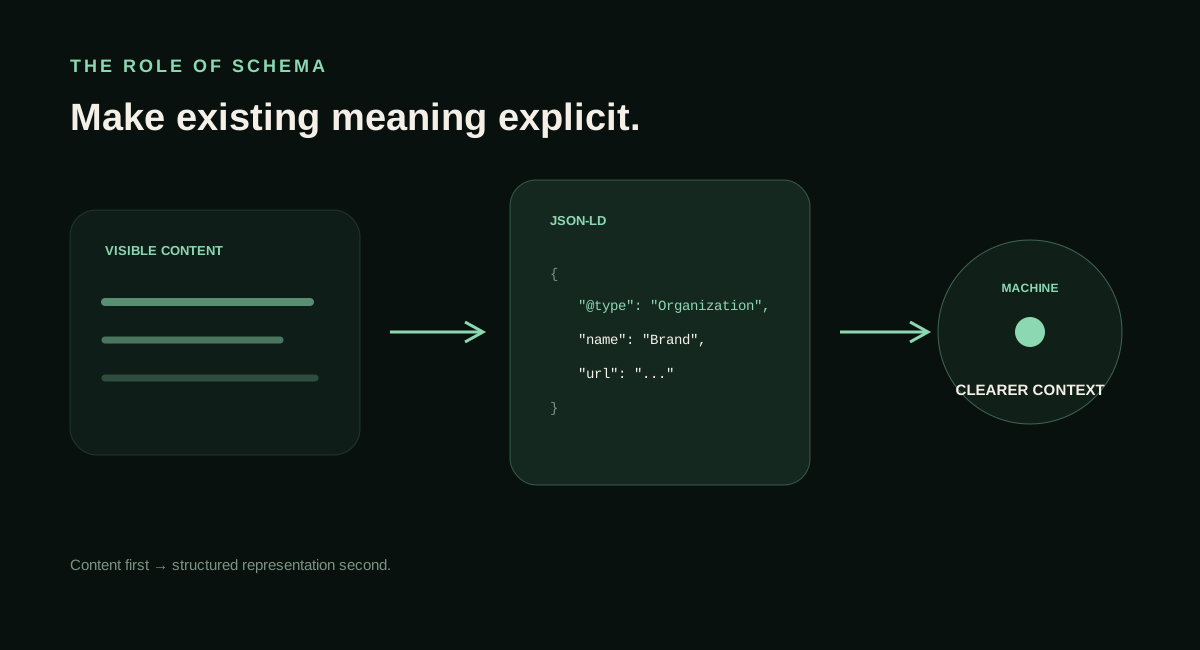
Visible content establishes the facts. Structured data expresses those facts in a machine-readable format. It should clarify the page, not create a second version of reality that users cannot see.
What structured data actually does
Google describes structured data as a standardized format for providing information about a page and classifying its content.
In practical terms, it lets you state explicitly that:
This is an organization
And this is its official name, URL, logo and relevant identity information.
This is a website
And this organization is the publisher associated with it.
This page is an article
And this is its headline, author, publication date and publisher.
This page sits here
Breadcrumb markup can express where a page fits within the site hierarchy.
This explicitness is especially useful when you are trying to improve entity clarity and Knowledge Graph readiness.
Official Google guidance
Google Search Central — Understand how structured data works ↗Schema does not guarantee AI visibility
This is the most important limitation in the entire guide.
Google explicitly says that even correctly implemented structured data does not guarantee that a particular search feature will appear.
Google also says there is no special schema.org markup required to appear in AI Overviews or AI Mode.
Avoid this claim
"Add this schema and ChatGPT will cite you."
Structured data can improve explicit machine-readable context. It cannot force retrieval, ranking, recommendation or citation.
Citation visibility depends on a broader chain involving access, relevance, answer quality, entity clarity, evidence and external corroboration. That framework is covered in How to Get Your Brand Cited by ChatGPT, Perplexity & AI Overviews.
Google structured-data policies
Google Search Central — General structured data guidelines ↗Google Search Central — AI features and your website ↗Which schema types matter most for a typical B2B website?
Do not add every Schema.org type you can find. Start with the entities and page types that genuinely exist on the website.
Organization
Use it to describe the company itself.
Organization structured data is one of the most useful identity layers for a company website.
Google says Organization markup can help it understand administrative details and disambiguate an organization in Search.
WebSite
Use it to describe the website as a site-level entity.
WebSite markup can connect the domain to its site name and publisher.
Keep this site-level information stable rather than generating a different identity object on every page.
Article
Use it for real editorial articles and blog posts.
Article markup can express the headline, dates, author, publisher, canonical URL and representative images.
It should describe the actual article visible on the page.
BreadcrumbList
Use it to describe a real page hierarchy.
Breadcrumb markup helps express where the current page sits in the wider site structure.
This is useful for humans and machines because it reinforces relationships between sections of the site.
1. Copy-paste Organization schema
Put your main Organization object on the homepage or another appropriate site-level location.
Replace every example value with accurate information about the real organization. Do not add an address, founding date, social profile or business identifier unless it is true and appropriate to publish.
Organization JSON-LD
{
  "@context": "https://schema.org",
  "@type": "Organization",
  "@id": "https://example.com/#organization",
  "name": "Example Company",
  "url": "https://example.com",
  "logo": {
    "@type": "ImageObject",
    "url": "https://example.com/logo.png"
  },
  "sameAs": [
    "https://www.linkedin.com/company/example-company"
  ]
}
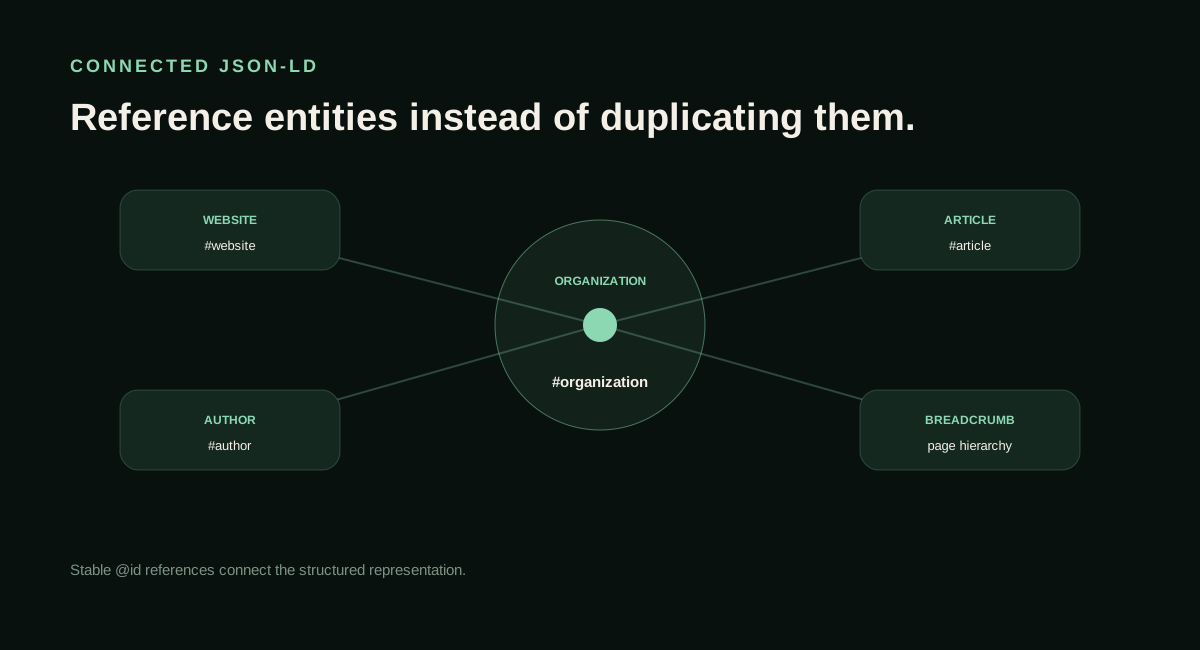
The @id creates a stable identifier that other structured-data objects on your site can reference.
Official Google documentation
Google Search Central — Organization structured data ↗2. Copy-paste WebSite schema
The website and the organization are related entities, but they are not the same thing.
WebSite JSON-LD
{
  "@context": "https://schema.org",
  "@type": "WebSite",
  "@id": "https://example.com/#website",
  "url": "https://example.com",
  "name": "Example Company",
  "publisher": {
    "@id": "https://example.com/#organization"
  }
}
Notice how the publisher does not repeat the entire Organization object. It references the stable Organization @id.
Google also uses WebSite structured data as one input for site-name preferences in Search.
3. Copy-paste Article schema
Article markup is appropriate for editorial pages that are genuinely articles.
Article JSON-LD
{
  "@context": "https://schema.org",
  "@type": "Article",
  "@id": "https://example.com/article/#article",
  "headline": "Example Article Title",
  "description": "A concise description of the article.",
  "url": "https://example.com/article",
  "datePublished": "2026-08-18",
  "dateModified": "2026-08-18",
  "image": [
    "https://example.com/images/article-feature.png"
  ],
  "author": {
    "@type": "Person",
    "name": "Jane Smith",
    "url": "https://example.com/about/jane-smith"
  },
  "publisher": {
    "@id": "https://example.com/#organization"
  }
}
Keep the headline, canonical URL, author, dates and images aligned with the content users actually see.
Do not mark every commercial landing page as an Article simply because Article schema is easy to implement.
Connect related entities with @id and @graph
One of the most useful structured-data patterns is to stop creating isolated objects that know nothing about each other.
A stable @id allows multiple schema objects to refer to the same entity.
Connected @graph example
{
  "@context": "https://schema.org",
  "@graph": [
    {
      "@type": "Organization",
      "@id": "https://example.com/#organization",
      "name": "Example Company",
      "url": "https://example.com",
      "logo": {
        "@type": "ImageObject",
        "url": "https://example.com/logo.png"
      }
    },
    {
      "@type": "WebSite",
      "@id": "https://example.com/#website",
      "url": "https://example.com",
      "name": "Example Company",
      "publisher": {
        "@id": "https://example.com/#organization"
      }
    }
  ]
}
How to add JSON-LD in Next.js
Next.js recommends rendering JSON-LD as a script element in a page or layout.
Its documentation also recommends sanitizing the serialized payload when values may contain unsafe strings. One documented approach is to replace the less-than character with its Unicode equivalent.
Next.js App Router example
export default function Page() {
  const jsonLd = {
    "@context": "https://schema.org",
    "@type": "Article",
    headline: "Example Article",
    url: "https://example.com/article",
  };

  return (
    <>
      <script
        type="application/ld+json"
        dangerouslySetInnerHTML={{
          __html: JSON.stringify(jsonLd).replace(/</g, "\\u003c"),
        }}
      />

      <main>
        {/* Visible page content */}
      </main>
    </>
  );
}
Official Next.js guide
Next.js — JSON-LD implementation guide ↗Structured data must match visible content
A common schema mistake is putting useful-looking facts into JSON-LD that are not actually supported by the page.
Correct
The page identifies Jane Smith as the author and the Article JSON-LD identifies Jane Smith as the author.
Incorrect
JSON-LD claims an expert reviewed the page when no reviewer is visible and no review actually happened.
Google's structured-data guidelines specifically warn against markup that misrepresents the page or describes content hidden from users.
Should you add FAQPage schema to every AEO article?
No.
Adding FAQPage markup everywhere because "AI likes FAQs" is not a useful AEO strategy.
Google reduced FAQ rich-result visibility and says those rich results are generally limited to well-known, authoritative government and health sites.
You can still write genuinely useful FAQ content. The value of the content should not depend on receiving a special search appearance.
Do not confuse FAQPage with QAPage
QAPage has a specific purpose.
Google says QAPage markup should be used when a page focuses on one question and users can submit answers.
A normal company FAQ, blog article or guide where the publisher writes the answers itself should not be marked up as QAPage merely to target answer engines.
The 8-point structured-data audit
Correct type
Does the schema type genuinely describe the thing or page being marked up?
Visible evidence
Can a user see the important information represented in the structured data?
Stable identity
Are important Organization, WebSite, Person and other entity IDs consistent where reused?
Accurate relationships
Do author, publisher, breadcrumb and entity references point to the correct real-world relationships?
Canonical URLs
Do URLs in your structured data resolve to the intended canonical pages?
Current facts
Are dates, names, images and other properties kept synchronized with visible page content?
Validation
Does the markup pass the appropriate Google Rich Results Test or Schema Markup Validator checks?
Crawler access
Can search systems access the page containing the structured data?
The same checks fit naturally inside the broader 15-Point AEO Checklist.
How to validate your implementation
Validation should happen before you treat the implementation as finished.
Test syntax
Confirm that the JSON-LD is valid JSON and that your production HTML contains the expected script.
Use Google's Rich Results Test
For Google-supported structured-data features, inspect detected items, errors and warnings.
Use URL Inspection
Check that Google can access the deployed page and see the rendered implementation.
Compare against visible content
Technical validity does not prove semantic accuracy. Manually check the marked-up facts against the page.
Monitor Search Console
Watch structured-data enhancement reports where Google provides them and fix recurring implementation errors.
Where schema fits inside AEO
Structured data is one layer, not the whole optimization system.
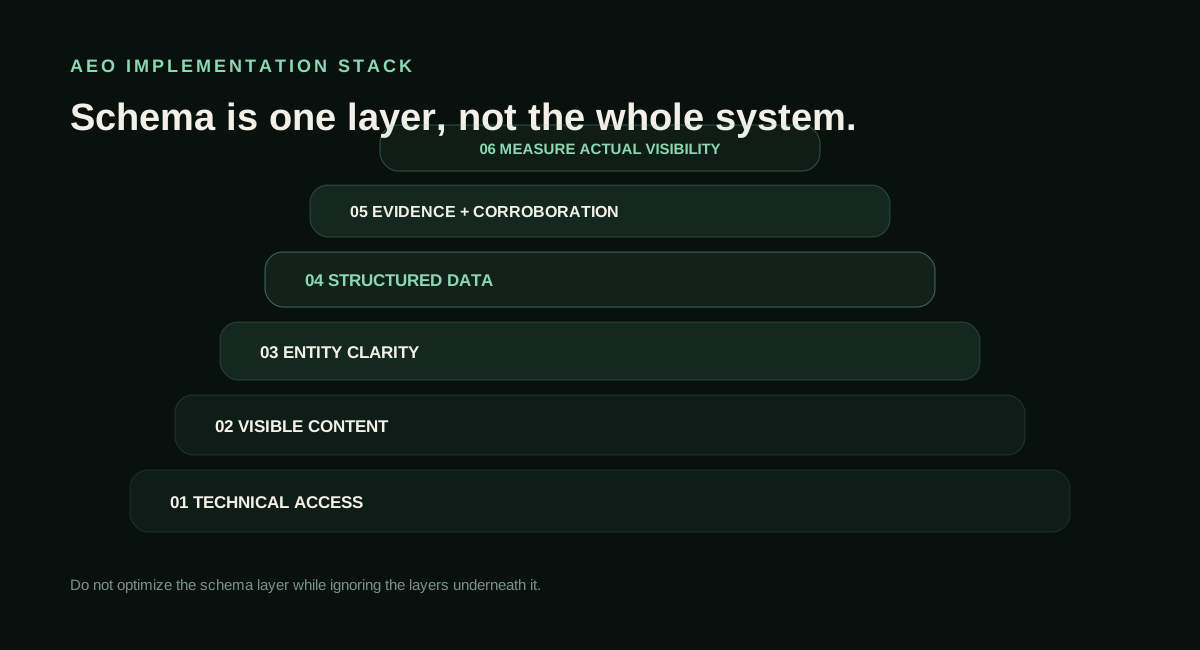
Technical access
The page still needs to be accessible to the systems expected to discover it.
Useful visible content
The information should answer real questions clearly and accurately.
Entity clarity
The business, people, products, services and topics should be easy to distinguish.
Structured data
Schema makes appropriate parts of that visible meaning explicit in a standardized format.
Evidence
Important claims still need real context, expertise and corroboration.
Measurement
Test whether the resulting search and AI-search visibility actually changes.
If you want to audit those layers manually, use the DIY AEO Audit.
7 schema mistakes that hurt more than they help
Marking up information that is not visible
Structured data should represent the real page rather than introduce hidden marketing claims.
Using the wrong type
Do not label a sales page as an Article or a normal FAQ as QAPage simply because the markup exists.
Duplicating entities inconsistently
Multiple Organization objects with different names, URLs or identifiers can make your structured representation harder to maintain.
Treating sameAs as a backlink list
Use identity-equivalent references rather than every URL that happens to mention the business.
Adding properties you cannot verify
More schema is not automatically better. Accuracy is more useful than property count.
Ignoring production output
A component may look correct in source code while the final rendered page contains broken or duplicated JSON-LD.
Promising AI citations
Schema can clarify machine-readable meaning. It cannot guarantee that a particular AI system will select or cite the page.
Make the meaning explicit
Find the technical and entity gaps behind your search visibility.
Run Growthract against your website to identify SEO and AEO opportunities across technical foundations, structured information, content and entity clarity.
Schema markup for AEO FAQs
Is there a special AEO schema?
No standardized schema type exists specifically for AEO. Use appropriate Schema.org types that accurately describe the real entities and content on the page.
Does schema markup help AI search?
Structured data provides explicit machine-readable information about pages and entities. That can strengthen clarity, but it does not guarantee retrieval, recommendation or citation in an AI-generated answer.
Does Google require special schema for AI Overviews?
No. Google says there is no special schema.org structured data required specifically for AI Overviews or AI Mode.
Which schema types should a B2B website use?
Common useful types include Organization, WebSite, Article and BreadcrumbList when those types accurately match the site's content. Other types should be added only when they genuinely describe the page or entity.
Should every FAQ section use FAQPage schema?
No. Useful FAQ content does not require FAQPage markup, and Google has significantly restricted the visibility of FAQ rich results.
What format should I use for structured data?
Google supports JSON-LD, Microdata and RDFa and generally recommends JSON-LD because it is usually easier to implement and maintain.
Continue exploring
Related insights
Case study
How a B2B platform migration could become an opportunity to rebuild information architecture, preserve search equity and improve entity recognition across Google and AI-powered search systems.
See the case study →
Insight
How entity clarity, structured data, consistent business information, relationships and third-party corroboration help search and AI systems understand what your brand actually is.
Read the insight →
Insight
Most SEO audits end at the recommendation. Here's why the next step — actually re-checking the fix against the live site — is the part that decides whether the audit was worth doing at all.
Read the insight →