Direct answer
Why do B2B SaaS teams need a dedicated AI visibility layer alongside their existing SEO tools?
Because AI Overviews and assistant answers now intercept a meaningful share of queries before a click ever reaches a website, B2B buyers increasingly research vendors through ChatGPT and similar tools before contacting sales, and traditional SEO tooling wasn't built to test, label or verify any of that. Growthract exists as an evidence-first layer that sits alongside conventional SEO work rather than replacing it.
01
The shift toward AI-mediated discovery is documented in independent, sourced data, not a vendor talking point.
02
Traditional SEO tools weren't built to distinguish AI readiness from AI visibility, or real observations from simulation.
03
Adding this layer is about closing a specific evidence gap, not replacing existing SEO work.
Your rank tracker still works fine. It just isn't answering the question a growing number of your buyers are actually asking first.
Search results pages increasingly show an AI-generated summary before any blue link at all. B2B buyers are folding ChatGPT and Perplexity into vendor research earlier than they used to. Neither of those is a prediction — they're documented in sourced, third-party data, not a vendor's talking point. The practical question isn't whether this shift is real. It's what your existing SEO tooling actually tells you about it, and the honest answer for most stacks is: not much.
What a conventional SEO stack was never built to check
A rank tracker tells you your position in a list of links. It has no concept of whether ChatGPT mentioned you in a generated answer, because that's a different kind of outcome entirely — one that doesn't correspond to a URL and a position. Most SEO suites have bolted an "AI visibility" module onto their existing product recently, which is a reasonable response, but bolting a feature on isn't the same as building the evidence discipline that feature actually needs.
Two distinctions matter here that a lot of tooling glosses over. First, a simulated AI answer and a real observed one are not the same evidence, and a dashboard that blends them without labeling which is which is quietly overstating its own confidence. Second, AI readiness — whether AI crawlers can technically access and understand your site — is a separate claim from AI visibility — whether an AI system actually mentions you. A tool built only for traditional SEO has no natural place to hold either distinction.
The gap shows up in real data, not just theory
Our own 2026 benchmark of 100 B2B SaaS websites found real, uneven readiness even among well-resourced companies: 21 of 97 inspectable homepages had no structured data at all, llms.txt adoption ranged from 56.5% to 87.5% depending on category, and even the near-universal 99% AI-crawler access rate had a real exception. A conventional technical SEO audit, run against the same 100 sites, would have missed most of this — because it wasn't built to look for it.
What a dedicated layer actually needs to do
Not replace your SEO stack — sit next to it, and answer the questions that stack was never designed to hold. Check technical AI readiness alongside conventional SEO fundamentals, since they share more overlap than they get credit for. Test AI visibility directly, with every result labeled by whether it came from a real observation or a simulation. Reason at the page level, since problems cluster on specific pages rather than spreading evenly across a domain. And close the loop with verification, rather than leaving recommendations unconfirmed.
That's the specific gap Growthract is built to fill — not a replacement for your existing SEO work, but the evidence layer that work doesn't currently cover.
See the gap on your own site
Add the layer your SEO stack doesn't have.
Run a free diagnostic to see your AI readiness and AI visibility evidence side by side with your existing SEO signals.
A couple of follow-up questions
Do I need to replace my existing SEO tools?
No. This layer is meant to sit alongside conventional SEO tooling, covering the AI-readiness and AI-visibility evidence that tooling wasn't built to check.
Is this only relevant for companies already struggling in search?
No — our benchmark found real gaps even among well-resourced, well-ranking companies. Ranking well in Google and being readable to AI systems are related but separate outcomes.
Continue exploring
Related insights
Case study
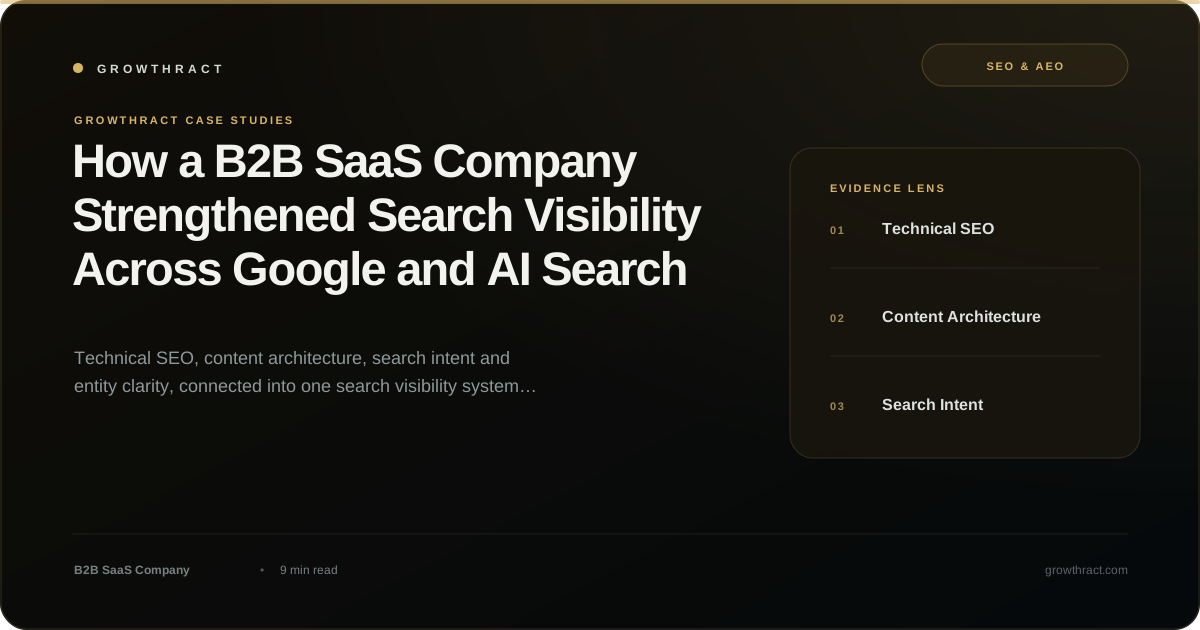
Technical SEO, content architecture, search intent and entity clarity, connected into one search visibility system across Google and AI-powered search — an illustrative walkthrough for a B2B SaaS company.
See the case study →
Insight
A tier-by-tier comparison of the AI-visibility and AEO tools B2B SaaS teams are actually using in 2026 — what each one measures, who it fits, and what none of them can promise you.
Read the insight →
Insight
A sourced timeline of the Google core updates, spam updates and AI Overview changes from 2025 through mid-2026 that mattered most for B2B SaaS search visibility.
Read the insight →