Direct answer
What technical SEO checks matter for AI search that a traditional audit might miss?
Beyond standard crawlability, speed and indexation checks, AI-search readiness depends on whether AI crawlers can access your pages at all, whether content is present in server-rendered HTML rather than only client-side JavaScript, whether entities are named consistently, and whether pages answer discrete questions directly instead of burying them in narrative copy. These checks supplement a traditional technical SEO audit; they do not replace it.
01
Confirm AI crawlers (GPTBot, ClaudeBot, PerplexityBot, and similar) aren't blocked before assuming a content problem.
02
Check what AI crawlers actually receive, not just what a browser renders — JavaScript-only content is a common blind spot.
03
Direct-answer structure and entity consistency matter as much as raw technical accessibility.
A standard technical SEO audit checks whether Google can crawl, render and index your site. That's still necessary — it's just no longer sufficient.
AI crawlers behave differently enough from Googlebot that a site passing every check in a conventional audit can still be invisible to ChatGPT, Perplexity or Claude. The 15 checks below are what to add, not what to replace it with.
The correct mental model
Permission to crawl is not proof of crawling, and crawling is not proof of citation. Each layer below can fail independently, which is why a single "SEO score" can't tell you where the actual problem sits.
1–4. Crawler access
Confirm AI crawlers aren't blocked in robots.txt
Check specifically for GPTBot, OAI-SearchBot, ChatGPT-User, ClaudeBot, Claude-User, Claude-SearchBot, PerplexityBot, Perplexity-User and Google-Extended — a blanket disallow rule written years ago for a different purpose can silently block all of them.
Check server logs for actual AI-crawler requests
robots.txt only states permission. Log analysis shows whether a given crawler has actually requested your pages recently — the two can diverge in either direction.
Check for bot-blocking at the CDN or WAF layer
Cloudflare and similar providers ship toggles that block 'AI bots' or 'known bots' by default in some security presets — a setting your SEO team may not know exists, let alone control.
Confirm no bot-detection wall blocks legitimate crawlers
Aggressive bot-detection or JavaScript-challenge pages, often enabled during a DDoS scare and never disabled, can quietly filter out AI crawlers alongside malicious traffic.
For a deeper walkthrough of log-based crawler verification, see Crawler Intelligence.
5–7. Rendering & content delivery
Compare what a crawler receives to what a browser renders
Fetch a page's raw HTML with a bot-identifying request and compare it against the fully rendered DOM a browser shows. A large gap usually means important content only exists after client-side JavaScript runs.
Confirm critical content has a server-rendered fallback
Not every crawler executes JavaScript the way a modern browser does. Pages relying entirely on client-side rendering risk key facts being invisible to some crawlers even when the page looks fine to a human visitor.
Check page load reliability under crawler conditions
Crawlers with limited patience or lower JavaScript-execution budgets may abandon slow or unstable pages before your content ever loads.
8–11. Entity & structural clarity
Confirm Organization and WebSite schema exist with stable @id values
A stable, reused @id lets other structured-data objects on the site reference the same entity consistently rather than duplicating disconnected copies.
Check entity-name consistency across your site, LinkedIn and major directories
Conflicting names, descriptions or category labels across your own properties make it harder for any system — search engine or AI — to build a single confident profile of who you are.
Confirm canonical tags resolve correctly
Broken or conflicting canonicalization creates duplicate-content ambiguity that dilutes both ranking signals and the clarity of what a page actually represents.
Check XML sitemap completeness and lastmod accuracy
An incomplete or stale sitemap can under-represent how much content actually exists, and inaccurate lastmod dates reduce the reliability of freshness as a signal.
12–15. Content & answer structure
Check whether key pages open with a direct, extractable answer
A retrieval system pulling a short excerpt to answer a question favors pages that state the answer plainly near the top, over pages that bury it under several paragraphs of scene-setting.
Check whether headings mirror real buyer questions
H2/H3 headings phrased the way a prospect would actually ask a question — in a demo, in a support ticket, in a search bar — are easier for both users and machines to match against intent.
Check for contradictory or stale information across pages
Pricing, feature availability or integration details that differ between your homepage, docs and a two-year-old blog post create the kind of conflicting evidence that undermines confident citation.
Check internal linking between related entities and topics
Isolated pages with no context make it harder to establish relationships between your products, use cases and category — internal links are one of the more direct ways to reinforce those relationships.
Direct-answer structure specifically is one of the patterns behind our own SEO to Search Visibility framework.
What this checklist won't fix
Passing every check above removes technical obstacles. It does not guarantee that ChatGPT, Perplexity or Google's AI features will choose to cite you — that still depends on relevance, evidence and competition for the same prompt, which no technical checklist can control.
15 checks, one report
Run this checklist against your own site automatically.
Growthract's free diagnostic checks crawler access, rendering, structured data and entity clarity in one pass.
Technical SEO for AI search FAQs
Is this checklist a replacement for a standard technical SEO audit?
No. It's a supplementary layer. Core web vitals, indexation, redirect hygiene and other conventional technical SEO checks still matter and aren't repeated here.
How do I check what an AI crawler actually receives from my site?
Request the page using that crawler's user agent (via curl or a similar tool) and compare the raw HTML returned to what your browser renders after JavaScript executes.
Does blocking AI crawlers in robots.txt hurt SEO?
It doesn't directly affect Google's traditional organic ranking, since Googlebot is a separate crawler. It does prevent the specific AI systems you've blocked from accessing your content at all.
Continue exploring
Related insights
Case study
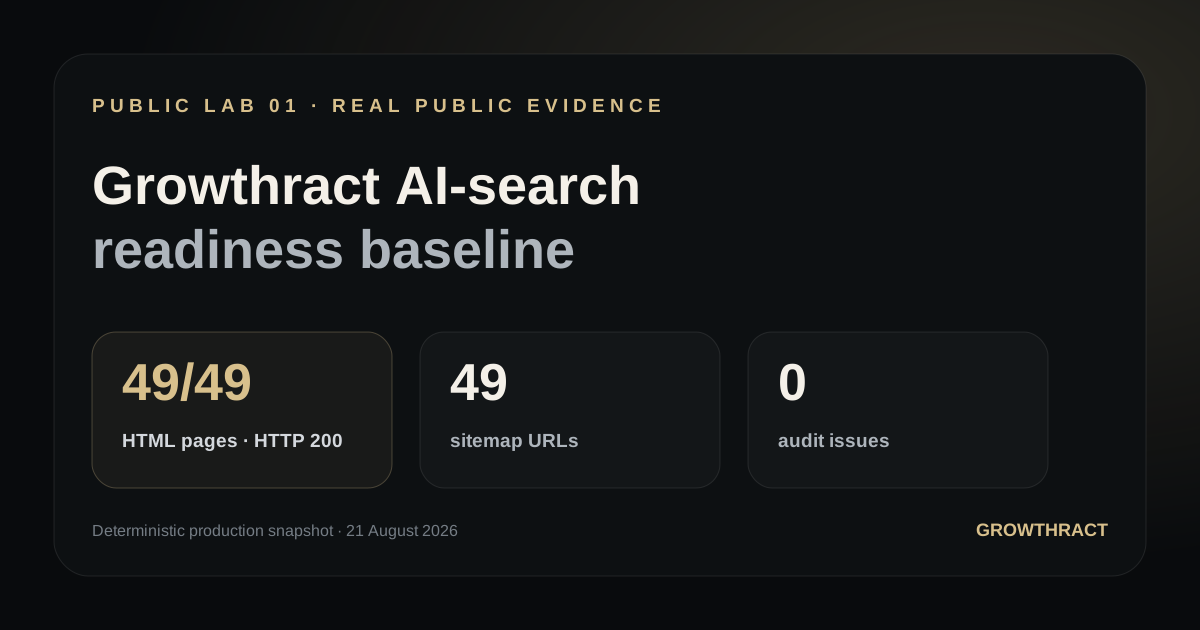
A public technical audit of growthract.com covering 49 production HTML pages, crawler access, robots.txt, sitemap integrity and legacy routes — with the limits of the evidence stated explicitly.
See the case study →
Insight
Traditional SEO audits are still essential, but they were not designed to evaluate entity clarity, answer readiness, citation visibility, third-party corroboration or prompt-level AI search presence.
Read the insight →
Insight
Original research across 100 B2B SaaS websites on llms.txt adoption, AI crawler access, JSON-LD, schema markup, canonicals, and technical readiness.
Read the insight →