Direct answer
What is the difference between SEO, AEO, GEO and AI SEO?
SEO focuses broadly on organic search visibility. AEO emphasizes being understood and surfaced in direct answers. GEO focuses on visibility in generative search experiences, while AI SEO is an umbrella term commonly used for optimization across AI-assisted search. In practice, the disciplines overlap and should operate as one search strategy.
01
SEO remains the technical and content foundation.
02
AEO and GEO extend visibility beyond traditional result pages.
03
Treat the disciplines as overlapping layers rather than separate programs.
SEO, AEO and GEO are increasingly used to describe how businesses become visible across traditional search engines and AI-generated answers.
The problem is that the terms are often treated as competing disciplines even though much of the underlying work overlaps.
For most businesses, the useful question is not which acronym wins. It is whether your information can be discovered, understood, retrieved, trusted and surfaced wherever customers search.
The short version
SEO helps useful content compete in search. AEO focuses on making information easier for answer-driven systems to understand and use. GEO focuses on visibility within responses produced by generative engines.
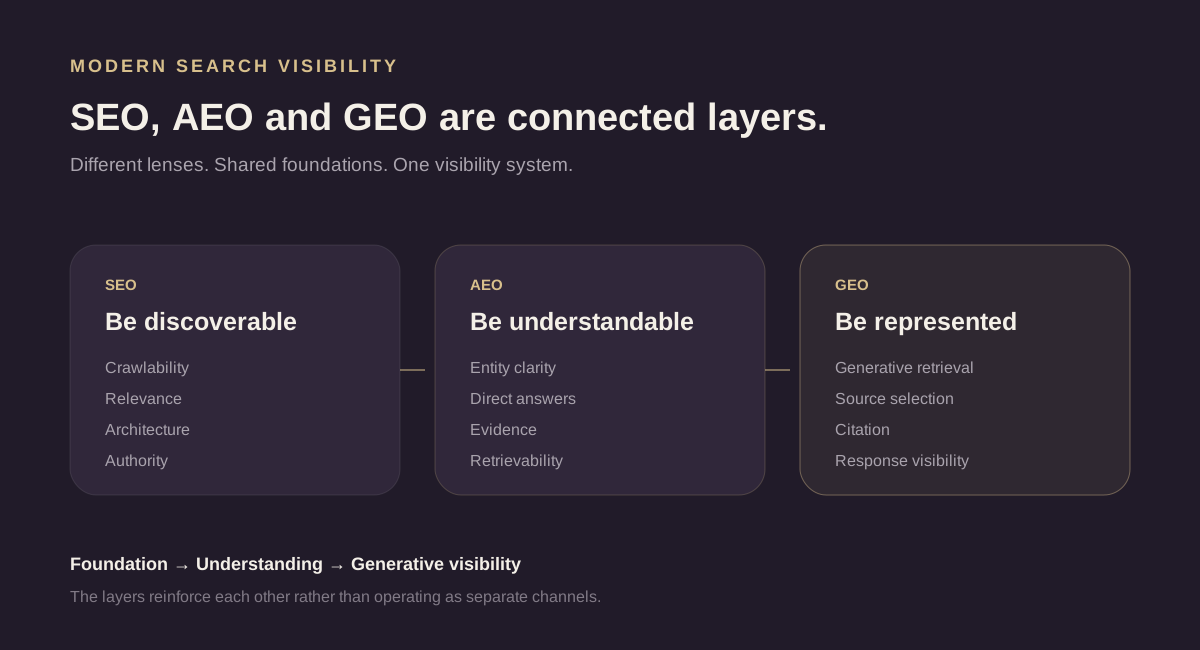
SEO vs. AEO vs. GEO in plain English
Start with what each discipline is trying to accomplish.
Search Engine Optimization
Primary goal: Increase useful visibility in search engines.
Focus: Technical accessibility, relevance, content, architecture, authority and search experience.
Measurement: Rankings, impressions, clicks, organic traffic, conversions and business outcomes.
Answer Engine Optimization
Primary goal: Make information easier to understand, retrieve and use in answer-driven search.
Focus: Entity clarity, answer structure, evidence, source consistency and machine-readable context.
Measurement: Brand inclusion, answer visibility, citations, sources, referral traffic and outcomes.
Generative Engine Optimization
Primary goal: Improve visibility within responses generated by generative search systems.
Focus: Retrievable information, source selection, citation, synthesis and representation.
Measurement: Generative-response inclusion, citation visibility, source presence and downstream outcomes.
What is SEO?
Search Engine Optimization improves the ability of useful pages to be discovered, understood and surfaced for relevant searches.
Its foundations include technical accessibility, site architecture, search intent, useful content, internal linking, authority and measurement.
Crawlability and indexation
Search intent and relevance
Content quality and usefulness
Internal linking and architecture
Authority and external signals
Organic performance and conversion
The arrival of generative search does not remove those foundations. Google says established SEO best practices remain relevant to its generative AI features because those experiences are rooted in core Search ranking and quality systems.
Official Google guidance
Google Search Central — Optimizing for generative AI features ↗That broader shift from ranking alone is covered in Why Ranking on Google Is No Longer Enough.
What is AEO?
Answer Engine Optimization expands the visibility question beyond whether a page can rank.
It asks whether important information is clear enough to understand, structured well enough to retrieve and supported strongly enough to use inside an answer-driven experience.
An AEO review asks:
Is it obvious what the business, product or service represents?
Do important buyer questions receive clear and useful answers?
Can important passages retain their meaning when retrieved?
Does structured information accurately match visible content?
Are important claims supported with evidence and context?
Do credible external sources reinforce the entity and its expertise?
For the complete framework, read our definitive guide to Answer Engine Optimization.
What is GEO?
Generative Engine Optimization was formalized in the 2023 research paper GEO: Generative Engine Optimization.
The paper introduced GEO as a framework for improving content visibility inside responses created by generative engines that synthesize information from multiple sources.
In practical marketing terms, GEO asks how your content, evidence and brand become represented inside a generated response rather than only how a page performs in a ranked list.
Important limitation
GEO is not a universal recipe for ranking inside every AI system. Generative engines can differ in retrieval, source selection, models, interfaces and response behavior. Visibility should be tested rather than assumed.
Original GEO research
Aggarwal et al. — GEO: Generative Engine Optimization ↗Where does AI SEO fit?
AI SEO is increasingly used as an umbrella term for search work aimed at visibility across both traditional search engines and AI-assisted discovery experiences.
Unlike SEO, AEO and GEO, however, AI SEO does not have one universally agreed technical definition. Agencies, software vendors and search teams often use the term differently.
SEO
Search foundation
Crawlability, indexability, relevance, content quality, rankings and organic performance.
AEO
Answer usefulness
Clear entities, direct answers, structure and evidence that help systems understand and use information.
GEO
Generative visibility
Whether information becomes visible, represented or cited inside generated responses.
Practical definition
At Growthract, we use AI SEO as a practical umbrella for work that connects established SEO foundations with AEO, entity clarity, technical accessibility and measurable AI-search visibility. It is not a replacement for SEO and it is not a claim that one optimization tactic controls how an independent AI system responds.
If you are evaluating AI SEO as a service rather than just comparing terminology, see our AEO and AI SEO approach for B2B SaaS.
What is the difference between AEO and GEO?
This is where industry terminology becomes less tidy.
AEO is commonly used as a broader practical discipline for making information useful in direct-answer and AI-search environments. GEO originates from a research framework specifically concerned with visibility inside generative-engine responses.
In implementation, the overlap is substantial.
AEO lens
Can the information be understood and used as an answer?
Entity clarity, direct answers, structure, evidence, retrievability and source consistency matter here.
GEO lens
Does the information gain visibility inside a generative response?
Retrieval, source selection, citation, synthesis and actual response visibility become the measurement layer.
SEO vs. AEO vs. GEO compared
Google shows why these disciplines overlap
Google is a useful example because its generative AI search experiences are not detached from conventional search infrastructure.
Google says SEO remains relevant to its generative AI features and explains that those experiences rely on its core Search ranking and quality systems to retrieve relevant information.
So a technically weak, poorly structured or unhelpful website does not become competitive simply because the interface is generative.
ChatGPT Search shows the same overlap
OpenAI says public websites can appear in ChatGPT search and advises site owners who want content discoverable and surfaced in search not to block OAI-SearchBot.
That one example touches all three lenses: technical accessibility resembles SEO, understandable and useful information fits AEO, and visibility inside the generated response fits GEO.
Official OpenAI guidance
OpenAI — Publishers and Developers FAQ ↗Which one does your business actually need?
For most businesses, the answer is not choosing one acronym. Start with the earliest broken layer.
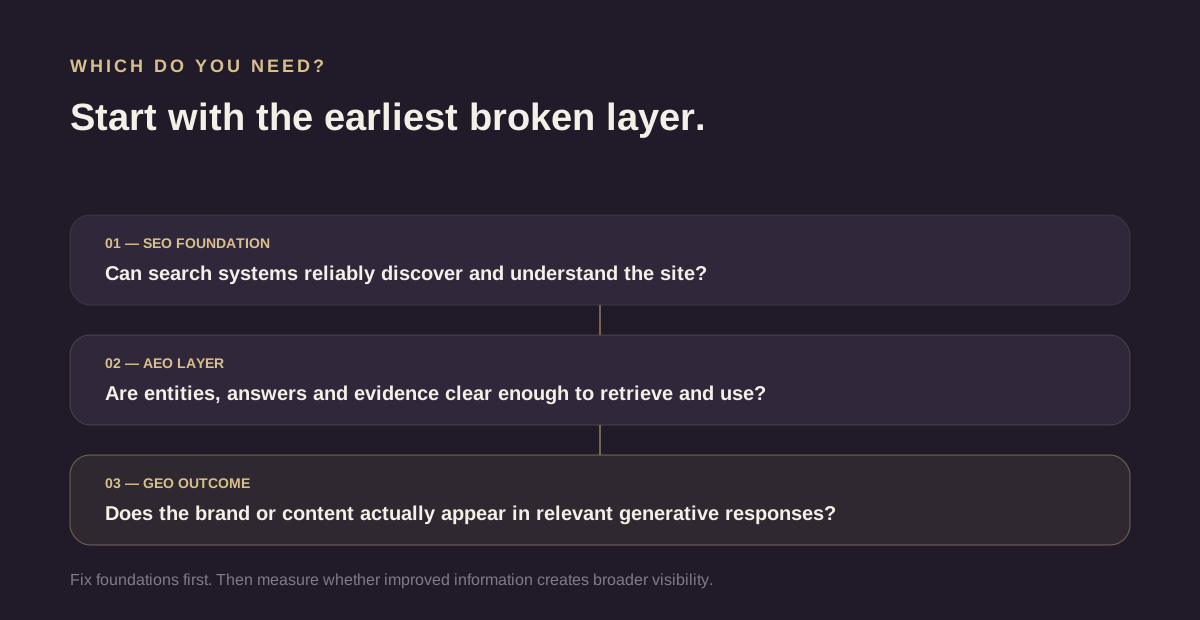
If search systems cannot reliably access the site, start with SEO.
Indexation problems, broken architecture, unclear page purpose and weak content foundations should be fixed before worrying about generative visibility.
If the site works but the business and answers are unclear, strengthen AEO.
Review entity clarity, direct answers, evidence, structured information and consistency across important pages and sources.
Use the 15-Point AEO Checklist to audit that layer.
If you want generative visibility, measure the GEO outcome directly.
Test commercially relevant prompts, record which brands and sources appear and compare the same baseline after meaningful changes.
Our guide to measuring AI-search visibility explains how to do this without inventing a universal score.
A better model: one search-visibility system
Instead of running three disconnected optimization programs, organize the work around the conditions required for visibility.
Be discoverable
Make important content technically accessible, indexable and easy to find through a logical architecture.
Be understandable
Clearly explain the business, products, services, people, topics and relationships that matter.
Be useful
Answer real questions directly, accurately and with enough context for the information to remain useful.
Be corroborated
Support important claims and strengthen legitimate third-party evidence around the brand and its expertise.
Be measurable
Track conventional search performance alongside prompt visibility, sources, citations and business outcomes.
How to audit SEO, AEO and GEO together
A modern audit should move through the visibility system in order.
Technical foundation
Can important pages be crawled, rendered, indexed and discovered?
Search relevance
Do pages clearly serve important topics and buyer intents?
Entity clarity
Is it obvious what the business and its offerings represent?
Answer readiness
Can commercially important questions be answered clearly and directly?
Evidence
Are important claims supported with enough useful context?
External context
What credible sources shape understanding around the brand and category?
Generative visibility
Does the brand appear across a repeatable set of relevant AI-search prompts?
Business outcome
Does identifiable visibility contribute to useful traffic, conversions or pipeline?
You can run much of this manually using the DIY AEO Audit, while Why Traditional SEO Audits Miss AI Search Signals explains why the conventional audit model needs to expand.
5 mistakes to avoid
Abandoning SEO because AI search exists
Generative search still depends on discoverable and useful information. Weak technical foundations remain weak foundations.
Treating AEO as adding FAQ blocks everywhere
Answer readiness is broader than FAQs. Entity clarity, context, evidence and useful information structure matter too.
Treating GEO as a guaranteed ranking formula
There is no universal checklist that guarantees citation or recommendation across every generative platform.
Optimizing only the website
Important third-party sources can contribute to how a business and its expertise are represented across the wider search ecosystem.
Using mystery scores instead of evidence
Record prompts, appearances, sources, dates, traffic and outcomes. A metric is useful only when you understand what produced it.
For the broader source ecosystem behind AI discovery, read Why AI Search Visibility Depends on More Than Your Website.
One search system
Find what your search visibility needs next.
Run Growthract against your website to identify SEO and AEO opportunities, understand the evidence behind them and prioritize the work that deserves attention first.
SEO, AEO and GEO FAQs
What is the main difference between SEO, AEO and GEO?
SEO focuses on search-engine visibility, AEO focuses on making information useful and retrievable for answer-driven search, and GEO focuses specifically on visibility within generative-engine responses.
Is GEO replacing SEO?
No. Generative search still needs discoverable, relevant and useful information. SEO remains part of the foundation.
Is AEO the same as GEO?
They overlap but are not identical terms. AEO is commonly used as a broader practical framework for answer-driven search, while GEO originated as a research framework focused on visibility inside generative-engine responses.
Does a business need all three?
Most businesses need the capabilities represented by all three but do not need three isolated strategies. Build strong SEO foundations, improve answer and entity clarity, then measure generative visibility as part of one search system.
Can GEO guarantee a citation in ChatGPT or Google?
No. No optimization framework can guarantee inclusion, citation or recommendation across every generative system.
How should SEO, AEO and GEO be measured together?
Combine conventional search metrics such as impressions, clicks and conversions with repeatable AI-search observations such as brand inclusion, visible sources, citations, referral traffic and downstream business outcomes.
Continue exploring
Related insights
Case study
An illustrative strategy showing how a Series B fintech could aim to improve citation coverage from a modeled 10% baseline to a 34% target across a controlled set of high-intent ChatGPT and Perplexity prompts.
See the case study →
Insight
Eight recurring, illustrative patterns behind B2B SaaS brands that show up more often in ChatGPT, Perplexity and Google AI Overviews — and why none of them is a guarantee.
Read the insight →
Insight
A practical framework for improving your chances of being discovered, understood, sourced and cited across ChatGPT, Perplexity and Google AI search without relying on fake citation hacks.
Read the insight →