Direct answer
How do you audit a website for AI search visibility?
An AI search visibility audit should check whether search and AI crawlers can access important pages, whether the initial HTML exposes meaningful content, whether entities and structured data are clear, whether content answers relevant buyer questions and whether the brand can be observed across a controlled set of AI-search prompts.
01
Start with access, rendering and indexable HTML.
02
Then evaluate entity clarity, content and supporting evidence.
03
Separate technical readiness from observed AI-search visibility.
AEO is not a switch you turn on. It is the combined result of being crawlable, understandable, useful, credible and easy to retrieve when someone asks a relevant question.
This checklist gives you a practical way to inspect those foundations. It is not an "AI visibility score" and passing all 15 checks does not guarantee a citation. The goal is simpler: identify the gaps that could make your business harder for search and answer systems to discover, interpret and use.
How to use this checklist
Review each point against your most important pages. Mark the item as clear, incomplete or unknown. The value is not the final number; it is knowing which failures deserve investigation first.
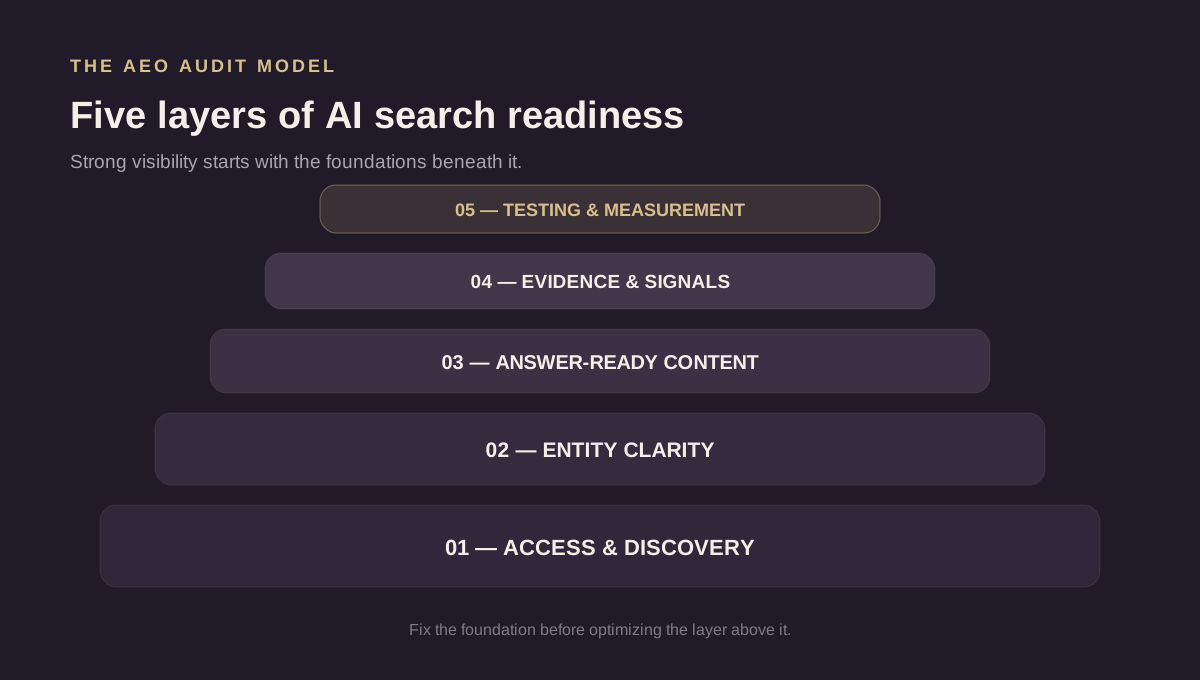
Can search and AI systems reliably reach the content?
Important pages are crawlable and indexable
A page cannot contribute much to search visibility if the systems responsible for discovering it cannot reliably access it.
Start with the basics: response status, robots directives, canonicalization and whether important content is available in the rendered page.
Check:Confirm priority URLs return a successful response, are not unintentionally noindexed and are not blocked from the crawlers you want to reach them.
Your crawler rules match your actual visibility goals
Different services operate different crawlers. If AI-search visibility matters to your business, know which crawlers you are intentionally allowing or blocking.
For example, OpenAI documents OAI-SearchBot for ChatGPT search discovery, while Perplexity documents PerplexityBot for appearing in its search results.
Check:Review robots.txt for Googlebot and the AI-search crawlers relevant to your strategy instead of assuming one rule covers every system.
Priority pages are easy to discover internally
Discovery should not depend on a crawler finding one obscure link buried deep in your website.
Use clear navigation, contextual internal links and a clean URL hierarchy to show which pages matter and how related topics connect.
Check:Make sure important pages appear in the sitemap where appropriate and receive contextual internal links from related, crawlable pages.
Is it obvious who you are, what you do and what you should be associated with?
Your business is described consistently
Your core identity should not change dramatically from page to page. A visitor — or machine — should be able to determine what the company does without stitching together contradictory statements.
Consistency does not mean repeating identical copy. It means keeping the underlying facts and positioning aligned.
Check:Compare your homepage, About page, product or service pages, organization schema and major external profiles for conflicting descriptions.
Important entities have dedicated context
A brand name in a navigation menu is not the same as an explained entity. Important concepts need context: what they are, who they are for, how they relate to the business and why they matter.
Check:Make sure major products, services, people, categories or concepts are explained on pages with enough context to stand on their own.
Your expertise is connected to clear topic areas
Publishing disconnected articles makes it harder to understand what your business consistently knows about.
Build useful relationships between commercial pages, educational content and supporting resources instead of treating every article as an isolated SEO asset.
This is one reason Answer Engine Optimization should be treated as a system rather than a collection of isolated AI-search tactics.
Check:Review whether your content forms coherent topic clusters around the problems and categories your business genuinely serves.
Does the content make useful answers easy to find and understand?
Key questions receive direct answers
If a page targets a real question, answer it. Avoid making readers work through five paragraphs of setup before reaching the useful information.
Direct does not mean shallow. Give the concise answer first, then add the reasoning, examples, caveats and detail needed to make it genuinely useful.
Check:Find the important questions on each page and verify that the answer appears clearly instead of being buried beneath a long introduction.
Headings describe the information beneath them
Descriptive headings create a usable information hierarchy. Vague labels such as "Overview" or "Learn more" carry far less meaning than headings that state the topic directly.
Check:Read only the page headings. They should communicate the actual questions, concepts and decisions covered on the page.
Important claims have enough context to stand alone
AI-generated answers may surface a small part of a much larger document. That makes clarity at the passage level important.
Explain conditions, limitations and exceptions where they matter. Useful content is not simply quotable; it remains accurate when a reader encounters the relevant section on its own.
Check:Review definitions, recommendations and claims that could be extracted from the page. Make sure surrounding context prevents them from becoming misleading.
Can systems verify what the page says and interpret its structure?
Structured data accurately describes visible content
Structured data can provide explicit clues about a page and its entities, but it is not a shortcut to rankings or AI citations.
Use schema where it accurately represents the page. Do not add properties simply because they seem useful to a crawler.
Google structured data guidelines ↗Check:Validate relevant schema and confirm every marked-up fact is also supported by content users can actually see on the page.
Claims show authorship, evidence or source context where needed
Not every sentence needs a citation. But factual claims that depend on external research, changing product behavior or proprietary data should be attributable and verifiable.
Dates and update information also matter when the subject changes quickly.
Check:Review statistics, research claims, comparisons and expert recommendations. A reader should be able to understand where the information came from.
Your brand has corroborating signals beyond its own website
Your own website is only one source of information about the business. External references can help reinforce identity, reputation and topic associations.
This does not mean manufacturing mentions. It means earning useful, accurate references in the places your market already uses.
Our guide to AI search visibility beyond your website explains why off-site sources deserve their own place in an AEO strategy.
Check:Search for your brand and core topics across relevant publications, directories, communities, profiles and other independent sources.
Are you measuring actual visibility instead of assuming optimization worked?
You have a defined set of priority prompts
Randomly asking an AI system about your company once is not a measurement framework.
Build a repeatable set of questions that represents how buyers discover, evaluate and compare businesses in your market.
Check:Create a stable prompt set based on real customer questions, category searches, comparisons and commercial decisions.
You inspect which sources are being surfaced
Competitor visibility can reveal the source gap behind your own absence. Look for patterns: official websites, editorial sources, communities, directories, comparison pages or other recurring source types.
The objective is not to copy every cited page. It is to understand what evidence the search experience appears to rely on for that topic.
Check:For prompts where sources or citations are available, record which domains and pages appear — not just whether your own brand is mentioned.
You keep a repeatable baseline
AI outputs can vary. A single response should not be treated as a permanent ranking position.
Consistent testing gives you a more useful question to answer: across the same important searches over time, is your business becoming easier to find and reference?
Check:Record the prompt, platform, date, result, cited sources and your brand's presence so future tests can be compared against the same baseline.
What should you fix first?
Do not treat all 15 items as equally urgent. Start with blockers, then clarity, then expansion.
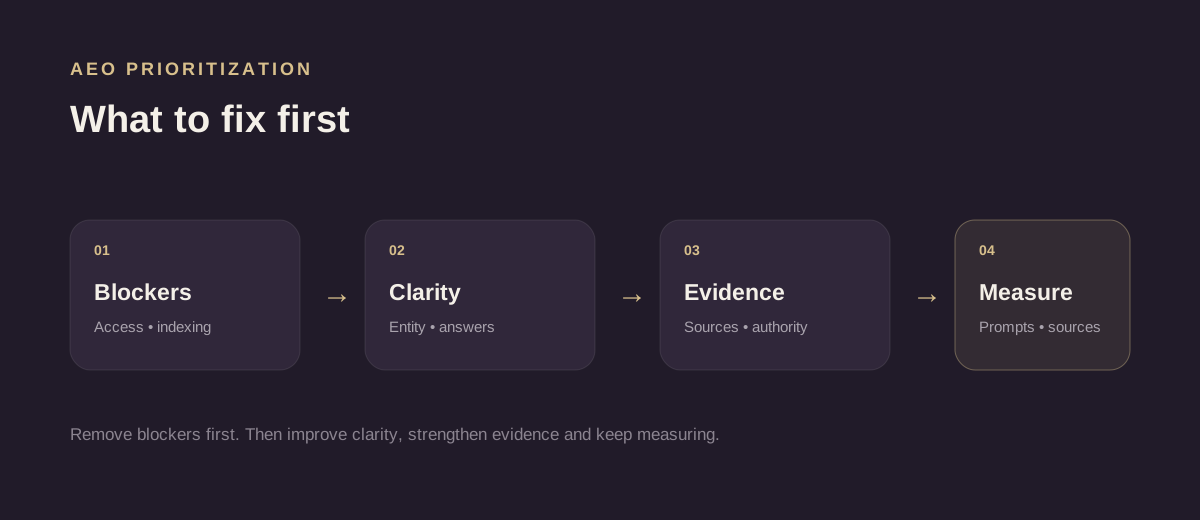
Remove access and indexability blockers
Fix problems that prevent important pages from being reached, rendered or indexed.
Fix unclear identity and content
Strengthen entity clarity, page purpose, direct answers and information structure.
Build evidence and external visibility
Improve supporting signals, useful third-party references and topic coverage.
Measure with a repeatable prompt set
Track what changes instead of assuming implementation created visibility.
What this checklist does not prove
There is no universal 15-out-of-15 threshold that guarantees your business will be cited by ChatGPT, Perplexity, Gemini, Google AI experiences or any other answer system.
Search and answer systems make their own retrieval, ranking and presentation decisions. Even technically correct structured data does not guarantee a particular search feature, and different AI products use different systems and sources.
The checklist is therefore a diagnostic framework: it helps you find weaknesses that are worth investigating without pretending those weaknesses can be converted into a made-up visibility score.
Put the checklist to work
Find the AEO gaps worth investigating on your own website.
Growthract can scan your site for SEO, AEO and AI-search opportunities and turn the findings into a prioritized set of actions.
AEO checklist FAQs
What is an AEO audit?
An AEO audit examines whether your website and broader search presence make your business easy for answer and AI-search systems to discover, understand and retrieve. It extends beyond traditional rankings into areas such as entity clarity, answer-ready content, crawler access, structured information and citation visibility.
Is AEO different from SEO?
Yes, but they overlap heavily. SEO establishes many of the technical and content foundations AEO depends on. AEO extends the work toward how content can be understood, retrieved and used in answer-driven search experiences.
See our SEO vs. AEO guide for the full comparison.
Does schema markup guarantee AI citations?
No. Structured data can provide explicit machine-readable information about a page and its entities, but it should not be treated as a guaranteed AI-citation mechanism.
How often should you repeat an AEO audit?
Repeat the parts of the audit that matter whenever your site, positioning or content changes materially. For AI visibility testing, a consistent recurring benchmark is more useful than occasional one-off checks because outputs and source selection can vary over time.
Continue exploring
Related insights
Case study
How a B2B SaaS Company Strengthened Search Visibility Across Google and AI Search
How a B2B SaaS company could connect technical SEO, content architecture, search intent and entity clarity into a stronger search visibility system across Google and AI-powered search.
See the case study →Insight
How to Do a DIY AEO Audit (And What a Tool Catches That You Won’t)
Learn how to run a practical AEO audit yourself, what to inspect across your website and AI search presence, and where manual analysis starts to miss important patterns.
Read the insight →Insight
Why Traditional SEO Audits Miss AI Search Signals
Traditional SEO audits are still essential, but they were not designed to evaluate entity clarity, answer readiness, citation visibility, third-party corroboration or prompt-level AI search presence.
Read the insight →