Direct answer
Can you run an AEO audit without paid tools?
Yes. Many foundational AEO checks can be performed with free browser tools, public HTTP requests, structured-data inspection and manual AI-search tests. Paid platforms can make monitoring easier, but they are not required to inspect crawler access, rendering, metadata, entities, answer structure or a small controlled prompt set.
01
Technical accessibility can be inspected without a paid platform.
02
Manual prompt testing can establish an initial visibility baseline.
03
Automation becomes more useful when monitoring needs to scale.
You can learn a lot about your AEO readiness without buying a tool. A careful manual audit can uncover unclear positioning, weak answers, crawl problems, thin topic coverage and obvious gaps in how your business appears across modern search.
The limitation is scale. Humans are good at judgment. Tools are good at checking more pages, applying the same rules consistently and exposing patterns that are easy to miss when you inspect URLs one at a time.
This guide shows you how to do both: run the useful parts of an AEO audit yourself first, then understand exactly where automation becomes valuable.
If you want to connect those checks to brand mentions, competitor presence, prompt coverage, and retrieval signals, use Growthract's AI search visibility analysis framework alongside this audit.
If you want a structured diagnostic rather than running every check manually, Growthract's AI visibility audit combines technical, entity, content, evidence, and point-in-time visibility findings into one baseline.
Before you start
If you want a point-by-point reference while doing the audit, keep the 15-Point AEO Checklist open alongside this guide.
What are you actually auditing?
A traditional SEO audit often focuses on whether search engines can crawl, index and rank pages efficiently. An AEO audit keeps those foundations, but expands the question.
You are trying to determine whether your business and its information are easy to discover, understand, retrieve and support when someone asks a relevant question.
Access
Can important systems reach the pages and information that matter?
Understanding
Is it clear what the business, product, service or topic actually represents?
Answers
Does the content answer real questions clearly enough to be useful?
Evidence
Are important claims supported by trustworthy context and corroborating signals?
That broader model is why SEO and AEO overlap without being identical. AEO does not replace the technical foundations of SEO; it builds on them.
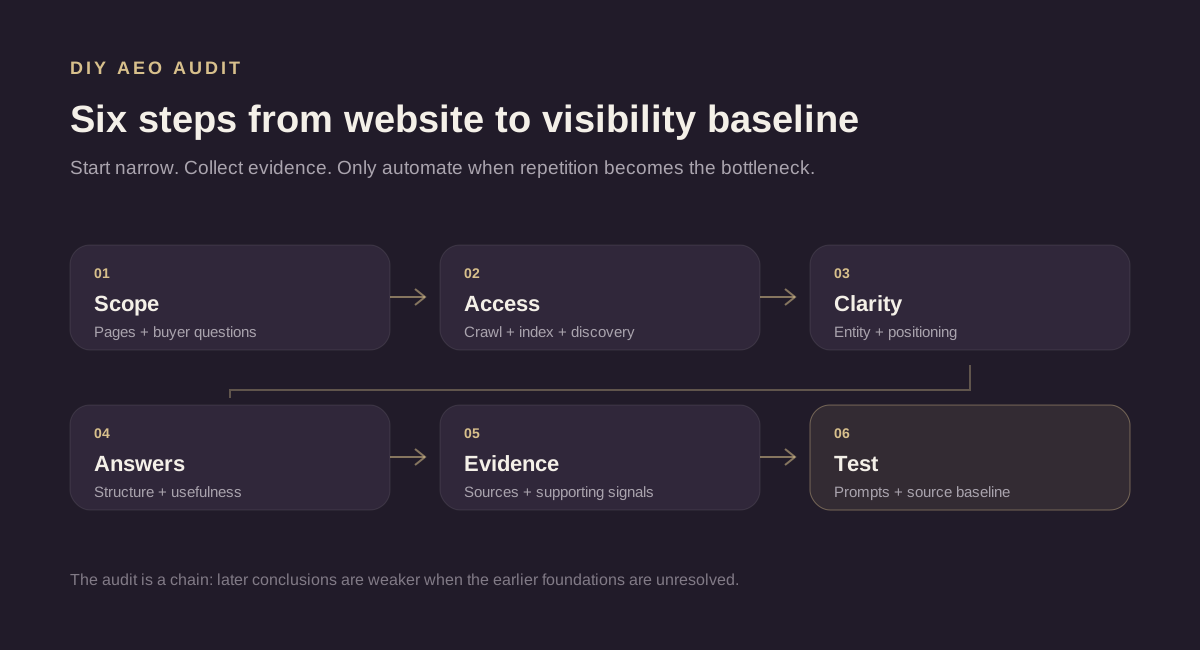
How to run a DIY AEO audit
Do not start by opening every page on your website. Start with a smaller set of commercially important pages and questions.
Choose the pages and questions that matter
Goal: Create a focused audit set instead of trying to review the entire site at once.
Start with the pages most closely connected to discovery, evaluation and conversion. For many B2B websites, that means the homepage, core service or product pages, important comparison or category pages and a few high-value educational resources.
Then create a small prompt set based on the questions a real buyer might ask.
- What companies provide this type of service?
- What is the best approach for solving this problem?
- How does this category work?
- What should I compare before choosing a provider?
- Is your brand relevant to a specific use case or problem?
The prompts do not need to be perfect. They need to represent the decisions your content is supposed to help influence.
Check access, indexability and page discovery
Goal: Make sure important information is technically available before analyzing how well it is written.
Inspect each priority URL. Confirm that it loads normally, is not unintentionally blocked or noindexed and has a sensible canonical target.
- Does the page return a successful response?
- Is the page intended to be indexable?
- Is the canonical pointing where you expect?
- Can the page be reached through internal links?
- Is it included in the sitemap when appropriate?
- Is important copy available in the rendered page?
This part looks familiar because AEO still depends on basic technical accessibility. Content that cannot reliably be reached is a weak foundation for any search strategy.
Audit entity and business clarity
Goal: Determine whether someone unfamiliar with the company could understand exactly what it is and what it should be associated with.
Read the page as if you had never heard of the business. Ignore the logo and brand familiarity.
Can you quickly identify what the company does, who it serves, what it offers and which category or problem space it belongs to?
- The company description is specific rather than vague.
- Products and services are named consistently.
- Audience and use cases are understandable.
- Important people, products or concepts receive enough context.
- Related pages reinforce the same core positioning.
- External profiles do not contradict major business facts.
Entity clarity matters because modern search visibility extends beyond matching keywords. Systems need enough context to connect a business with the topics and problems it genuinely represents.
Inspect whether the content is answer-ready
Goal: Find places where a useful answer exists but is difficult to locate, interpret or extract.
Take each important question and try to find its answer on the page. Time yourself mentally: does the answer become obvious quickly, or do you have to interpret several paragraphs of marketing copy first?
- Important questions receive direct answers.
- Headings describe the information beneath them.
- Definitions appear close to the terms they explain.
- Comparisons make the actual distinction clear.
- Recommendations include enough context to remain accurate.
- Paragraphs do not bury the main point beneath unnecessary setup.
Good AEO content is not content written for robots. It is content whose meaning is easier for both people and machines to understand.
Our broader Answer Engine Optimization guide explains how this fits into the larger search strategy.
Review evidence and machine-readable context
Goal: Check whether important information is supported and represented consistently.
Look at the claims the page makes. Some are simple business facts. Others depend on research, performance data, expertise or third-party evidence.
- Important factual claims are attributable where needed.
- Research and statistics have clear sources.
- Dates are visible where freshness matters.
- Relevant structured data reflects visible page content.
- Organization, product or service information is internally consistent.
- The brand has useful corroborating references outside its own domain.
Do not treat schema markup as an AEO cheat code. Structured data can clarify information, but it cannot make weak or unsupported content authoritative by itself.
Test your visibility with a repeatable prompt set
Goal: Establish a baseline you can compare after making improvements.
Use the prompts you created in Step 1 across the search and answer experiences that matter to your audience.
Record what happens instead of relying on memory.
- Prompt used
- Platform tested
- Date tested
- Whether your brand appeared
- How your brand was described
- Which sources or domains were surfaced when visible
- Which competitors or alternatives appeared instead
One response is not a permanent ranking. AI outputs can vary. What matters is building a repeatable baseline that helps you see patterns over time.
This is also why AI search visibility depends on more than your website. The sources surfaced around your category can be just as useful to study as your own pages.
Where a manual AEO audit starts to break
A DIY audit is excellent for learning how your site communicates. It becomes less reliable when the job changes from understanding a few pages to comparing patterns across dozens or hundreds.
The biggest problem is not intelligence. It is consistency.
The manual-audit problem
The tenth page rarely receives exactly the same scrutiny as the first. The fiftieth almost certainly does not.
What a tool catches that you probably won't
A useful audit tool should not replace judgment. Its job is to increase coverage, reduce inconsistency and surface patterns worth investigating.
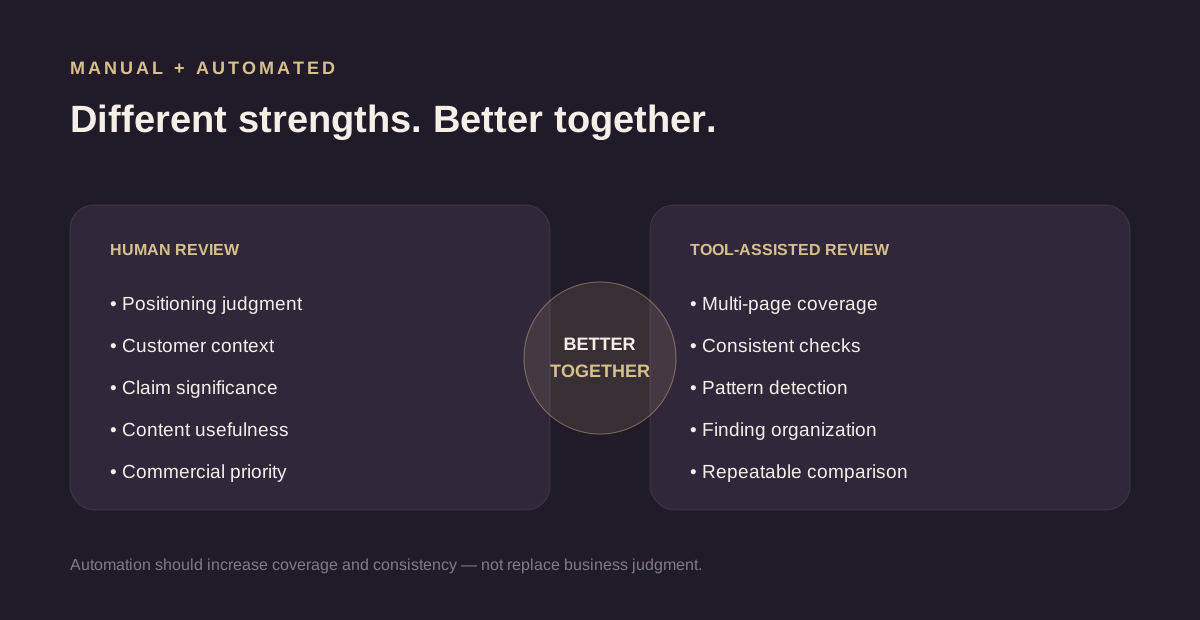
Five areas where automation becomes especially useful
Finding repeated problems
A weak title, missing contextual signal or technical inconsistency on one page may be accidental. The same pattern across twenty pages is a system problem. Automation makes those patterns easier to see.
Checking pages consistently
A tool can apply the same baseline checks to page 50 that it applied to page 1. That consistency is difficult to reproduce manually.
Comparing sitewide structure
Page-level review can hide architecture problems. Looking across URLs makes it easier to detect duplicated purpose, thin clusters, weak internal linking and inconsistent entity treatment.
Reducing the observation pile
A large audit can generate dozens of findings. A useful system groups related issues and helps turn them into a smaller set of actions rather than a spreadsheet nobody knows how to prioritize.
Repeating the audit after changes
Re-running the same checks creates a more reliable way to see what improved, what remains unresolved and whether new problems appeared.
What an AEO audit tool cannot decide for you
Automation has limits too. A scan can surface evidence. It cannot automatically turn every finding into the right business decision.
Whether your positioning is actually good
A tool can identify unclear or inconsistent language. It cannot decide what your market should value about the company.
Whether a claim is strategically important
Software can detect a statement or missing source. A human still has to judge whether the claim matters to buyers.
What your customers really mean
Search terms and page patterns provide evidence, but customer interviews and commercial context often explain the reason behind them.
Whether an AI answer is objectively correct
A visibility check can record what appeared. Domain expertise is still needed to judge the accuracy and significance of the answer.
The best model is therefore not manual versus automated. It is automated discovery combined with human interpretation. For a closer look at what a free AI search visibility checker can and cannot tell you, see how to read its results.
A simple DIY AEO audit template
You do not need a complicated scoring system. Create one row per important page and record the evidence you actually find.
Page
Which URL are you reviewing?
Purpose
What question or decision should this page help with?
Access
Any crawl, indexation, canonical or discovery problem?
Entity clarity
Is it obvious what the page and business represent?
Answer quality
Can important answers be found quickly and understood alone?
Evidence
Are claims and business facts supported appropriately?
External context
What independent sources reinforce or contradict the topic?
Priority prompts
Which buyer questions should this page influence?
Finding
What is actually wrong or uncertain?
Next action
What specific change deserves attention?
When should you stop doing the audit manually?
Stay manual while the scope is small and the learning itself is valuable. Move to a tool when the work becomes repetitive enough that manual inspection starts reducing coverage or consistency.
A useful trigger
If you are spending more time collecting findings than thinking about what those findings mean, automation can probably help.
That is the role of Growthract's analysis system: scan the website for relevant SEO and AEO opportunities, organize the evidence and help turn a large observation set into a clearer list of priorities. It is not a substitute for business context, and it does not pretend to know the internal ranking logic of every AI platform.
Compare your manual audit
See what a structured website scan finds next.
Run Growthract against your website to surface SEO and AEO opportunities, compare them with your own observations and identify the issues worth investigating first.
DIY AEO audit FAQs
Can I do an AEO audit myself?
Yes. A manual audit is particularly useful for reviewing a small number of important pages, understanding your positioning and evaluating whether content genuinely answers customer questions. Automation becomes more useful as the number of pages and checks increases.
What is the difference between an SEO audit and an AEO audit?
An SEO audit typically evaluates technical search foundations, content, links and ranking-related issues. An AEO audit includes many of those foundations but extends the analysis into entity clarity, answer-ready content, external corroboration and visibility in answer-driven search experiences.
Does an AEO audit guarantee AI citations?
No. An audit can identify weaknesses that may limit discovery, understanding or usefulness. It cannot guarantee that a specific AI system will cite or recommend a particular website.
What should an AEO audit tool automate?
The strongest candidates for automation are repetitive checks, multi-page comparisons, technical consistency, internal-link analysis, structured finding collection and repeatable before-and-after analysis. Human judgment should still determine what matters commercially and what action is appropriate.
How often should I repeat the audit?
Repeat it after meaningful website, content or positioning changes, and keep a regular visibility baseline for the prompts that matter most to your business. The objective is to compare changes over time rather than chase individual AI responses.
Continue exploring
Related insights
Case study
How a B2B SaaS Company Strengthened Search Visibility Across Google and AI Search
How a B2B SaaS company could connect technical SEO, content architecture, search intent and entity clarity into a stronger search visibility system across Google and AI-powered search.
See the case study →Insight
The 15-Point AEO Checklist: How to Audit Your Site for AI Search Visibility
A practical 15-point AEO checklist for auditing crawlability, entity clarity, answer-ready content, structured data, evidence and AI search visibility.
Read the insight →Insight
Schema Markup for AEO: A Copy-Paste Implementation Guide
Learn which structured data actually matters for AEO, how to implement Organization, WebSite, Article and Breadcrumb schema, and what schema cannot guarantee in AI search.
Read the insight →